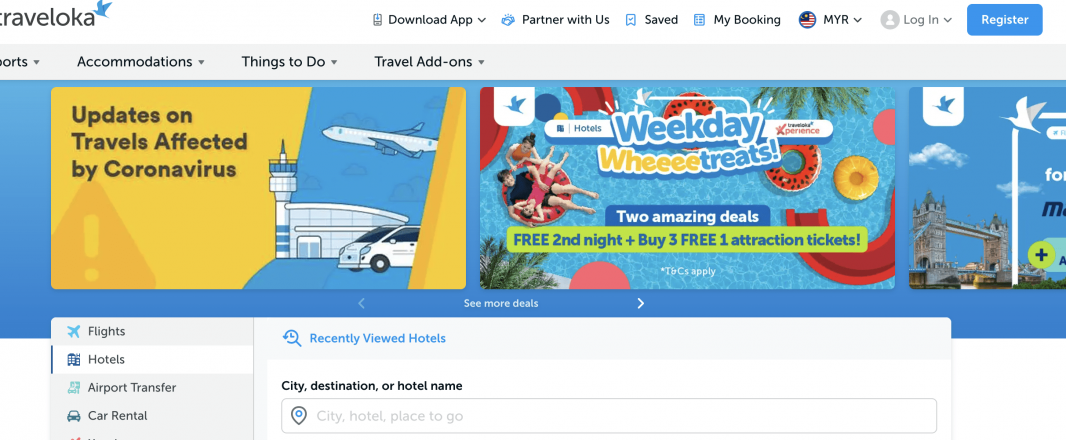
From meta-search to lifestyle superapp as it adds services from food delivery to Buy Now Pay Later
THERE’S no disputing the fact that Traveloka, Indonesia’s homegrown travel unicorn, has come a long way in the 10 years it’s been around.
What started out as a flight meta-search in CEO and co-founder Ferry Unardi’s attempt to enter the online travel space in 2012 has become a lifestyle superapp, offering flights, hotels, experiences, restaurants, food delivery and financial services. It has raised a total of US$1.2b in six rounds of funding, and it’s expanded beyond Indonesia to other markets in South-east Asia – Singapore, Thailand, Vietnam, Philippines and Malaysia. It currently boasts 40m monthly users, up from the 20.4m in 2016, the year it started tracking this number.

Alfan Hendro: In good shape to ride the recovery.
“When I joined (in February 2014),” said Alfan Hendro, chief operating officer, “searching travel was still very hard to do – to book a hotel, consumers would spend 30 minutes to an hour. Now you book a flight in 10-20 seconds. We have made it easier for people to travel.”
And that remains Traveloka’s purpose, even as it looks out another 10 years. Asked what Traveloka could look like 10 years from now, as it celebrates its first decade, Hendro laughed, “That feels like a lifetime but we continue to see ourselves fulfilling and evolving around the user experience and the lifestyle needs of an aspirational generation with higher spending power.
“What’s exciting about the next 10 years is within the emerging middle class of South-east Asia, there will be even more younger digitally native users who will be highly aspirational and our products and services will evolve to meet their needs and financial services will continue to be very relevant.”
On reopening: Fewer tests, fewer documents – “we will get there soon”
Looking back the past 10 years, Hendro said, “We have a lot to be proud about. We were the first tech company in Indonesia to expand to South-east Asia, the first in Indonesia to move to mobile app. We were the first to do live streaming during the pandemic, we added delivery to Eats and Order Now where you can go to a restaurant and order from the app.
“We introduced a virtual credit number so that Traveloka customers can use their Wallet to buy things on other ecommerce sites. Our Buy Now, Pay Later (BNPL) service is getting a lot of usage from customers. It helped during the uncertainty for people to have access to credit. And as we open up to more use cases, we see adoption increase – seeing people buy travel or local attractions using BNPL and other financial services, and this gives us good data to build more services.”
Hendro, who’s travelled from Jakarta to Singapore three times on the Vaccinated Travel Lane between the two neighbours since the special arrangement began, said, “The good news is, things are getting easier with each trip. The first time, my first trip outside Indonesia, I felt a big relief. I missed that feeling of flying. There are now fewer tests, fewer documents. I see that for myself. Each government is trying to make it easier and easier and we are seeing more countries opening in the next few months. We are getting there and we will get there soon.”
On Traveloka’s part, it will do its best to help provide information and content through its app and websites to make it easier for travellers to manage the different rules and conditions of reopening. For example, it’s making it easier for travellers to book Covid tests, listing over 800 centres in South-east Asia.
The fact that Traveloka is predominantly a domestic business, not only in Indonesia, but also across its South-east Asian markets (with the exception of Singapore) has minimised impact relatively but there’s no denying it’s bbeen a challenging time for the young OTA when its home market went through several stages of lockdowns to contain the pandemic. But the tide is turning.
In markets like Vietnam and Thailand, Hendro said, business is exceeding pre-2019 levels. In Indonesia, its biggest market, domestic business has been robust since 2021. Cross-border travel across Asia has yet to get into full swing but the recent spate of announcements from governments in South-east Asia on the reopening of their borders to vaccinated travellers is cause for cheer.
On expansion: Plan to launch financial services “where relevant”
Indonesia’s crown jewel, Bali, reopened to international travellers from March 7. Foreign nationals from 23 countries who have received a second dose of vaccine can apply for a visa on arrival and will need to wait only 24 hours until their on-arrival PCR tests return negative.
Hendro said, “Everytime any restriction is relaxed, we see significant increase. When non-quarantine in Bali was introduced, we saw an 8x increase in searches from Singapore and 4x from Malaysia. With increased relaxation, travel interest will be on an upward trajectory. We are very excited – each week, we are going to see more announcements and more and more destinations will open. As an online platform, our strength is to offer content, information and knowledge to help our users as they do their planning.”
Asked if Traveloka had invested further in human-powered customer service, given customers may need more hand-holding at this time, he said, “We continue to invest in customer service but aside from paying extra attention to things that are not so easily done online, such as rescheduling or refunds, our direction is self-service.”
He’s also not concerned that Asia, at this moment, remains the laggard in travel recovery – IATA projects that air travel in APAC will recover to pre-Covid levels only by 2025, as opposed to the US which should get there by 2023 – and that Traveloka, with its roots in the region, may be disadvantaged.
“Our domestic business is in full recovery, in some markets, exceeding 2019. We think people will continue to travel domestic still – longer stays, more remote places. There will be shifts in travel trends. We will continue to invest in our platform and depending on what’s relevant, we will look to introduce services such as delivery and Eats in other markets, as well as BNPL. Traveloka Wallet offers a number of payment methods and we could look to expand that to other markets, where relevant.”
He disagreed with my suggestion that while Traveloka has become stronger in Indonesia, it’s become weaker everywhere else because of the pandemic. “We are firing on all cylinders. Our knowledge and understanding comes from Indonesia, which is applicable to South-east Asia. We have strong local teams in markets.”
On talent crunch: “We need you to take time off”, staff told
The last two years of the pandemic have also tested the mettle of its 2,000-strong team, most of whom are located in Indonesia, said Hendro. “Through the pandemic, uncertainty has been the constant and we used it as the principle of our operation. Whatever happens, we will support users. Regardless of how the pandemic evolves, we will support users. As a result, we became a lot more agile.
“We’ve always been an empowered team but the pandemic truly tested that – there was a lot of innovation, our team members were able to make fast decisions, using data, and that empowerment became even more apparent during the pandemic.”
Nevertheless, as strong as the team has been, Hendro acknowledges that the battle for tech talent will become even more competitive as more tech companies take root in South-east Asia.
“There is high demand for tech talent in South-east Asia and we are working with partners to build up a talent pool,” he said. It has initiatives with companies such as Google and Amazon to train young talent and works with the Indonesian government in an internship programme to have interns join Traveloka. “Most of the time, we end up hiring them,” said Hendro.
Traveloka maintains three tech centres – Indonesia (the bulk of employees), Singapore and India. He said that while it’s true that “one can hire from anywhere these days”, “there are arguments on both sides, the ability to hire from anywhere is an exciting opportunity but having people in the same place where there is a transfer of knowledge and mentorship is also important. We try to accommodate the need for people to work from home or their hometowns but there is also a need for people to sit in an office from time to time.”
It’s implemented work from home or flexi-work and providing better support to employees who work from home. Previously, it allowed employees to take time off anytime, with no tracking in place. “What we found during the pandemic was people didn’t take time off so we told them, we need you to take time off, be healthy. So we formalised time off and then they can take additional time off on top of that.
“I do forsee a challenge in tech talent for a long time and we will do our best to maintain our edge.”
Hendro declined to comment on funding-related matters, saying, “I’d rather not comment on speculation.” In September 2021, news surfaced that Traveloka had decided not to pursue talks to list in the US through a merger with Bridgetown Holdings, a special purpose acquisition company (SPAC), backed by billionaires Richard Li and Peter Thiel. There is renewed speculation that it it likely to go public via a traditional initial public offering (IPO) in the US to raise up to US$400m.
Plans to go public have been talked about since 2017 but clearly, timing is an issue. The pandemic, as well as declining interest in the SPAC market, has clearly put the spanner in the works but the early signs of a South-east Asia travel recovery may augur well for Traveloka.
Given its reputation for innovation and speed of execution, there is also bound to be curiosity over what Traveloka thinks about the much-hyped tech trend of NFTs and metaverse and how it sees it being applied to its business. Well, we will have to stay curious. Said Hendro, “It’s very interesting, we are watching it. Right now, we have no plans to implement anything. We’re more excited about trends such as, consumers consuming a lot more content, a lot more media and we see this as a good base for content discovery – recommendations around dining, live streaming, consumers making discoveries that are not mainstream.”
Indeed, for Traveloka, most of its transactions have tended to come from social and branding, rather than performance marketing, and this is an area the OTA will continue to bet on as it continues to grow over the next 10 years, to make it easier for the Next Billion Users to travel and experience the aspirational lifestyle they yearn for.