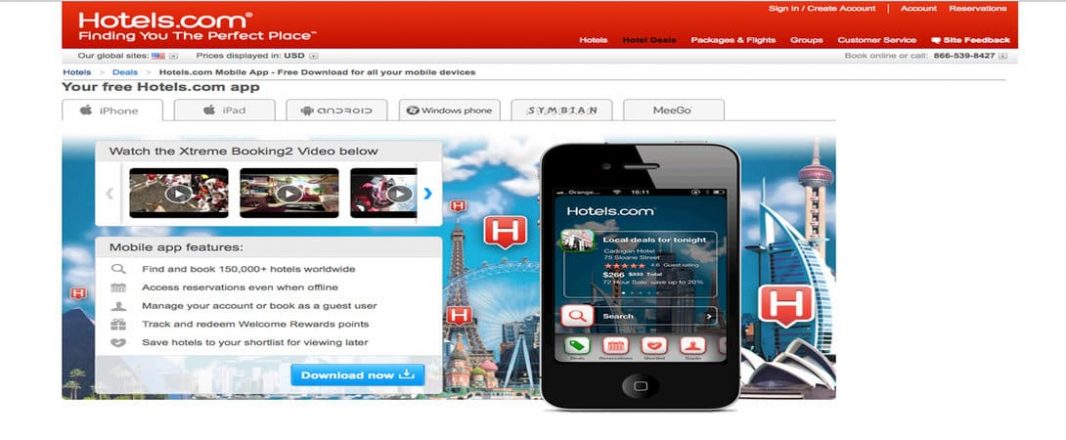

With the battle heating up on the mobile front, WIT asks Christelle Chan, Global Mobile Director of Hotels.com, what she’s doing to adapt the business model to changing customer behaviour.
Q: How is mobile changing customer behaviour on hotels.com – any discernible differences between customer behaviour in the US vs Asia?
Mobile customers generally have the same behaviour irrespective of the region – the devices themselves will drive most of these new behaviours.
The two main ones to call out are the immediacy and local elements. A higher proportion of our mobile transactions are for same-day stays compared to desktop – 60% of mobile transactions are for same day stays. We are also seeing a higher proportion of our mobile bookings being local. This means that the Japanese customers are more likely to book Japanese destinations/hotels on a mobile device.
Q: Does mobile favour intermediaries like hotels.com or hotels direct – what trends are being seen here? Will mobile accelerate the shift towards hotels direct bookings?
Mobile is a new distribution platform – we view mobile as one of our three main platforms (call centre, desktop and mobile). This new distribution platform gives the same opportunities to both the intermediaries and hotels direct. The main driver of any shift will be based on the ability to take full advantage of the mobile opportunity.
So far, the intermediaries have been quicker and made better progress from a technology and marketing perspective compared to the hoteliers but the latter have the ability to own the end to end customer experience and mobile opens up a new dimension they can use. It is early days and it will be interesting to follow how fast and innovative the space will be.
Q: What can independent hotels do to take advantage of the mobile trend? What advice would you give?
Independent hotels should definitely take advantage of the reach intermediaries like Hotels.com offer. We heavily invest in technology and marketing whether this is on the desktop or on mobile and are able to bring customers from around the world (more than 75 sites) to an independent hotel. This enables the independent hotels to concentrate on their core business both from an investment and operations stand point and leave us the trouble to finding the right customer for them.
Q: In terms of mobile behaviour, what differences are you seeing by types of devices – iPads vs. smartphones? Android vs IOS?
Consumer behaviour is different based on the device they are using – these behaviours are mainly driven by the devices themselves. For example, smartphones are used on the go, so they will drive very short booking windows with 60% of the transactions for same-day stays, while tablets are used mostly at home where the family can book their holidays together – the basket value will tend to be higher than the desktop.
The OS environment is the main difference between Android and iOS. Android is a very fragmented environment and will lead to a lower basket value compared to iOS which provides a concentration of higher income customers and thus a higher basket value.
Q: What factors will determine which OTA wins on the mobile front? Will it be different from those factors that determined success on the web browser?
A new platform like mobile does not mean that the OTA space will necessarily change overnight. That said, we are definitely aiming for the first mover advantage more specifically in the Apps space – users are likely to only use a few apps by category and being one of them is our priority.
Q: In terms of demand generation and customer acquisition, what works best still – search, social and what role is mobile is playing in this area? How does hotels.com use social – any evidence of conversions?
We are seeing that demand generation and customer acquisition is still the most effective through search. However, this is a very expensive space and as most we are looking into how to reduce our dependency on this marketing channel by highly focusing on customer retention.
Mobile as a platform leads us to look into both the acquisition and retention elements through mobile search as well as apps acquisition and retention mechanisms.