
There are some people who’ve just got the start-up gene in their blood and Turochas Fuad, co-founder of travelmob, is one of them. He left a cushy corporate job to start travelmob. He’s also been successful at exits – he sold his first start-up 10 years ago in Silicon Valley and last year, he sold a majority stake in travelmob to HomeAway. There are some who say he may have done that too early but as he said in this interview at WIT Middle East, “there’s no single formula on when and how to a company should be sold”.
Q: When you announced you were leaving Skype to do a start-up in 2012, people thought you were crazy. I thought you were crazy – you were MD for Asia Pacific of a huge company and you left to do something where you’d have to put your own money and you didn’t even know if it would make money … Why did you do that?

T Fuad: “I’m a big believer in Asia and this is the region where we’ll continue to see growth and disruptive innovations.”
I am huge believer in Asia and this is the region where we’ll continue to see growth and disruptive innovations.
Yes, I did leave a lot of money on the table when I left Skype post the Miscrosoft acquisition to start travelmob. And many of my friends, associates and family members were quite surprised by that move. My wife, who was expecting then, was a tad worried but she knew that I was neither excited nor happy with my corporate life despite being at a pretty good place (from a career perspective).
There were three reasons. Firstly, I missed everything about running a start-up – bringing an idea to life and crafting a business out of it. Secondly, I stumbled into and fell in love with the ideology (and potential) behind collaborative consumption or the sharing economy. Last but not least, I am huge believer in Asia and this is the region where we’ll continue to see growth and disruptive innovations.
Q: How hard was it to adjust from corporate to start-up life? You were with Yahoo before Skype …
It was quite an easy transition actually. This was my second startup and it didn’t take too long to get back to that start-up way of life (and working habits). The harder part was to achieve certain objectives with a lot less funds and resources.
Q: travelmob’s not your first start-up – you sold a business to Yahoo – which obviously made you enough money to start it.
My first start-up was sold 10 years ago and it was based out of the Silicon Valley. It did give me some seed money to get things going but it also meant that I have a lot more to lose considering the stage of my career and where my life is. I like to think that I had a bit more maturity and experiences building businesses.
Q: So what did you want to do with travelmob? What made you think you’re uniquely qualified to create the Airbnb of Asia?
From the start, we have built our product to meet the needs of our users in Asia and not trying to “localize” a global platform like most of our competitors. Within a few months of operation, we were either neck-to-neck or surpassed our competitors in terms of quality supply across Asia. The market is still nascent in this part of the world and we’re still collectively shaping the industry as a whole. Our goal remains the same where we want to lead the vacation rental space in this region. 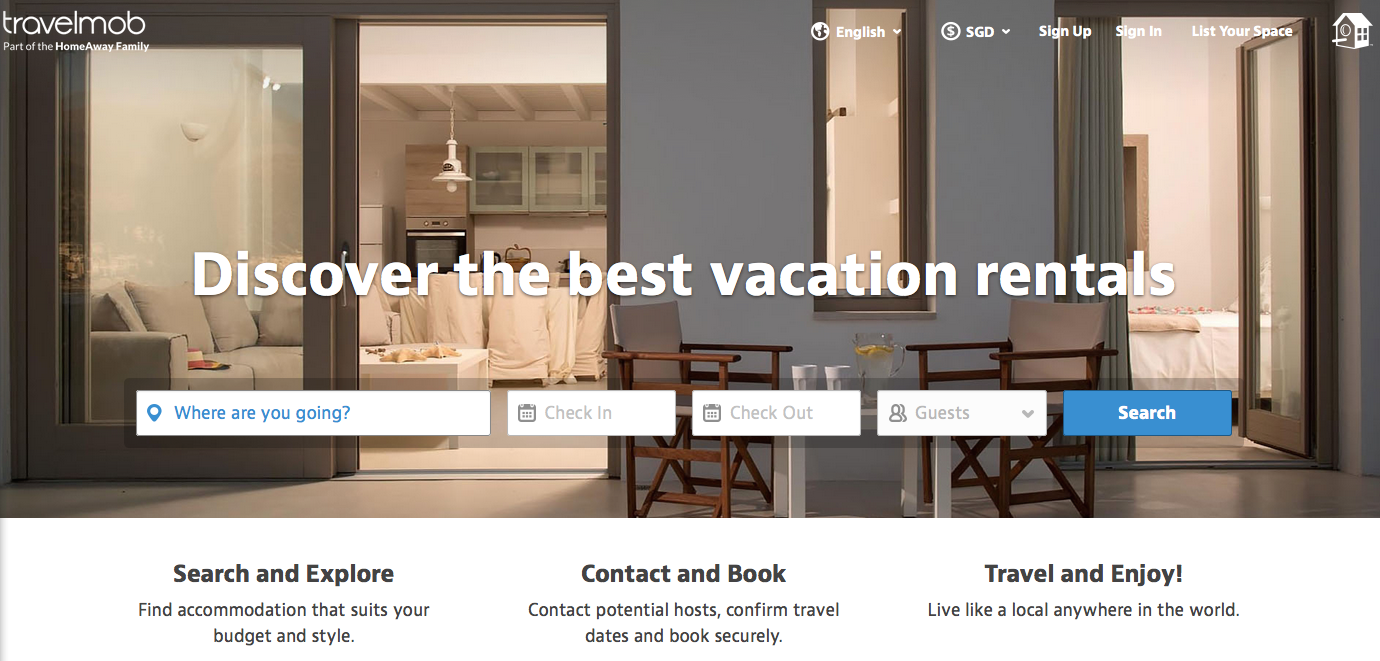
Q: People said you were doing a clone of Airbnb – so a copycat really. You didn’t mind people saying that?
Our collective business model is quite similar but our focus (and offerings) is quite different. Both companies’ supply of hosts (property owners) are both equally helpful and know the local neighborhoods like the back of their hands. While their accommodations are mostly primary homes (i.e. you are either sharing a space or staying in someone’s home), travelmob’s accommodations are mostly secondary or investment homes. This means you’ll find properties that are catered for your rental needs and ensure you have complete privacy. At the end of the day, we believe that, for about the same price, travelers would prefer a dedicated space and privacy when they travel. As they say in Thailand, same same (almost), but different.
Q: What was the hardest thing you had to do in the early days? How dirty did you have to get your hands?
The hands are still dirty and that’s a good sign. The first few team members have all worn various hats – from cold-calling property owners, providing customer support during odd hours to developing new solutions on a daily basis. A few of us visited property owners and guided them how to use the “internet” in order to get their properties online. In the early days, a few of us also helped meet up guests in order to “check them in” on behalf of our hosts (i.e. property owners). The mantra is simple – whatever it takes.
Q: Then in July 2013, you sold 63% stake to Homeaway – which I have to say I was rather surprised. My initial thought was, it’s too early – what was your thinking behind doing that deal?
The truth is that there’s no single formula on when and how to a company should be sold. We took a look at 3 things and made a decision based on them.
1) The valuation was more than fair and HomeAway committed to inject a significant investment into travelmob to help us compete effectively at a global scale.
2) We looked at the market condition and realized that the competition landscape is getting tougher, and we needed to partner with a global leader to win. HomeAway is still the largest vacation rental site in the world. The structure of the deal allowed us to maintain our independence and continue what we started (but with a lot more funds to work with).
3) The acquisition is a superb return on investment for investors, founders and the travelmob team. The deal structure would also reward the travelmob team as we grow the business in the coming years.
Net net, there was a series of factors that got us to this decision and we adamantly believed (still do) that we made the absolute right one. The market landscape has a few less players now and we’re still here, fighting a very good fight.
Q: So now you have to adjust to working for someone again?
The founders at travelmob report up to a board and collectively make key decisions together. HomeAway has intentionally kept the travelmob entity separate and allow us to still run it on our own. travelmob still develop its platform for Asia and we ensure that we cater to the regional/local demand. For example, HomeAway does not rent out “rooms” but travelmob does and we continue to offer that to our collective user base (i.e. certain parts of Asia is largely focused on room accommodations).
Q: So let’s talk about the sharing economy – and how it’s playing across South-east Asia. Do you think the sharing economy will be huger in Asia and Middle East than say Europe or US because of our culture, around sharing? Kampung, communities, the way we eat …
I’m a big believer in Asia and how this region will trump the rest of the world with regards to all things Internet. Yes, this includes the sharing economy for primarily 3 reasons:
1) Middle Incomers – Asia is welcoming 90 million new middle incomers annually. This group of folks now have access to excess funds and are internet savvy.
2) Internet and Mobile – we have 43% more internet users compared to EU and NA combined, while we’re still at 30%+ penetration. And Mobile is the default internet device of choice.
3) The “Gotong Royong” culture in Asians – it was prevalent in the old days, the spirit of working together, sharing our resources for the betterment of life and society. That DNA is still within us and the entrepreneurial component to the sharing economy is bringing this spirit back with a vengeance.
Q: Accommodation: What kind of traction and trends is Travelmob seeing? Plans for the Middle East? We have hundreds of quality properties across Dubai at the moment and we’re slowly expanding our supply across Middle East and Africa. We are also seeing a very healthy growth in outbound Middle East travelers – booking for accommodation in Bangkok, London, Phuket and Singapore.
Q: You once said, Be the king of something, not the prince of everything. What do you want to be the king of?
I was emphasising on the importance of “Focus”. It is super important to ensure one focuses on their core efforts and do not get distracted by things that do not add significant value to the goal at hand. When travelmob entered this space, we were neither the first nor the biggest. It was our focus on execution and a concentrated effort on Asia that got us to where we are today.
Q: Quiz – where does travelmob have the most listings?
Thailand.
Note: The Medan-born Turochas Fuad will be speaking at WIT Indonesia, Bali, on April 30. See programme here.