
In the space of one year, it is clear that Traveloka has streaked ahead of its competitors, and that position is no doubt making its rivals nervous and uneasy.
Rumours abound as to what its burn rate is and how much it is spending a month on search and customer acquisition.
 Observers point to Rocket Internet’s “go fast, go hard, go big” model but Ferry Unardi, CEO & co-founder of Traveloka said firmly, “We are not a Rocket company, we are invested in by one of the founders.”
It is evident that the investment it took in from Global Founders Capital, a fund founded by Rocket Internet’s Samwer brothers, is allowing it to scale fast and this Tech In Asia article tips it as “one company that is arguably the most likely candidate to be given a single horn and a pair of wings”.
The company launched in 2012 originally as a meta-search, but pivoted to an OTA soon after. It now employs 270 staff, up from 120 last September. The Tech In Asia article said SimilarWeb clocked Traveloka’s desktop traffic at an estimated 3.95 million visits compared to Tiket’s estimated 1.95 million desktop visits during the same month.
Whether its approach is sustainable and how deep its pockets are, are questions being asked but for now Traveloka is the clear leader in the local OTA space in Indonesia.
“Everything is happening in Indonesia in a very short period of time,” said Unardi during the panel moderated by Brett Henry, vice president, commercial for Abacus International.
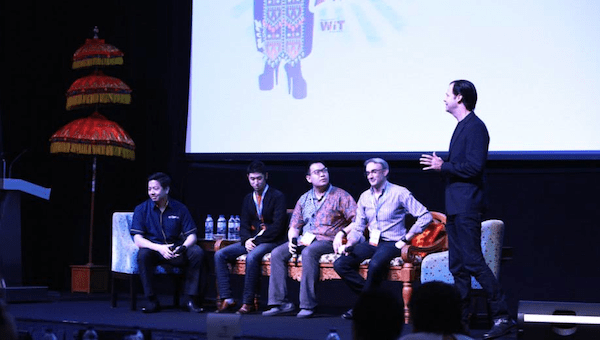
Panel discussion (from left): Gaery Undarsa, Tiket.com; Kohei Nakajima, Pegi-Pegi, Ferry Unardi, Traveloka; and Hans Ebenhahn, Nustatrip, with Brett Henry.
Commented Henry when asked about the competitive landscape, “Traveloka is definitely out in front in a large growing market. They have a strong leadership and tech team along with strategic investors who know the space and play to win.
“If they continue to scale and can deliver a positive P&L it’s believable but it’s a lot of hard work from where they are to get there.”
Its competitors are not surrendering the fight by any means, and all are optimistic that as the Indonesian online travel market grows, there will be room for everyone provided they differentiate well and execute smart.
Kohei Nakajima of PegiPegi, the Recruit joint venture, is confident that as consumers get satisfaction from online shopping, they would not return to the offline channel. “Our job is to ensure they are happy with the experience.”
Hans Ebenhahn, CEO of Nusatrip, said that while the market is competitive, there is now scale although consumers were still not very matured when it came to online shopping.
The big trend all are watching is mobile with Ebenhahn saying it was seeing better conversions on mobile. “The key is building more trust.”
Nakajima agreed that mobile conversions were also increasing at Pegi Pegi to a similar level as PC. “In future check-ins will be done through mobile and this will not only help the booking process but the entire travel process.”
A key concern is of course rising costs of customer acquisition given the war on SEM. Undarsa said, “Google still has my money. We believe in scale and we spend quite a lot as well, but we are in for the long term. A lot of online players say, scale first, sustainability later.
“Someone actually bid on my name, imagine that. I think there are lines that shouldn’t be crossed – sustainability and viability are important.”
Which is why he’s working hard to build loyalty as one way to reduce customer acquisition costs. His strategy is therefore high touch. “Indonesians like to be served. Price is one thing, loyalty wins and that will be built by interaction and service.”
For Ebenhahn, high touch is not scalable. “It defeats the purpose of being online travel agents – if you want high touch, go to a traditional travel agent.”
On the one piece of advice they’d give global brands, all of them agreed local knowledge and local execution were important. “Work with the locals,” said Ebenhahn. “They already know about Indonesia, they know it’s complicated and they will do what they do everywhere, they will just acquire.”
Unardi added, “Understand the market – build, borrow or buy.”
Nakajima said there was always room for both. “There is always a market for locals, people have different behaviour, service can be different.”
And the one piece of wisdom they’d give budding entrepreneurs?
Nakajima: “Connecting dots. In my career, I’ve had different jobs. All experiences connect to my current job – everything can be connected to make a new experience for your customer.”
Ebenhahn: “Remain curious and keep learning. It helps you connect the dots.”
Unardi: “Humility, there is always someone smarter than us, so listen.”
Undarsa: “Be brave to set a target personally. I came home to Indonesia in 2010 because I knew this was going to be the next big thing and it’s a good thing I committed to the market. So set a target, pursue it and commit to it.”
• Featured image credit (chequered flag): kirstypargeter/iStock