Our millennial columnist, Marissa Trew, comes face-to-face with the hard truths of doing a start-up and her conclusion after the first SkyChat talk – “It is almost Darwinian and if not ‘survival of the fittest’ then certainly ‘survival of the stubborn’.”
The inaugural SkyChat Evening took place last week at the eclectically-coloured Skyscanner Singapore office. The informal evening of networking and intelligent-minded discussion oscillated between industry-grade banter and plenty of insight on ‘how to run a successful start-up’.
As a relatively fresh graduate – one year out, to be exact – my ears pricked up as the two speakers casually and systematically laid out all the not-so-obvious pitfalls that start-ups tend to fall through. The pages in my notebooks were quickly tattooed with my spidery penmanship as I jotted down their insider ‘tips and tricks’ and rationales for why they believed their businesses were so successful and equally as compelling, why others failed.
First to helm the conversation were guest speakers, Fritz Demopoulos (CEO, Queen’s Road Capital and one of the co-founders of Qunar) and Turochas “T” Fuad (CEO and co-founder of Travelmob, now HomeAway Asia).
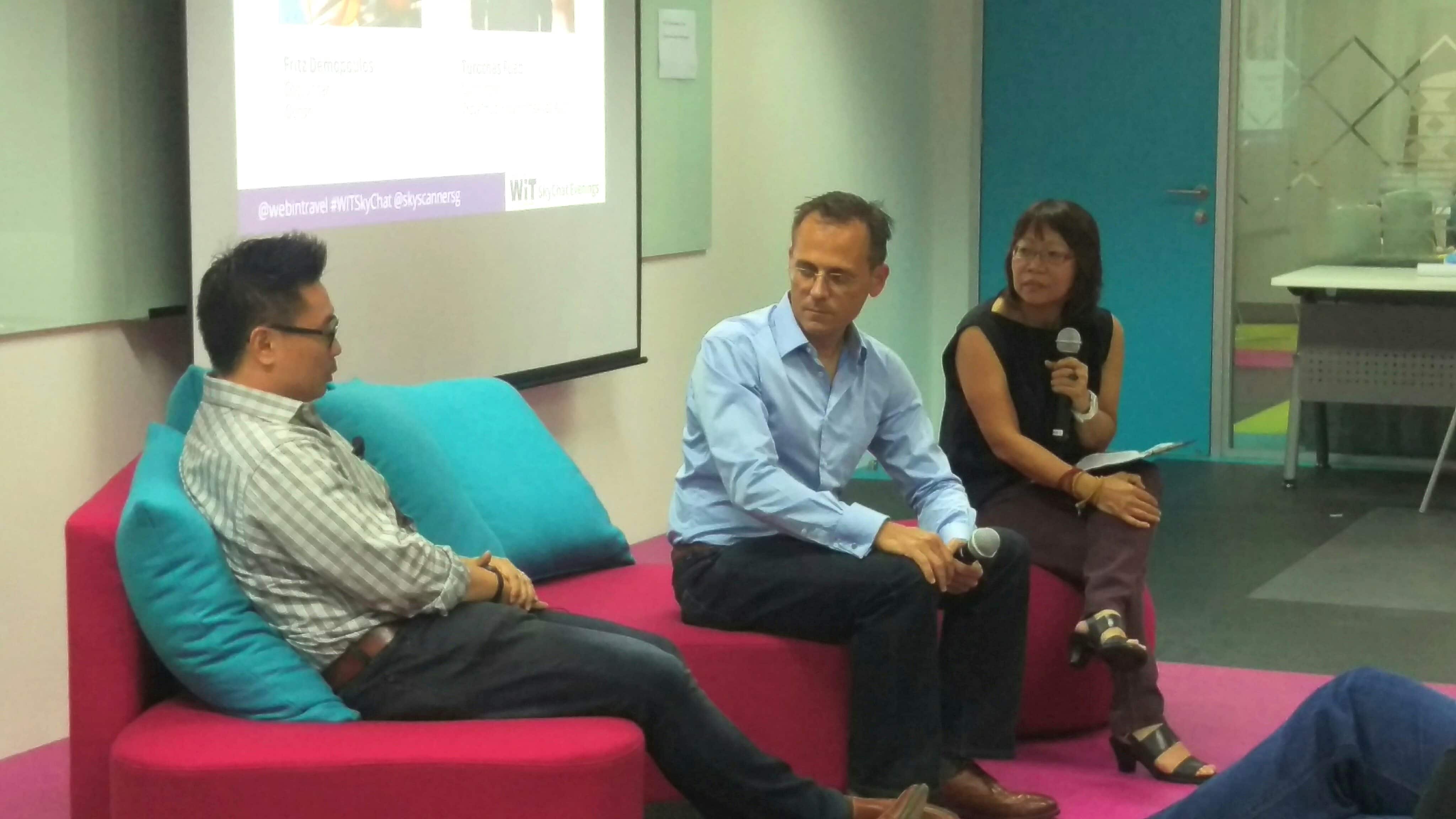
From left, T Fuad and Fritz Demopoulos discuss their start-up story with Yeoh Siew Hoon, founder of WIT, during the SkyChat Evening, powered by Skyscanner
Both Fritz and T agreed over many critical points, specifically: the importance of timing, the necessity of a sustainable business model, recognising your ability to monetise, a strong focus on your own product (understanding where your value lies) and to always hold at least some idea of an exit or acquisition strategy in the back of your mind.
They were also adamant about the power of networking, understanding how key characters operate in their own business and as Fritz put it, “making sure key people have your phone number”.
Fritz and T were also open about the fact that when starting their respective businesses, they looked at who was making money and pondered how they could do it better themselves. It laid to rest the belief that success requires a totally original idea, but rather developing the ideas that already exist, to adapting them to ever-changing circumstances, eventually making them even greater than the original version.
It helps you realise that a great original idea can only ever carry you so far. Suddenly the logistics of launching your own (successful) business are not nearly as straightforward as it sounds. It shatters the hope that any idea will survive, so long as it is good enough.
A web page titled ‘Autopsy | Lessons from Failed Start-ups’ (autopsy.io) is further testament to that. The frankly uninspiring website, illustrated with a basic table of various start-ups, brief summaries of their ideas and often bitter-sounding descriptions under ‘Reason for Failure’ opens your eyes to just how many ideas claiming to be ‘the next big thing’ never even make it to the surface, drowning instead in a turbulent sea of rival ideas.
While there is some sense of schadenfreude about Autopsy.io, its original intent was to make the errors glaringly obvious so that others would not suffer similar fates.
In this day and age, starting your own company is supposedly about as easy as setting up a bank account. So, what is to stop us all from taking the plunge and simply choosing to invest in our own ideas? Judging by the quality of the ideas listed on Autopsy.io, very little… so what in fact holds us back?
Many of us hold a grand image of the start-ups in trendy hotspots around the world like Silicon Valley, crawling with 20-something venture capitalists wearing T-shirts, skinny jeans and limited edition Nike Air Max sneakers, while riding MonoRovers while drones deliver their organic work lunches. I am sure the reality is much less charming.
Ultimately, all start-ups are tests of self-belief. So often it seems that those who do ‘make it big’ are almost evangelical, bordering on messianic in their overwhelming and total self-confidence.
Most of us are not made this way… and mundane reasons like giving up the day job and figuring out how you will keep feeding the dog (let alone the family) are probably among the greatest of our practical concerns. Unless you happen to have an inheritance tucked away inside a mattress or friends with an infinite level of faith in your capabilities, financial insecurity seems to be a given.
Common sense tells us it probably involves plenty of people struggling to keep (or even get) investors interested, while simultaneously figuring out how to run a business in a competitive market. They’ll endlessly try to convince their significant other that success is just around the corner… only to discover that some nerd in San Diego has done their same idea before them, and better.
When I attended this seminar or talk, I was ready to hear tales of success by those that dared to devote themselves to pursuing their idea. Sure, we know that their journey wasn’t seamless and was dotted with periods of struggle… except we become enchanted by their success. However, after one hour or so, the dawning reality loomed inescapably before us – this stuff is damnably hard to succeed at. It is almost Darwinian and if not ‘survival of the fittest’ then certainly ‘survival of the stubborn’.
In most of our daily lives we hold onto a level of blind faith that if our idea is good, and we do everything right, we will eventually be fine. Yet, as we learned in the first SkyChat evening, success is never just around the corner.
In fact, success is hard and persistence might not always a blessing. Unless you find the happy medium between ambition and calculated reasoning, the search for success will rarely be straightforward. Though, that is not to say that it is impossible.