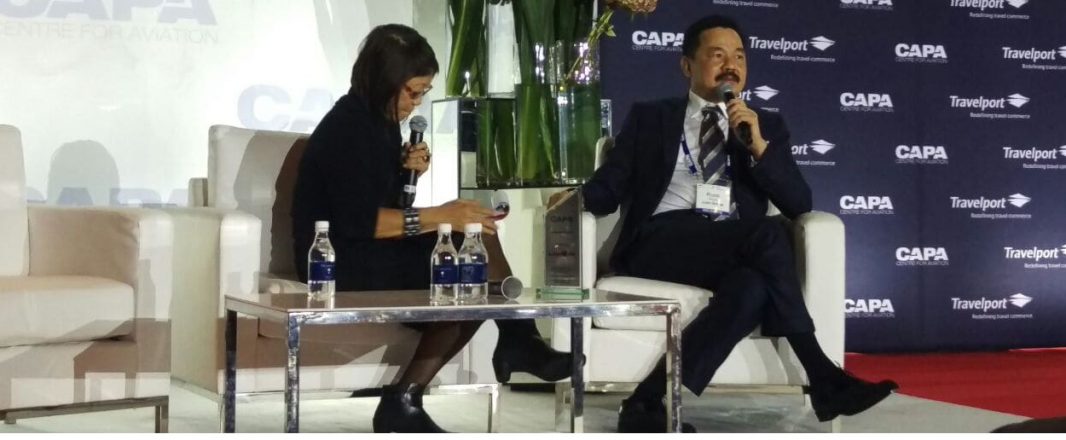
Things could have turned out very differently for Rusdi Kirana, recipient of the CAPA Legends Award 2015 if he had listened to a official from the Transportation Ministry when he first applied for a licence to start Lion Air.
The advice he got was to start a condom factory instead. “If I had listened, I would be a AIDS or HIV campaigner by now,” laughed the founder of Lion Air during an interview with me when he accepted the award Monday night during the CAPA Asian Aviation Summit in Singapore.
Not that he has any regrets about persisting with his dream of starting an airline which has, in a span of only 15 years, emerged as one of the world’s largest airline groups, with a fleet of over 200 aircraft and more than 500 more aircraft on order. The group now includes five airlines across three South-east Asian countries and a leasing subsidiary.
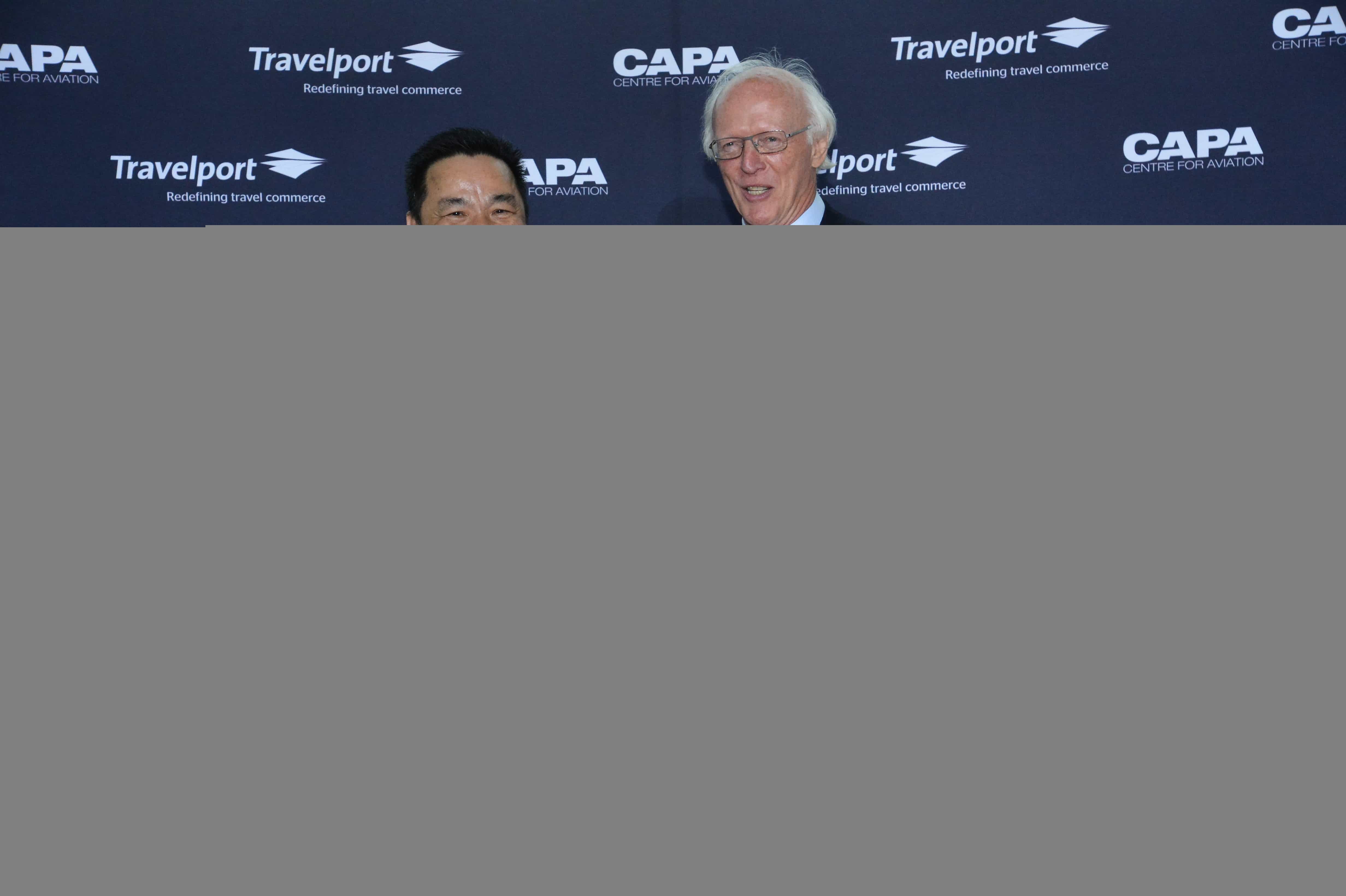
Lion Air founder and CEO Rusdi Kirana accepting the Legends Award from CAPA’s executive chairman Peter Harbison.
In recognising the Indonesian aviation pioneer, the Sydney-based Centre For Aviation said, “It is the leader in its home market and has been pursuing rapid growth over the last two years in Malaysia and Thailand. It is the first LCC group to establish a full-service subsidiary, giving it an innovative multi-brand strategy in its home market.
“Our legend started with practically nothing and has built an impressive franchise of carriers that have led to rapid change across the Southeast Asian aviation marketplace. The emergence of his airline would not have been possible without his hard work, creativity and strong strategic leadership. But it is his bold expansion into other South-east Asian markets that really sets him apart and makes him one of Asia’s leading entrepreneurs.”
What sets Rusdi apart too is his low profile. He rarely speaks at events, seldom gives interviews. And in this 20-minute interview on Monday, he came across as humble and no-nonsense, and a true blue entrepreneur with both feet firmly planted on the ground.
Although Rusdi and his brother Kusnan did not start Lion Air with “practically nothing”, they only had US$900,000 in their pocket to start the airline and in building up an entity that a recent Forbes article valued at around $2 billion, they’ve proven that it is possible to go from millionaire to billionaire and not the other way round in building an airline business.
But building up that $900,000 took hard work. Born of immigrant Chinese parents, he said “I had no choice but to work hard”.
He worked as a typewriter salesman, selling Brother, a piece of equipment that’s now extinct. He was earning $7-$8 a month then. Later he got into German baking ingredients.
He’s compared running an airline to making “kueh lapis”, the Indonesian layer cake, which is extremely hard to get right but, according to him, “still not as hard as running an airline”.
“You need to focus all the time, there’s not a day that you can afford to lose focus,” he said.
And while in the past it was making money that motivated him, today it’s responsibility that drives him – “responsibility for my family – one wife, three daughters – and my staff”.
The group has 30,000 staff and he’s built an entire complex – which he likens to being like a city – for them, which includes housing and schooling for their families. His airline now flies 40 million people a year and he controls nearly half the domestic aviation market.
As with all die-hard entrepreneurs, Rusdi believes that every cent spent is revenue and he personally designed the airline’s logo and crew uniforms himself. They remain in use to this day.
He is bullish on Indonesia, his home market. “We have a 250 million population, 17,000 islands, with 5,000 miles in a straight line from east to west, but fewer available seats per kilometer compared to other Asian countries in the region. We still have huge room to grow,” he told Forbes in an interview earlier this year.
This explains his ambitions – he placed the largest single commercial order from Boeing in its history, $21 billion in 2011 for 230 aircraft (with an option for 150 more). In 2013, he placed a $24 billion order for 234 aircraft from Airbus, and in late 2014, he did a $1 billion deal with Italy’s ATR for 40 turboprops. In the last four years he has committed to spend $46 billion to expand Lion Air.
Not only that, he plans to build an airport in Lebak, Banten province, 50km from Jakarta. The development will be on a 5,500 hectare site and will have four runways, capable of handling 100 million passengers, and able to handle the A380.
He said he hoped it would be ready before “I have to go to hospital”.
Rusdi is also betting on ASEAN, a market of 700 million people, hence his foray into Malaysia and Singapore and he’s confident Lion Air will be able to build up its brand in markets outside Indonesia.
I asked him what his thoughts were on AirAsia’s Tony Fernandes’ comment about ASEAN brands’ expansion in ASEAN and that “it’s easier for McDonald’s to come here than for an ASEAN company to go into the Philippines and Malaysia, Indonesia, and Thailand”.
Said Rusdi, “McDonald’s is not the same everywhere, in Indonesia, they offer rice. We will localise our offering for different markets but one thing remains the same, if people want cheap fares, they fly with us.”
Kirana is now economic advisor to Indonesia’s President Joko Widodo and he said his passion is to support SMEs (Small Medium Enterprises) and inbound tourism. He wants to champion entrepreneurs because they distribute wealth and inbound tourism because Indonesia has so much potential and opportunities for sightseeing.