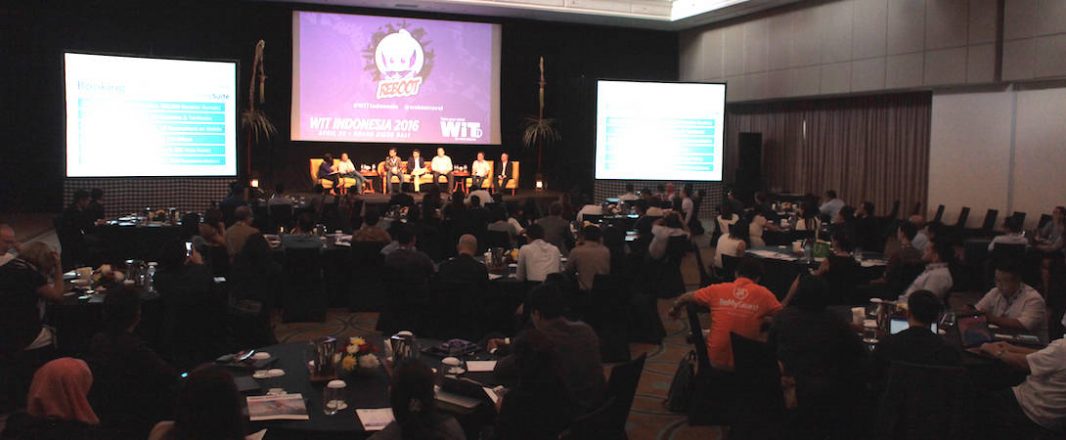
Perhaps it was the Bali setting which has a way of inspiring anyone to flights of fancy but in the opening session of WIT Indonesia, there was talk of surfing, aquariums and team sports, even sumo wrestlers.
The conference opened with the premise that technology is like a surf – it starts slow, then it creeps up, picks up pace and then suddenly, that huge wave is upon you and you’d better be good to ride it out.
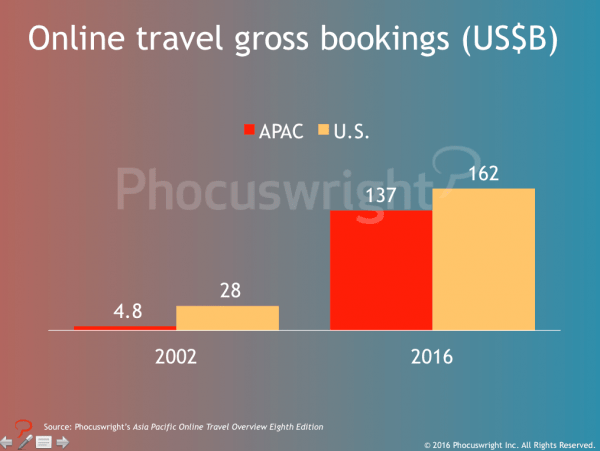
This is where the state of online travel is at in Asia Pacific, with mobile the big wave changer in the region. From 2002, the year Phocuswright first measured the region, to 2016, the online travel market has grown from $4.8b to $$137b.
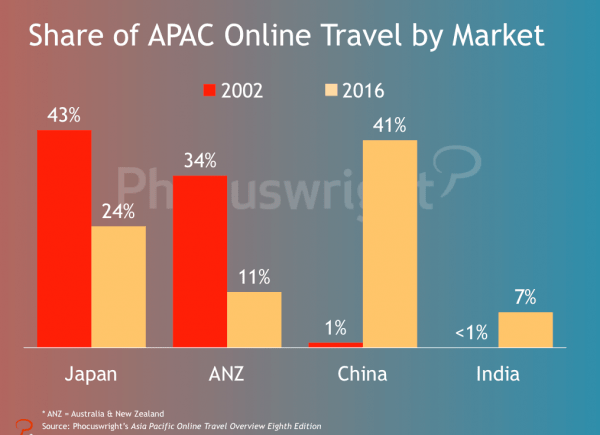
The share of online travel by market in Asia Pacific has also shifted with China jumping from 1% in 2002 to 41% in 2016, while Japan has dipped from 43% to 24% in the same period.
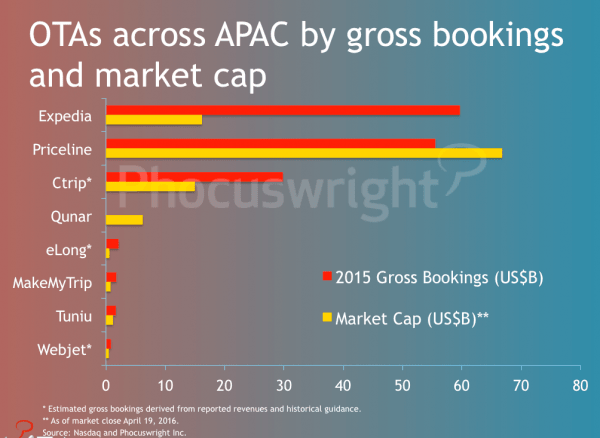
With OTAs such as Ctrip now valued at approximately $1.8 billion and Booking.com recording nearly one million transactions a day, Jean Luc Chretien, co-CEO of FASTBOOKING said OTAs had become like sumo wrestlers, with hoteliers up against some serious heavyweights. “OTAs are becoming bigger and bigger,” he said.
Oliver Hua, managing director Asia Pacific of “sumo wrestler” Booking.com, preferred to see it as an aquarium “where big fish and small fish can all swim together” in one giant tank. “There’s plenty of room for everyone,” he said.
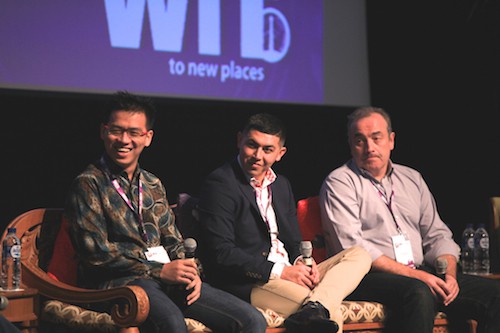
From left: Alfan Hendro, Patrick Torres & Timothy Hughes.
Timothy Hughes, vice president of marketing, Agoda called it a “team sport” and said it was time to end the “winner takes all” notion. “Direct and OTA distribution are complementary,” he said. “If we can all end this us vs them battle and all of us focus on the customer, everyone wins.”
Patrick Torres, head of sourcing, South Asia for GTA, shared an image of the complex world of travel distribution with transportation and other ancillaries involved, and said hotels needed to think beyond their own channels and collaborate with other partners in the wider world.
Traveloka, Indonesia’s first OTA to expand beyond home shores, clearly has ambitions to be a sumo wrestler. Alfan Hendro, head of accommodation, has been assigned the mission of scaling inventory across the region and believes Traveloka, founded in 2012 and backed by Global Founders Capital fund, an arm of Rocket Internet, believes its local expertise in Indonesia gives it the advantage in growing across South-east Asia.
Why this would be when Traveloka is no more local than say Agoda is in countries like Malaysia and Thailand but Hendro said that markets in the region have certain similarities and Traveloka’s success in cracking the tough and competitive Indonesian market and understanding its peculiarities would hold it in good stead.
Certainly, the industry is watching Traveloka’s expansion with interest – rumours abound as to how much it is spending to buy traffic and how long this can last – but for now, Traveloka represents the first South-east Asia homegrown OTA to try and build a brand across the region.
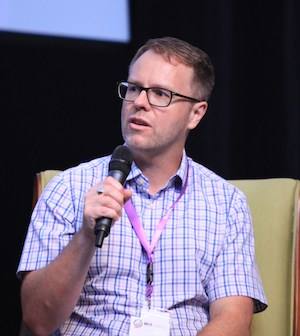 TripAdvisor is also seeing good growth in Indonesia, with Grant Colquhoun (pictured left), senior director of account management, Asia Pacific, saying the Indonesian site (tripadvisor.co.id) saw a 56% growth from January 2015 to January 2016 and a 144% growth in user reviews. And while mobile accounts for 50% of visits worldwide, the share in Indonesia is 69%.
As for the opportunities they saw for hoteliers in this new landscape, each panellist had their own take. Chretien, whose business is all about helping hoteliers drive brand.com business, said hotels had to start investing in their direct channel business. This, they can do through differentiation in experience, recognition and personalisation.
Hua agreed, saying hoteliers should focus on what they do best, look after guests. He said that only 2% of Booking.com’s customers returned to book the same hotel, which meant the channel was a good acquisition platform for new customers.
Hughes said content has become a big part of discovery and hotels should work on content creation and content marketing. A later session on content offered the opinion that if you had $100 to spend on content, you should spend 30% on creation and the rest on marketing.