The technology powering the just-announced Value Alliance, which sees eight low cost airlines partnering on a sales and distribution platform allowing customers to book on all of them, including ancillaries in a single booking, was developed by UK-based startup, Air Black Box.
ABB was set up by co-founders Timothy O’Neil Dunne and Paul Addy in 2012 to address a fundamental gap in the marketplace of allowing airlines to cross-sell and upsell each other’s products in a seamless, real-time manner.
“As low cost carriers rose and full service airlines retreated, we saw a gap in the market. Low cost and full service carriers are fundamentally different models and no existing technology could fix it,” said O’Neil Dunne. “People have tried to put bandaids on it for years so we set about understanding how a carrier in their home market, irrespective of their model, could cross-sell and upsell another airline’s products.

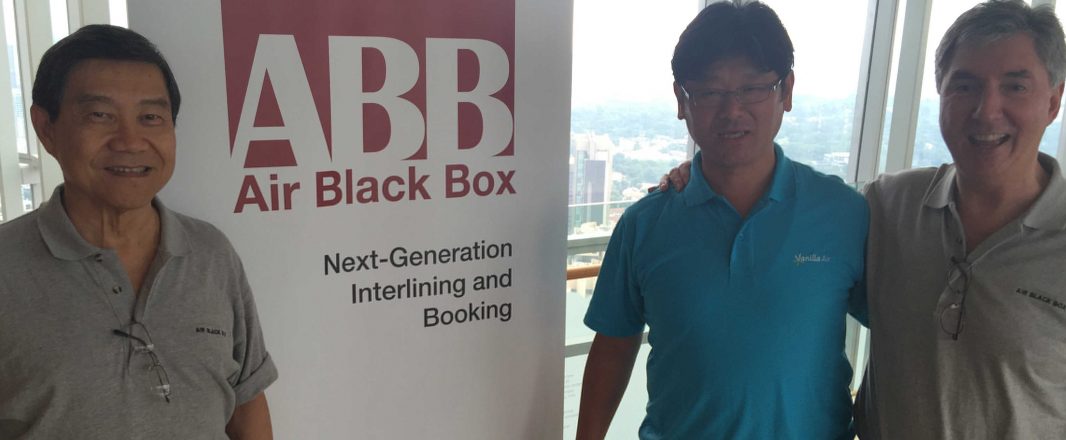
O’Neil Dunne (right) and Bill Liu, airline distribution veterans behind ABB (top picture, with Katsuyo Goto, president, Vanilla Air)
“We first looked at trying to solve the problem for airports. Airports still have this issue of being able to help their tenant airlines utilise all of their services but the decision making is not made at the airport level, but at the airline level. So we set out to find airlines who understood the problem and were keen to solve it.”
Through an “act of serendipity”, it met Scoot, Nok and NokScoot (the three lead carriers in the Value Alliance) who were looking for technology to do just that. “They knew it wasn’t just confined to their own issues, their own small world, they felt that collectively many airlines would see the same issue, so they were able to gather other like-minded airlines who had the same problem – we are just the technology that makes it happen.”
The technology is owned by ABB Technologies Ltd, a venture-backed IP owning firm, while the joint venture in Singapore, which covers the territory of APAC, called Air Black Box Asia Pacific Pte Ltd, is held between Vaultpad Ventures, Scoot and NokAir. Airline distribution veteran Bill Liu, a former president of Abacus International, is the chairman.
According to O’Neil Dunne, ABB’s breakthrough is that it marks the first time “that you can provide a distribution service so that the airline PSS does not have to change, that is no infrastructure cost change” on the airline’s part.
A totally new platform built on the IATA NDC platform, it can also accommodate different workflows and product types, he said. “Our system is based on open source but with strict development methodologies. We deliver API or full UX. We decided to learn with the full UX version so we maintain a complete copy of the airline’s website.”
While the technology was developed closely with its airline partners as well as some airports such as Changi, O’Neil Dunne said, “The experience of the team was borne out of their direct knowledge of how airlines work on a far broader scale. So far we have met with all the Value Alliance members as well as airlines outside the Alliance who are keen to get their hands on this new solution. For us whether your carrier model is LCC, FSC or Hybrid – this does not make any difference to us.”
O’Neil Dunne said the process of developing the technology was “all pretty hard and very complex”.
“There are a lot of moving parts to this. Aligning commercially was a significant first challenge but with the goodwill of all the parties that worked out. Technically the hardest thing was proving that our system could actually do what it does.
“There was a lot of skepticism that a small UK-based software company could actually do something that up till now only very large players have been able to do. Doing what we do with interlining when there was other easier lower hanging fruit was probably a bit foolhardy.
“However now we have cracked the interline piece, the booking engine is deep and robust to handle a wide variety of use cases, not just the edge ones.”
As for scalability, he said, “We have scaled for a very large number of transactions. It is commercially sensitive – but so far we have been able to demonstrate large volumes of transactions (search, bookings etc) for complex itineraries, example, 4 separate airlines in one PNR.
“We do not have aspirations to be a GDS. We are a technology company not a distribution company. ABB can handle alliances of any type. Full cross sell and upsell across multiple carriers had been thought to be too hard.”
O’Neil Dunne said Asia Pacific had more need than other markets for its solution because of its geography. “There’s a higher proportion of low cost airlines in the region than elsewhere and there’s lots of headroom for growth.”
Having been in the airline distribution space for more than three decades, he feels the time is right now for such a product as ABB. “Interlining one of the hardest things you can do, real time cross-selling of another airline’s full product catalogue has never been done before, which is why we have a patent pending on the service.
“Whether you’re a full service carrier who wants to connect with a low cost carrier or the other way round, it has to be in a mode that works for the passenger. For this, we had to deconstruct the process of airline reservations – and then reconstruct them in the form that a customer can consume it. For this reason, we spent extensive amounts of time understanding NDC and applying the architecture of NDC, repurposing not just for distribution but inter-carrier communication, a use to which it is ideally situated.”
ABB was started with a grant from Innovate, a UK investment fund. The grant was used to evaluate the marketplace first and helped the company develop the initial prototype. The rest of the funding came from the co-founders and Vaultpad Ventures.
There’s no intention to raise funds. “We believe our business model is stable enough not to need external funding at this moment,” said O’Neil Dunne.