
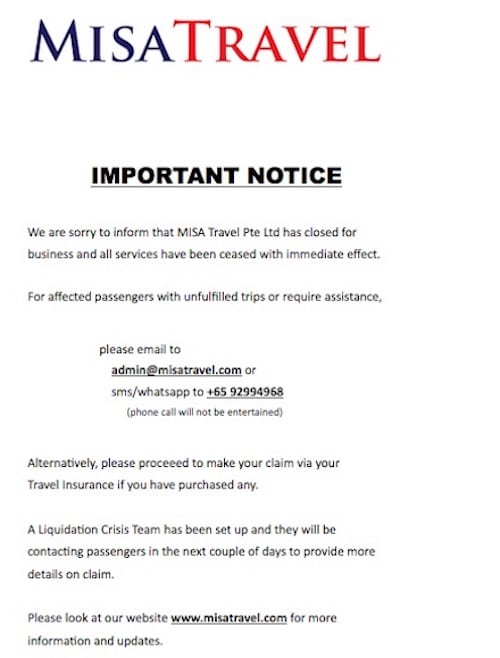
The revocation of the travel agency licence of MISA Travel on May 30 is indicative of the growing challenges facing traditional travel agencies in Singapore.
In its advisory, the Singapore Tourism Board stated that the notice was served “as it has ceased to carry on the business of a travel agent and is unable to fulfil its obligations towards its customers”.
A visit to the MISA Travel website reveals this screen shot.
The news has sent shockwaves and sadness throughout Singapore’s small and tightly-knit travel agency community, which viewed MISA Travel as one of the more progressive agencies which had embraced technology to remain relevant.
At its height, MISA, which ran airfares.com.sg, was among the top five online travel agency sites in Singapore, competing with the likes of Zuji and Expedia and was hailed as a role model traditional travel agency that had managed to migrate online.
Its founder Kenny Chew, who built it up over 20 years, was often seen at online travel events and conferences like WIT to learn about the new world and how his agency could adapt.
In September 2014, it was acquired by Zana Capital, a private equity firm, for an undisclosed amount and the announcement declared that “MISA Travel hopes to contest against low yields and the competitive tourism landscape to expand its portfolio further to greater heights. This support will help accelerate growth by increasing the scale and presence of the MISA Travel in Singapore and regionally.”
In October 2014, Kenny Chew retired and Wee Hee Ling, the former CEO of CTC Tourism Holding, took over.
In an interview with WIT, Wee acknowledged the challenges she would face returning to the business after a two-and-a-half year break and learning the ropes of an online travel business as MISA continued to transform its business model.

Wee Hee Ling: “We are like the last of the Mohicans …”
She said, “It’s exciting to be back but, at the same time, I feel a little nervous because the current job is very different from the last 27 years of my career. Now I am jumping into online. I want to learn new things and this is the future.”
She admitted she was nervous because she knows online is the land of giants and scale. “We are like the last of the Mohicans – a small local play – and we have to look at how we can carve a niche. We don’t have millions to spend like the Expedia and the Ctrip but we will look at carving a space for ourselves.”
What MISA had going for it was its relationships with airlines which allowed it to offer competitive and special air fares to suit local market needs – for example, offering good labour fares for the migrant worker population in Singapore.
In the interview with WIT, she said she was staking “last stretch in my career” on online because she believes it is the future.
“In the last two years, I have observed that it’s getting tougher to survive as a traditional agent in Singapore.
“The shift from groups to FITs was very apparent last year – two years ago, the market was 50/50 but early this year, the ratio swung to 80/20 in favour of FITs and the group segment includes MICE – this is a very rapid shift.
“Tourism boards recognise this trend and now want to target the FIT market which means traditional tour packages are going to be affected.
“The Singapore traveller is definitely more savvy and more are shopping online rather than going to a travel agency.”
Clearly carving out that space for MISA has been difficult. How do you hold on to your traditional share in a hyper-competitive, price-led and shrinking market – with more customers migrating online – while chasing new customers online is an ongoing dilemma of many traditional travel agencies in Singapore.
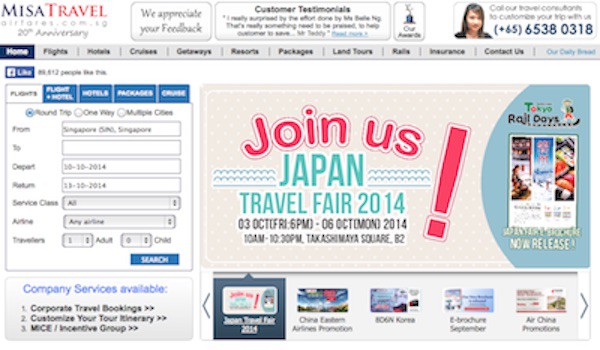
It had been difficult for MISA Travel carving out the online space.
Speaking to a handful of traditional travel agents at the Hotelbeds Markethub conference in Bangkok last week, several of them echoed Wee’s comments that it was hard to compete in the online world without the huge budgets and know-how and tech resources of the giants and that the only way to survive was to focus on being niche, deliver great consistent personal service and really add value to customers by knowing more than them.
One spoke of how he intended to use chatbots and AI to deliver a minimum quality consistent level of service so that client relationships would not be dependent on the human working on their account but on the service delivered by the agency.
For MISA though, it clearly was a tough act to balance and so the last of the Mohicans has fallen.
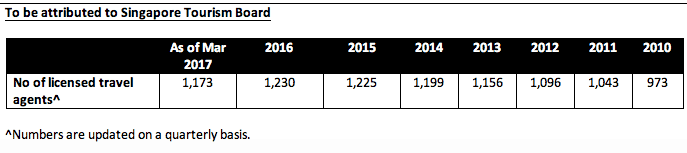
Note: Interestingly, according to numbers supplied by the STB, the number of travel agents has grown over the years from 93 in 2010 to 1,173 (as of March 2017)
• Featured image credit: MR1805/iStock