
Karuizawa is an hour’s train ride from Tokyo. The hill resort is a popular summer retreat for Tokyo folks looking to escape the heat and stress of city life. At WIT Japan & North Asia, there was a lot of talk about the need to disperse tourism beyond the main centres of Tokyo, Osaka and Kyoto as inbound visitors soar to reach its 40m target by 2020.
Karuizawa is the perfect spot for foreigners looking for experiences beyond Tokyo. It is accessible by train – Japan Railways’ tickets are now in English, one more proof point of how Japan is changing to accommodate foreign travellers – and it is a delight to explore and discover the place on foot or on bicycles. The air is distinctly fresher and cooler, the greenery lush and soul-enriching – even the birds sound chirpier here.

‘Karuizawa’s Swan Lake – changes colours with the seasons.
As I explored Karuizawa over the weekend – enjoying the local soba, dairy produce, jams and “domestic sausages” and visiting local shrines and lakes, I was struck by the blend between Japanese and foreign culture in this historic town which seems to have found “chowa” (harmony) in the ongoing dance between local and global.
In days gone by, this was the playground for Canadian missionaries working in Tokyo and there are old photos of locals dressed up in frocks and carrying parasols just like the foreign women. Churches stand alongside shrines tucked away in the forests. Western influences are infused into the local cuisine and produce – French pattiseries, German chocolates, Italian pasta.
At the hotel I was staying in, Kyu Karuizawa, chef Soshi Ueno, trained under Alain Ducasse, produces the best crumby, fluffy croissants and his scrambled eggs, infused with truffle, leaves you longing for more.

Truffle-scented scrambled eggs at Le Signe: Egglicious!
On my last evening, I happened upon the Sajito Forest Café, located next to a church and a shrine. It’s run by a Nepali owner, who came to Japan as a student, married a Japanese woman and settled in Karuizawa. It serves the best samosas, momos, curries and naan I’ve tasted in a long time – Nepali/Indian cuisine using local ingredients.
I like how just as the houses blend with the nature in Karuizawa, foreigners who’ve made a life for themselves here have also assimilated themselves into the local fabric of life.
And it seems to me that the best success stories in travel happen when there’s diversity of ideas and talent, and blending of local and foreign practices – a belief that was reinforced at the sixth edition of WIT Japan & North Asia 2017.
Here’s a summary of the key takeaways from the event.
1. Peach stays true to goal of serving inbound and women, innovating and spreading happiness
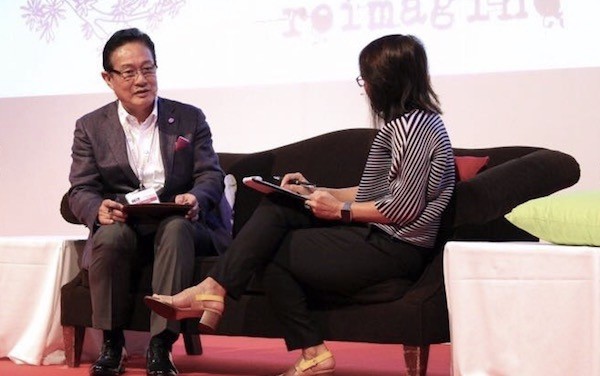
Peach CEO Shinichi Inoue shared the reasons behind Peach’s four consecutive years of growth in revenues and profits. (Photo credit: Travel Voice Japan)
In the opening session, CEO of Japan’s first low cost airline Peach, Shinichi Inoue announced four consecutive years of growth in revenues and profits. Japan’s first low cost airline launched in 2012 released its financial results for the year ending March 2017 the day WIT opened – it posted operating income at 51,709m yen, up from 47,939m yen a year ago, operating profit of 6,302m yen (6,181m yen) and current net income of 4,944m yen (2,744m yen). Operating profit to revenue was 12.2%; average seat occupancy was 85.4% (paid seats), and the number of paying passengers about 5.13m.
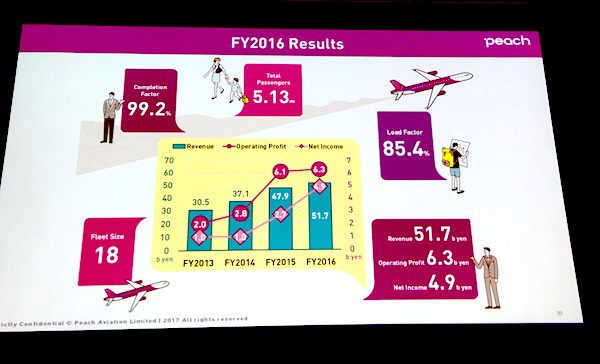
Peach’s 2016 financial results in a slide
Inoue recalled the day when his then-boss at All Nippon Airways asked him to take the helm of Peach. “He said, ‘set up an airline to bring foreign visitors to Japan’.”
The first thing he did was put together an advisory team which included Patrick Murphy of RyanAir, who remains on the board. “The expertise we tapped into at the start was invaluable,” he said, and the airline now runs on four pillars – quality product, cost management, branding and innovation.
Another thing he did was to ensure he didn’t bring in any bad “legacy” habits to the new airline. “If ANA goes east, we go west,” he said.
From the start, he fostered a culture of innovation. “We don’t hire anyone who is not interested in innovation. We are more interested in output, not processes.”
The Osaka-based airline has 23 nationalities on its team. “Good people are attracted to multinational teams,” he said when I asked him how he manages to hire “superstars” such as his CMO, Yoshihiro Morii, who came from an advertising (Dentsu) and food retail background (sushi roll).
Morii, speaking at the WIT Bootcamp, spoke of how the airline has flipped the conventional marketing funnel by “back-casting from real behavior data to identify our target communication channel”. It works heavily with social influencers across Asia.
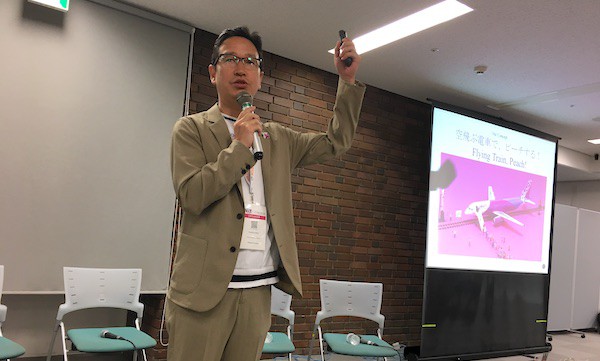
Yoshihiro Morii, CMO of Peach, talks about the airline’s marketing and retailing strategy
Morii also spoke of how the airline is moving into retailing, not just selling airline seats, and recently tested selling Volkswagen cars inflight. It was surprised when it managed to sell five, totaling 30 million yen, and now it’s contemplating selling condominiums.
With just 18 aircraft, Peach has been able to change the lives of travellers across Asia by offering them fares that are equivalent to a “flying train” and changed the way they travel, where decisions are made by price, not place.
Today, 70% of Peach’s passengers are inbound travellers and 60% are women aged under 30. This focused customer strategy has clearly helped the Osaka-based airline to perform well.
And four years on, it remains true to its mission of spreading happiness – at the launch of Peach, Inoue said, “I think the impressions and joys that are born from connections between people , the feeling of excitement and the smiles – these are sure to bring people happiness.”
On stage at WIT, he said, “Face to face matters. People are happy when they meet face to face, no matter the generation.”
2. It’s not about the tech, it’s about local knowledge, say Chinese giants

China reimagined, (from left) Ctrip’s Peter Yoshihara, Tujia’s Hai Zhuang and Qyer’s Bryan Xiao with Phocuswright’s Maggie Rauch moderating
There’s no doubt that when it comes to mobile, China is leading not only in North Asia but also the world. Yet as big as they are at home in market size and ahead in tech innovation, Chinese travel companies do not believe their technology gives them the edge in expanding outside their home country.
Hai Zhuang, founding team member of Tujia and president of Tujia Holdings, said when it comes to expansion, technology is not the key but local knowledge and relationships – which is why it has set up an on-ground team in Japan.
Japan is the biggest and fastest growing market for the Chinese vacations rental giant which is seeing more than 80% of transactions happening on mobile. And it is seeing 6% of transactions happening within the Wechat channel.
At the WIT Bootcamp, Zhuang admitted that the mobile take-off took him by surprise. “I didn’t think home rentals would take off on mobile, Melissa (Yang, co-founder) was right when she pushed mobile. Today, my life, my work – everything is on mobile.”

Tujia Holdings’ president Hai Zhuang in conversation with WIT’s Yeoh Siew Hoon at WIT Bootcamp: He wanted to see the direct impact of his work.
Zhuang, who left Microsoft to join the founding team of Tujia as its third employee in engineering, also spoke of how he wanted to be part of something small that he could play a big part in rather than be a small cog in something big “where I could not see the direct impact of my work”.
In making the transition from CTO to president where he’s responsible for strategy and acquisitions, he said the biggest challenge is learning to deal with uncertainty. “Engineers like certainty. When you’re responsible for strategy, you have to deal with unknowns and take risks.”
Ctrip’s general manager and head of marketing for Japan, Peter Yoshihara, spoke of the difference between Ctrip’s domestic app, which has 800m downloads, and the overseas version (in Japan, it offers domestic rail and ground transport options in addition to flights and hotels). “Our Chinese app is a one-stop shop – all you need,” he said. “Our overseas app was developed later, for international use.”
Yoshihara is Ctrip’s first person on the ground in Japan to look after marketing. It has a Japan team of up to 50 people contracting hotels and clearly with 30% market share of a 120m outbound market, Ctrip has a strong advantage over other OTAs making a play for Japan.
Bryan Xiao, co-founder of Qyer, an outbound travel planning site for Chinese travellers and which is expanding abroad as well, said, “In our task of globalising, as an IT guy myself, I have to keep reminding myself not to think about digital all the time.”
Qyer has launched a new trip planning product, making use of AI and machine learning, whereby it crawls through user-generated itineraries and generates personalized recommendations for users.
On what technology excited him currently, Zhuang cited AI and deep learning but said, “Don’t follow the hottest tech, think about your model.”
3. Asia lit the fire on mobile and “we’re playing catch-up”

Discussing how global OTAs are expanding in North Asia – Amadeus’ Chris Lee, Booking.com’s Oliver Hua, Agoda’s Tim Hughes and Expedia Asia’s Jonty Neal
After having heard Ctrip’s numbers on mobile (800m downloads, 70%-plus of transactions), foreign OTAs like Agoda, Expedia and Booking.com were naturally coy to disclose their numbers.
“Asia lit the fire on mobile and we’re playing catch-up,” said Timothy Hughes, vice president, business development of Agoda. He said the Agoda of today, with 50% of its business coming from apps, is very different from the Agoda of the early days.
“We’re late in the game,” said Oliver Hua, managing director APAC of Booking.com. However it has other things in its favour, such as a strong portfolio in private accommodation (650,000 of its 1.2m listings), which is hugely popular with travellers to Japan.
Expedia, whose business in Japan is worth more than $1 billion, is hopeful that its Innovation Lab, opened in Singapore earlier this year, will help it better understand local behaviours. “We’re working on the confluence of mobile, messaging and machine learning and where that might go in terms of product development,” said Jonty Neal, CEO of Expedia Asia.
It is clear that unlike a few years ago when these global OTAs had much of the market to themselves, competition is rising from new marketplace models in Korea, Japan and China as well as local giants who are defending territory; however the power of scale should not be underestimated as the compounding effects of growth kick in.
Most telling was when I asked Hughes during another panel where Agoda was seeing fastest growth in Japan and he said, “Domestic market.”So while the foreign OTAs were modest in saying they have a long way to go before truly winning in Asia, it is also clear they are on the right path.
4. Local Samurais determined to fight back as inbound grows

The Samurai panel with Venture Republic’s Kei Shibata (left) moderating
The local travel giants in Japan may not be showing it yet but it is clear there is serious concern for alarm as inbound travel grows and with it, the growing power of foreign OTAs who have stronger brand caches with travellers from abroad.
Rakuten’s Yoshiyuki Tanako, was candid when he wrote the number “100%” when asked on the “Reimagining The Samurai Spirit” panel how alarmed he was by the success of foreign OTAs in Japan inbound. “I think it’s great to raise my alarm. Overseas OTAs are providing great service and marketing. We do have differentiating points. I think the most important thing is to pay attention to your customers.”
JTB’s Ken Mishima wrote the number “150%”. “I was with Expedia for a few years, these global OTAs have the tech know-how.” He said that according to JTB’s own research, there were 700m room nights available in B&B private accommodation. “The international OTAs have captured the market and we have to do more.”
He also said that JTB, which has 800 stores, has a lot to learn from companies like Amazon on “how to blend online and offline.”
JTB’s buying spree of destination management companies (DMCs) – most recently acquiring Kuoni – was part of its strategy to own content, both online and offline, globally.
Meanwhile, the Relux-KDDI combination seems to be kicking in well. Takaya Shinozuka, founder of the accommodation startup, which was recently acquired by the Internet games and entertainment giant, said, “I was scared at first. I thought they’d micro-manage but actually our decision making has been accelerated.”
On KDDI’s part, Takahiro Oono, general manager, said he was positively surprised by the activity and enthusiasm of the travel startup scene and the travel industry, as well as Relux’ continued execution of becoming the go-to site for high end accommodation and ryokans in Japan.
Using SNS marketing, something Relux has mastered over the years, inbound business is now 20% of customers and 15% of transactions. Shinozuka said inbound was seeing faster growth than the domestic segment, a clear sign of where the local Samurais have to get better at if they want to win in the next few years on the back of Japan’s inbound tourism boom.
Part 2 next week