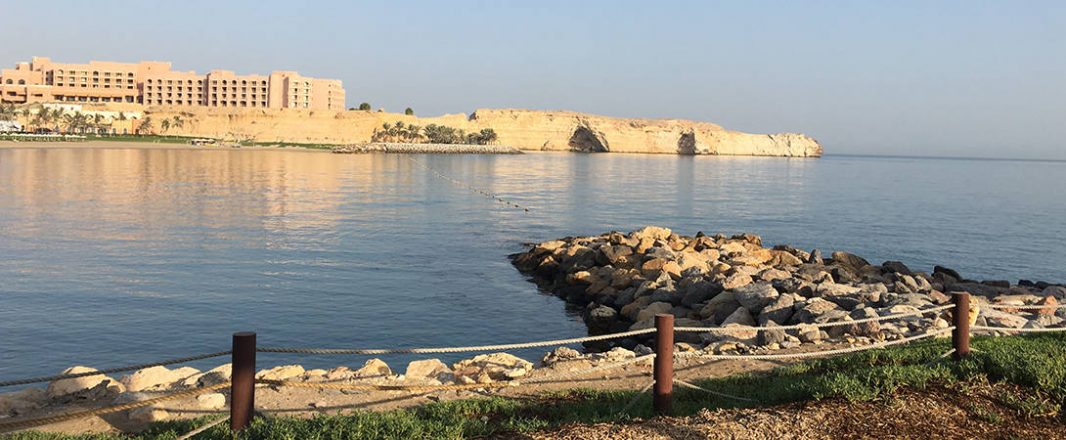
For some reason, Muscat seems closer in my mind than it really is. To get here, I had to connect via Dubai and with a four-hour layover, it’s almost a 12-hour journey and I thought I could have flown to London in that time.
But returning to Oman eight years later was what I wanted to do. After all it inspired the first children’s book I co-wrote (Adventures of Habibi, The Wise Turtle) and once I landed, it all felt worthwhile.
Okay, the visa on arrival process could be more efficient – for example, why couldn’t I have paid for that online prior to arrival and skip the queue?
It was a point raised by Remo Giovanni Abbondandolo, general manager of Travelstart Middle East, when he spoke on a panel about payments at the Travelport Live MESA (Middle East & South Asia) conference held at Shangri-La’s Barr Al Jissah Resort & Spa.
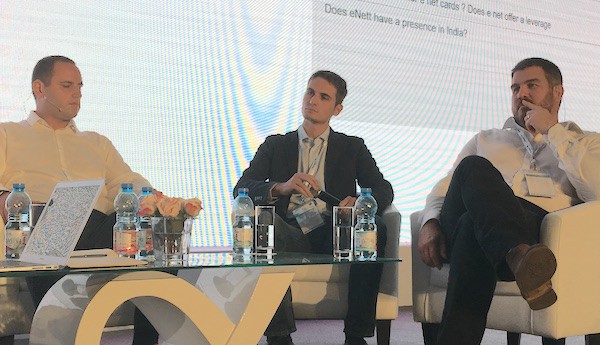
Travelstart Middle East’s Remo Giovanni Abbondandolo (middle): The UAE is quite advanced in credit card penetration
“It was easy getting here from Dubai but once you get here, you get stuck in that visa process,” he said. “Why can’t this be done through eNett (Travelport’s payment solution) and we can offer this as a service to our customers?”
There are clearly plenty of pain points in the emerging digital travel landscape in the Middle East, and I was reminded anew by how similar the markets here are to Southeast Asia – fragmented, mobile first or rather, mobile only (Saudi Arabia has 127% mobile penetration) and a travel-hungry young population.
With the fragmentation of markets, payments and content are the two biggest challenges and opportunities facing startups in this region.
Talking about the payment scene, Abbondandolo said the UAE was quite advanced in credit card penetration, Kuwait had Knet while Saudi Arabia was developing its own payment system. “Iran is the most effciient when it comes to payments with high credit card pentration but it’s hard for a foreign company.”
But one thing is clear, the Middle East digital travel market is finally coming of age. It was an opportunity recognised by Wego six years ago when it had to look for markets outside Asia for future growth and as Ross Veitch, CEO & co-founder of Wego said in this interview, he’s got the timing right when it comes to the Middle East.
Dean Wicks, chief commercial officer, who’s moved to Dubai, told the audience that Saudi Arabia is its biggest market and Kuwait its most promising. Pakistan and Iran also hold promise. “There are lots of OTAs coming up now everywhere,” he said, which means perfect ground for meta-searches.
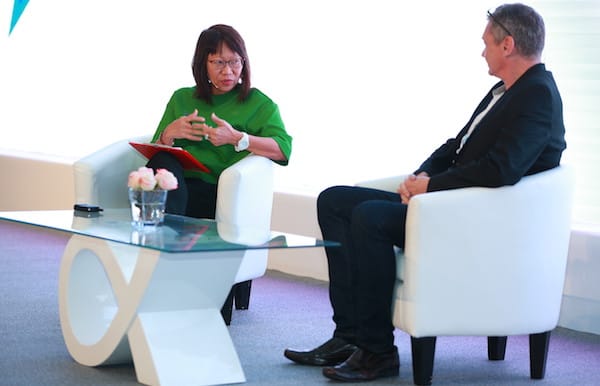
Dean Wicks (with WIT’s Yeoh Siew Hoon): Saudi Arabia is Wego’s biggest market, Kuwait its most promising
Being the first Arabic travel meta in the region, Wego has had first mover advantage. It covers almost 95% of the airlines in the region and it has assisted and facilitated booking with 40 airlines. Wicks said this feature was leading to 4x conversion ratios.
Its ability to build a consumer brand here early has also helped with customer acquisition with almost 50% of its traffic coming direct. It currently has 16 million visitors a month, and Wego intends to double that with the new funding it has secured – US$12m from regional broadcaster MBC Group and an equity ownership deal with Middle East Venture Partners.
Wicks, who was featured in the “From Startup to Stardom” session at Travelport Live, told the 200-plus delegates that their opportunites lay in mobile – 80% of its traffic in Saudi Arabia comes through mobile – and emerging markets like Pakistan and Iran.
Meta-search scertainly seems less competitive than the OTA space. I met several new OTAs that have popped up in the last couple of years in markets like Qatar, Kuwait and Turkey – not to mention Dubai of course.
Said Abbondandolo who’s been looking after Travelstart Middle East for the past three years, “Travel is definitely shifting online and the new entrants are quite aggressive.”
At the conference, there was a lot of discussion around mobile and the new technology that’s coming to change travel – AI and chatbots, among them.
Google’s Industry Head Travel, Bilal Kabbani, spoke of how Google was using AI and machine learning to improve its products from smart reply with Gmail to local languages with Google Translate and image recognition with Google Photos.
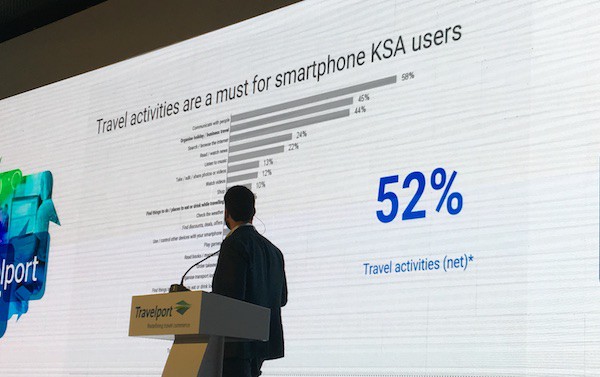
Google’s Industry Head Travel, Bilal Kabbani, speaking on AI and machine learning
When it comes to image recognition, he said, “the computer always wins.”
A new product to come, Google Lens, which Kabbani likened to Camera 2.0 will surface information as we take photos, making searching easier.
And then there’s Google Trips which can be used offline and how that will help us look for activities and restaurants in-destination. In Saudi Arabia, Google found that the top activity on smartphone usage was looking for activities.
There was of course the inevitable question – is Google friend or foe in the competition for the digital travel market which would be worth $600b by end of 2017? To which Kabbani said, “Google is a tech company and its DNA is to solve problems.”
Kabbani said global travel search was now mobile first – 52% as of April 2017.
Matthew Powell, managing director of Travelport Middle East & South Asia, in his opening, said mobile travel sales in the Middle East and India was expected to rise from US$2.8 billion in 2017 to US$8.6 billion by 2022. E-commerce transactions in India was projected to grow from US$30 billion in 2016 to US$120 billion, while the Middle East would rise from US$25 billion in 2015 to US$69 billion
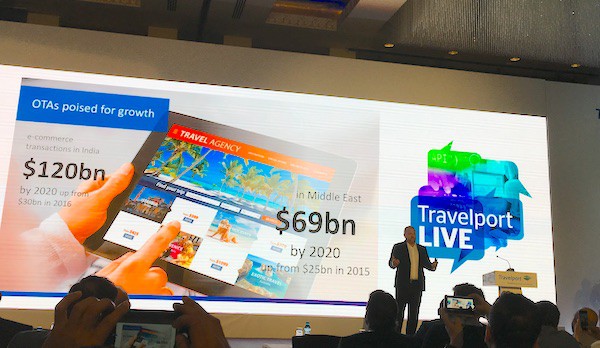
Matthew Powell at the opening of Travelport Live
The fact that Amazon recently paid US$580 million for Souq.com, the region’s leading marketplace, is evidence of the recognised opportunity by global brands.
Oman is a good example of the developments happening in the region. When I was last here for the pre-opening of the Shangri-La resort, international brands were just entering the sultantate. Today, there’s Ritz-Carlton and lots more to to come. Next to Shangri-La, a huge new development is taking shape – Muscat Bay – and a massive mall is being built downtown by the owners of the Dubai City Centre.
One of my lasting memories from my first visit was how well the architecture of the city blended with the natural environment. I am glad to see that other than a couple of tall buildings (nothing compared to Dubai), that hasn’t changed, and I hope it doesn’t.
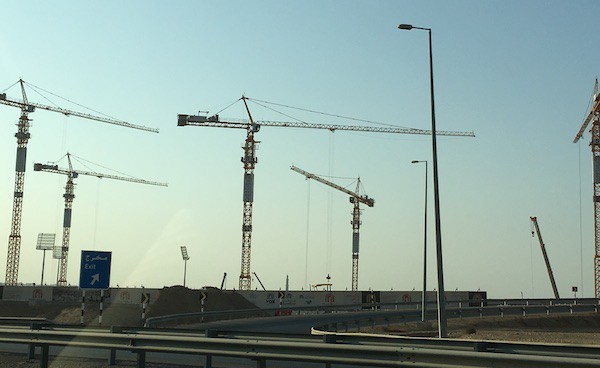
Ongoing developments in Muscat
On the ride back to the airport, my Omani driver said to me, after he learnt I was from Singapore, “We’re like Singapore, only 5 million people, and we are clean and green.”
Driving through an exclusive suburb with grand villas, he said, “There are plenty of rich people here. I am not one of the rich but I am not poor either. Oman is a good place if you want to run a small business. Maybe you should move here?”
Perhaps not me but if you’re a startup looking for problems to solve in digital travel, this may be the market for you. Go ask Wego.