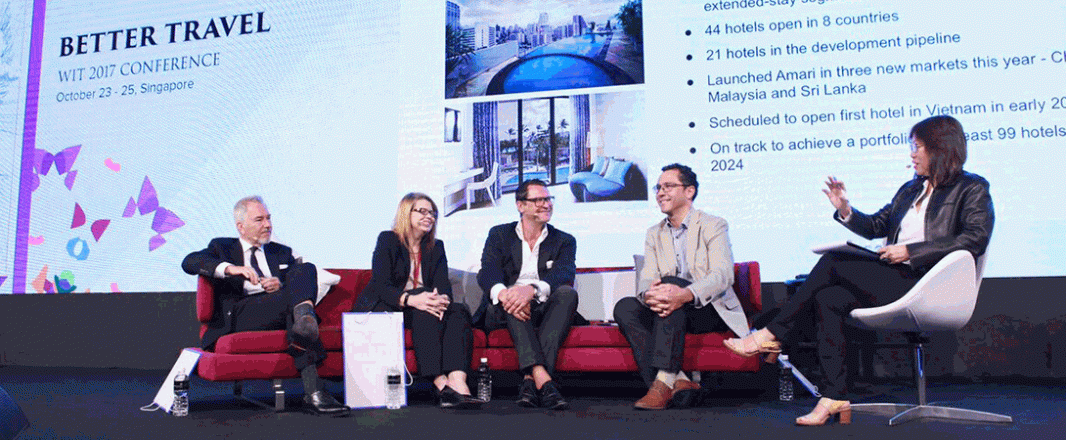
Home grown independent, owner-controlled hotel groups are mushrooming in Asia, and are competing not only among themselves but also in a world of scale, consolidation and distribution power. How do they fend off the global competition? By localisation, personalisation and doing things differently, said a panel featuring Wharf Hotels, Hotel ICON, ONYX Hospitality Group and Sabre Hospitality Solutions.
Richard Hatter, general manager of Hotel ICON, the teaching and research school of the School of Hotel and Tourism Management of the Hong Kong Polytechnic University, said his model allows his team to experiment especially with revenue management and pricing. He believes that hoteliers worry too much about other people’s prices and not enough about the value they provide.
His hotel, a customer of Duetto, is experimenting with personal pricing by targeting specific segments of customers with a bundled package and price. It’s found success for instance with young, single Korean women.
Hatter said that despite what some people might think that because it is a teaching hotel, it does not have to operate by similar financial principles, he said Hotel ICON was run like any hotel and has to be profitable, which it is. “The fact that we are making money intrigues people,” he said.
The challenge is of course how to scale such a model. Hatter said there have been discussions to replicate the model in markets like London but the panel posed the question, could this model be the future for an industry that needs new talent and new skills?
One challenge Hotel ICON faces is convincing people to pay US$300 to stay in a teaching hotel and he overcomes this by using data to target different market segments such as entrepreneurs and families with different offerings for each. “We do niche picking and use technology to cherry pick,” he said,
Hong Kong’s Wharf Hotels’ vice president of sales & marketing Philip Schaetz described the group as a ‘small brand” managing 14 hotels in China, Hong Kong and the Philippines under the Niccolo and Marco Polo brands. “The beautiful thing about being small is we can experiment,” said Schaetz.
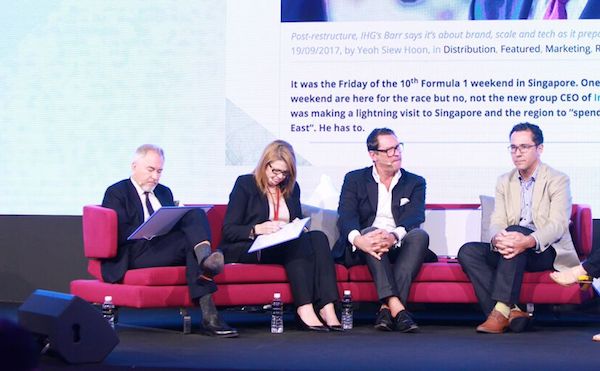
The panelists (L-R): Richard Hatter, Debrah Pasco, Philip Schaetz, Frank Trampart
Schaetz believes in a world of scale and commodtised brands, hotels which have local personality and character are important to give diversity and choice to customers. “I think there is great opportunity in this world of mergers to position yourself differently. To get closer to consumers, talent and owners, being small and therefore more flexible should be an advantage.”
Bangkok-based ONYX Hospitality Group, a ‘middle player” that manages brands including Amari, Shama, OZO, YOO2 and The Mosaic Collection, said that knowing what your brands stand for and then finding the right people and right tools to differentiate them was key. “The combination of people and technology is important, we need to ensure our people know how to use the technology.”
Localisation and being able to help guests have better experiences within the hotel and in the neighbourhoods was also cited as an advantage by these hotel groups.
Frank Trampert, managing director & chief commercial officer, Asia Pacific, Sabre Hospitality Solutions, who has seen life of both sides of the fence – he was with Carlson before joining Tune Hotels in Malaysia – said one thing regional groups could do better at is speed in a world where nano-seconds matter and at conversion, turning people to bookers.
The panel lamented legacy PMS (Property Management Systems) as the factor holding them back from integrating technologies but Trampert said this may soon become a thing of the past with the emergence of the cloud.
On what tech they are each watching, ICON’s Hatter said “Duetto” (Cloud-based hotel revenue management software and revenue strategy solutions), both Onyx’s Pascoe and Wharf Hotels’ Schaetz went for Artificial Intelligence, while Sabre Hospitality Solutions’ Trampert chose distribution and pricing.