
In the last 10 years, longhaul low cost airlines have mushroomed with international seats growing by 900%. Newcomer World Airways, the first longhaul LCC in the US, will be 100% digital and Millennial-focused while Cebu Pacific is trying to think of itself less as an engineering company but more of an ecommerce business with aeroplanes. My summary from the first day of the CAPA Global LCC Summit 2018 in Singapore.
There is no doubt that low cost airlines have changed the way we travel within our region – now get set for the next wave because long haul LCCs are taking off and spreading their wings and it’s going to change the way we in Asia think of longhaul travel. “Let’s go to Berlin for the long weekend” will become as common a cry as “Let’s go to Bali”.
A few years ago, I heard aviation experts express skepticism about the viability of a longhaul LCC – about how it wouldn’t be viable if fuel price was over $70 and who’d want to travel for long hours in a low cost airline but new, economical aircraft types have arrived to allow airlines like Scoot, AirAsia X and Jetstar Airways offer products and services that ain’t too bad for the price you pay, as well as new technologies that allow airlines to retail and merchandise better.
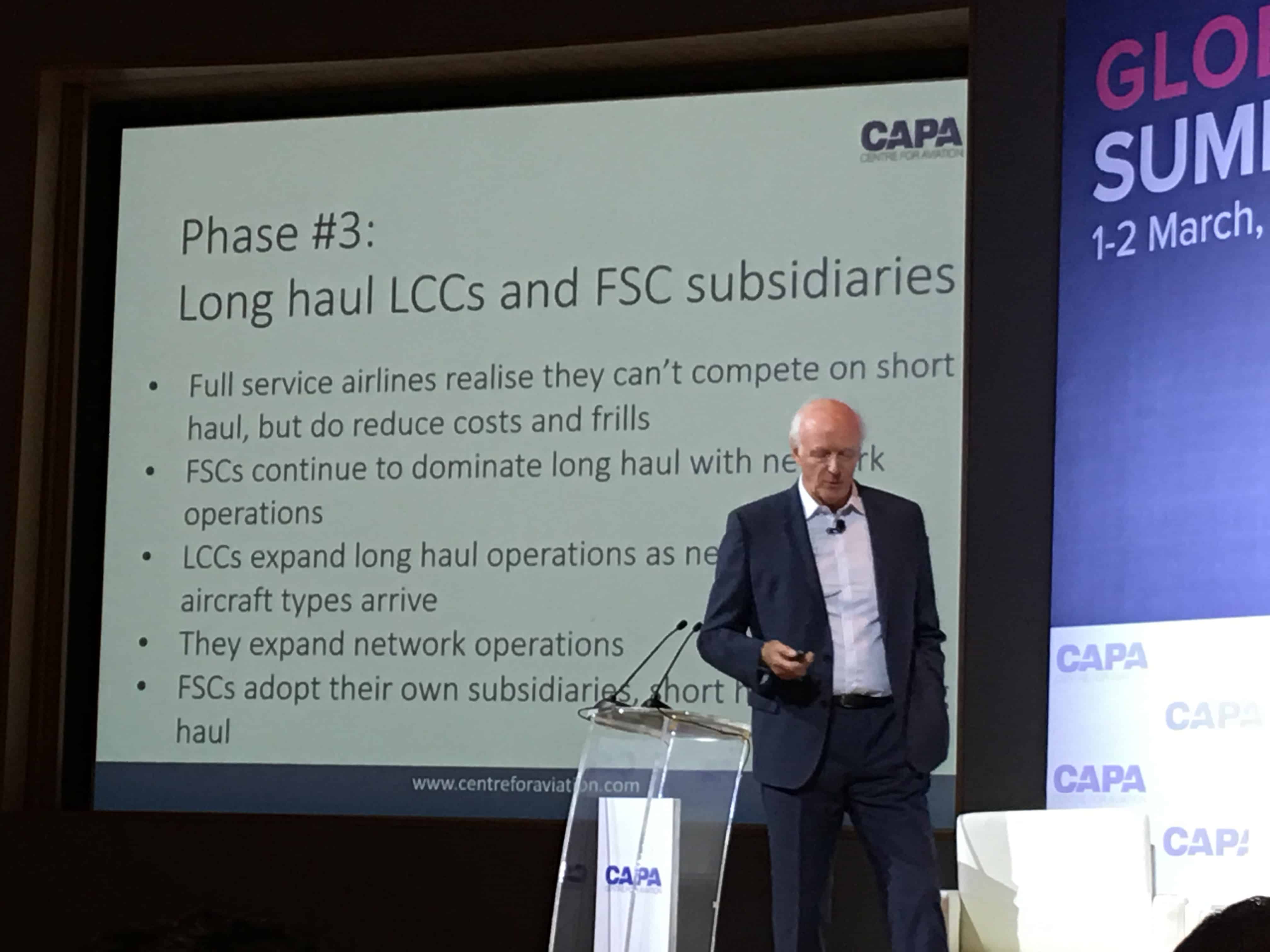
Peter Harbison on the evolution of longhaul low cost – that’s where the next battle in the skies is.
Peter Harbison, executive chairman of CAPA, talking about what he called the third phase of LCC evolution, said that full service carriers, realising they can’t compete on shorthaul, will reduce costs and frills and while they will continue to dominate longhaul with network operations, they will also start their own longhaul low cost subsidiaries, for example, Singapore Airlines and Scoot, which has announced flights to Berlin, Athens and Honolulu. Meantime, LCCs would grow their longhaul routes, and expand network operations.
All of which means good news for us travellers as air fares come down on longhaul routes and we can as easily take holidays in Hawaii as Hong Kong.
According to CAPA which held its LCC Global Summit in Singapore this week, in 2008, longhaul LCC accounted for 2,082,545 domestic seats and 2,686,804 international. In 2018, the numbers are 3,224,553 and 25,992,277 – meaning domestic seats have increased by 55% and international seats have grown by 900% in the last decade.
And the fever is spreading to the US. Miami-based World Airways is poised to become the first Millennial-focused, digitally-driven longhaul low cost airline in the US that wants to tap into what Adam Weiss, director of business development, an untapped opportunity. “Sixty five percent of Americans have not travelled internationally and 41% never over water. There is a huge gap in the market and people without the opportunity to access destinations,” said Weiss.
According to the US State Department, there are 113,431,943 valid passports in circulation, which means 36% of Americans own a valid passport (and therefore 64% do not). This assumes all those with a passport travel so the number is probably lower. A total of 66,960,943 U.S. citizens traveled outside the country in 2016. 37,403,398-stayed within the confines of the US. Quick math: 44.1 percent. 18.5 percent of international travelers went to Europe, 6.6% to Asia, 2.1% to South America (source: https://travel.trade.gov/view/m-2017-O-001/index.html)
Said Weiss, “We will be the first US longhaul low cost carrier and we want to digitize the whole journey. We want to serve products to consumers at the time they want it – from the time they search to when they land and go in-destination.”

World Airways, the first longhaul low cost carrier in the US.
For Weiss, this was his first exploratory trip to Asia to learn about the dynamics of the market – can you imagine direct services from points in Asia to places like Las Vegas or San Diego on competitive fares and we don’t have to go via Los Angeles or other congested hubs?
Miami investment fund, 777 Partners, acquired the IP of World Airways, first founded in 1948, and announced plans to revive it as a longhaul low cost carrier last November. Its website says it will have hubs in Miami and Los Angeles and plans to fly to Asia and Latin America, and is eyeing the Boeing 787 Dreamliner, although Weiss didn’t give details on when the airline will launch operations.
What is clear is that the airline will have digital at its core. As a startup, it has the opportunity to start on an empty canvas. “We are not beholden to any legacy systems,” said Weiss, who has no airline experience. He wants to monetize the entire inflight experience. His reasoning is, where else do you have an environment where customers are held captive – imagine what you can sell to them. “There are huge slabs of consumers and there are tons of ways to monetize with current technology that didn’t exist before,” he said.
CAPA executive chairman Peter Harbison, saying that with wifi connectivity improving in flights, “this could be the next big thing”. I wonder too whether it means airlines will no longer have to produce their own inflight entertainment and allow customers to stream Netflix and Spotify. Ian Heywood, Travelport’s global head of product & marketing, is a bit sceptical about retailing inflight arguing wifi connectivity is not that good but as it gets better, could things change?
On the same panel as Weiss, Rick Howell, chief operations adviser of Cebu Pacific Air, said he remained sceptical about pure longhaul LCC saying the airline had exited markets, but he added the airline was trying to think less like an engineering company and more as an ecommerce company that flies.
He said tech companies like Google and Amazon have a culture of experimentation and this doesn’t fit well with airlines. “It’s hard to say, I want to fly to Berlin and just do it. Typically, a full service airline has to open an office, hire service staff, open a lounge because its customers expect that so this is not something you can just turn on and off.”
 Cebu Pacific has announced plans to fly Manila-Melbourne this August. While 70% of its sales comes direct from its website, Howell said only five percent of passengers arrange their own self-connection on domestic routes. However on longer flights, such as to Dubai and Sydney, that number goes up to 15% which, in a full service airline, would be “abject failure” but in a LCC model, “that’s good” – proving with the right technology, airlines can sell better.
Timothy O’Neil Dunne, group general manager of Air Black Box, the technology that powers the Value Alliance (of which Cebu Pacific is part), allowing member airlines to cross-sell each other, said customers have to be at the core – now it’s about seventh on the list for most airlines.
“Digital means you got to think digital completely, have a digital DNA. If you don’t this, you’ll be roadkill soon.”
His technology sits in the Amazon Web Services cloud which he said has valuable AI tools. “I have so much data. Engagement with the customers is not the problem, in fact they are surprised why suppliers aren’t engaging with them.
“Technology is the excuse we use. We have to change our thinking. Stop thinking of projects, listen to your customers. Make it easier for them to buy the product.”
O’Neil-Dunne, who’s acting as adviser to World Airways, said valuable lessons can be learnt in Asia, which was where his startup found its first traction. “Here, micro moments are being leveraged real time into real action into real results.
“Over a third of travellers in the US are millennials and as a Millennial airline, it will be 100% digitally engaged. Did you know, in 2008, the average price of a domestic airline ticket was $276, now it’s three times that – because our regulatory environment does not encourage innovation unlike in Asia. There is huge pent-up demand.
“In Asia, we have enablement, in the US, restriction. The world has changed.”
I can’t wait for all these longhaul low cost airlines to expand, connecting Asia to the world with competitive fares so we are not held hostage by a few big carriers. Time to play my next holiday to Europe – Norway perhaps?