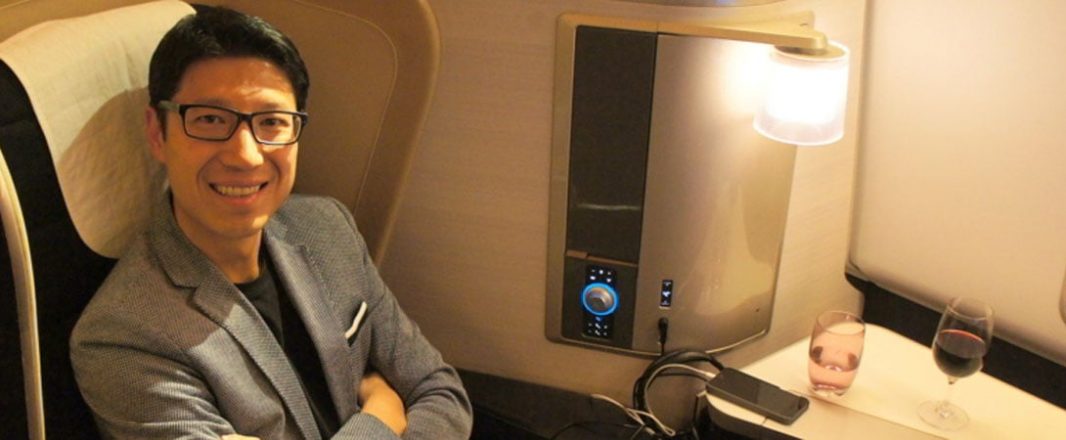

And being a financial planner, he started to think about all those lost frequent flyer points as assets that could be managed in particular for individuals and SMEs.
Thus was the born the idea of iFLYflat, a financial planning service he started 20 months ago, and which has gone on to make him cover boy of In The Black magazine as one of the Young Business Leaders of Australia this year.
“As an accountant, I always felt comfortable with numbers and dollars, and to me it always made sense to maximise the potential value of something. This was the trigger which led me to start iFLYflat, in order to help everyone to optimise their points to get more value out of them and to use them to experience something with wow factor, such as flying First or Business class.
“These are brilliant flying experiences which most people are not willing or cannot afford to fly if they were paying full price, but it is totally achievable with a structured plan.”
Since it started, it’s claimed to have redeemed more than 7 million points and saved more than A$1 million for its members, who are mainly individuals and SMEs in Australia (Sydney, Melbourne and Brisbane), although it now has customers in Asia, namely Singapore and Hong Kong.
“SMEs spend more money on running their business – they accumulate a lot of credit card points. We also get to talk to the owner directly and the owner sees the benefits right away,” said Hui. Typically too, SMEs travel more than corporate executives – 4-5 times a year compared to twice a year for salaried employees.
What might Etihad’s The Residence cost in points?

Personally, he said that he has been able to fly first and business class on international flights on points alone – that’s 4-5 trips a year.
“If you’re flying Sydney to Los Angeles, Virgin Australia is good – lots of seats available. To Europe, Emirates is a great product. Singapore Airlines, lately, it hasn’t had as many seats as it had in the past but their business class flights are pretty cheap – 46,000 points one way – but fuel taxes are higher. Qantas charges the most points.
“For example, Sydney to London, one-way flying first class on Singapore is only 112,625 KrisFlyer miles while Qantas is more expensive at 192,000 frequent flyer points for the same journey flying first class.”
And he calculates that if Etihad made its new product The Residence available on points, an Abu Dhabi-London return (costing US$42,000 each way) would cost an estimated 2 million points.
iFLYflat offers three membership plans and typically they cover a 12-month period. “We come up with a strategy to understand your business, determine which frequent flyer programme works for you and then work on a plan to book the flights. We look at opportunities to spend money and earn points.”
“In Singapore, people just want to go somewhere, they don’t really care where”
It’s a model, he believes, that can work globally. “No one helps people manage points. It’s a question of finding the right people who have the right skills and we can use the same back office to find flights and book them. But our priority is to build the brand first in Australia, then we will expand.”
However having dipped his toes into the Singapore market four months ago, he’s learnt that “there people travel a lot and they just want to go somewhere, they don’t really care where and they want us to help them. So a tech model that finds flights somewhere for the points they have would be good – like mystery flights.”
He is intrigued with the psychology of loyalty. “Loyalty programmes should be an enhancement for customers, yet companies see it as a cost and they are cutting back on that. It should be a competitive advantage to get people to try your product.”
He himself belongs to 15 loyalty programmes because “I want to try them all”. If there is one he’s loyal to, it’s his American Express credit card – you can earn and burn points easily.
.jpg) “Finding ways to save money to enjoy life more”
“Finding ways to save money to enjoy life more”
Recognised as one of the top 20 Young Business Leaders in Australia by In The Black magazine (left, Hui is on right) has been a boon. This is Hui’s second start-up, his first was giving advice to people on how to help save money buying consumer electronics.
“My inherent value is to find ways to save money to enjoy life more,” he said.
“Working as an entrepreneur, I meet so many interesting people and you can learn from them and understand their business. There are so many ways to make money – you just got to do what you do well.”
Stepping out from Macquarie was easy. “I’d been there for 10 years 9 months and it was time for me to leave. I also engineered a redundancy so it was win-win. I got a nice package and took six months off.”
It wasn’t a smooth take-off for iFLYflat of course. “Coming from an accounting mindset to sales and marketing was a leap. Accounting tells the whole story, all facts and figures, in sales, you need just a hook and tell people enough to excite them. People get bored if you tell them too much. So explaining something fairly complex in simple terms was hard – people have short attention span.
“The turning point happened six months after we started. I realized then people don’t really care what you are doing but what you can do for them. So my pitch became, if you have got points, I can get business flights for you.”