
They are not your usual travel tech startups. First, they are hardly in the first blush of youth. They had successful corporate careers in blue chip companies in Singapore before they took the plunge into their first travel startup in 2014.
Second, their office is not in some cool co-working space or gentrified shophouse but in an industrial estate which is more home to auto repairs than to building travel dreams. Third, when you speak to them, their vocabulary is more of “giving back” or “doing good” than of “hyper growth” and “profits”.
Make no mistake though, the team behind WEGOGO, the company that built its tours & activities business on the WeChat platform, targeting Chinese consumers, and is now planning an ICO to become the world’s “first travel blockchain for aspirational travel in Asia”, is not doing it all for happiness or charity.
They say they are in it to build a solid business and generate profits for their stakeholders but there’s an underlying bigger purpose to what they want to build. They want to empower the long tail in travel, to give the small, independent operators of tours & activities an equal and fighting chance to take part in the bounty of the massive travel market.
But first let’s start at the beginning, like all good stories should do.
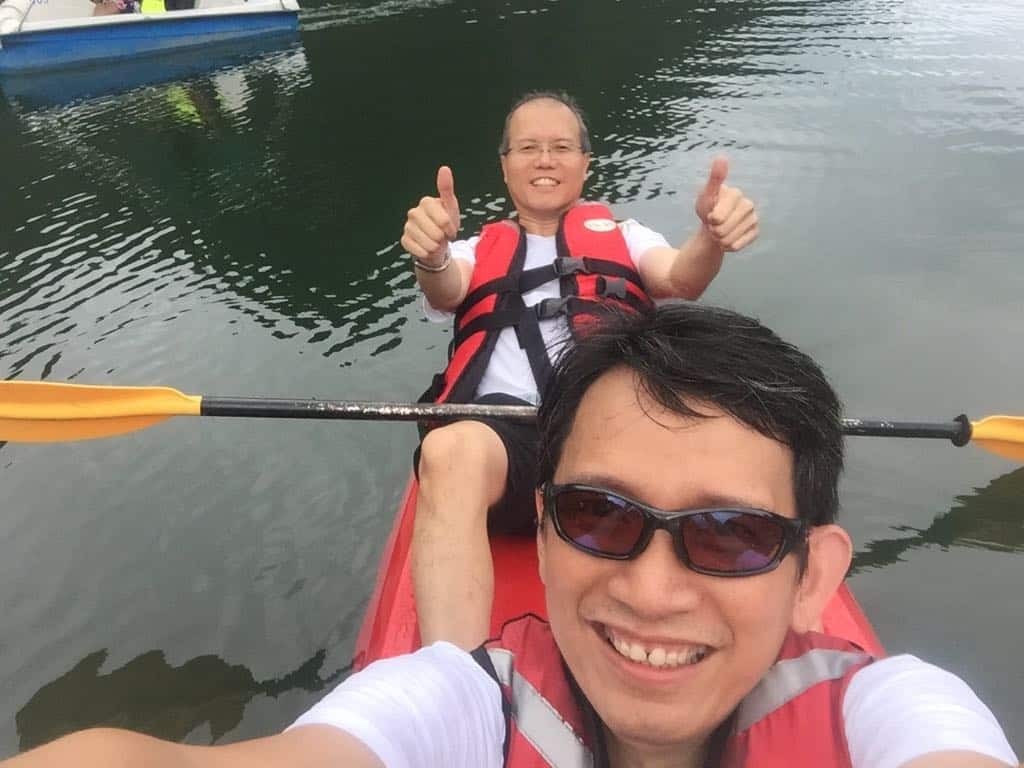
Co-founders Mak Chee Wah and Richard Tan (foreground) on one of their scouting trips to find tours & activities to sell on their platform. “How nice if activities such as these could be made available to other people?”
Wegogo CEO and one of the three co-founders, Mak Chee Wah, who built his corporate credentials with telco giant Singtel, was having a holiday in Langkawi, Malaysia, in April 2014 when he bought a jetski trip.
He thought it’d be a half-hour coastal ride but it turned out to be a 3.5 hour-ride across islands, and lakes and he saw amazing rock formations and took part in the feeding of sea eagles. Then he got to ride the jetski as fast as he could.
“How nice,” he thought, “if activities such as these could be made available to other people?”
The first seed was planted. The second seed was sowed when he went on a business trip to China, saw the latest technology innovations happening there and visited Alibaba’s headquarters in Hangzhou. He started networking with entrepreneurs from all kinds of businesses and started asking the question, as people do when they get to a certain point in corporate life, “what should I be doing next?”
“Something hit me and I said, I should be doing travel,” he recalled.
He returned to Singapore, called up an old friend, Richard Tan, who was employee No 5 for Dell and knew all about building regional networks and distribution in markets such as ASEAN, South Asia and North Asia. He told Tan about his plan for a travel startup and Tan came onboard as COO to drive business development.
A third founder was needed to handle finance and they roped in Yue Yew Hoong, who was the co-founder of Melioris, a business process management company servicing IT companies such as Hewlett Packard. Yue was also corporate strategy manager with SilkRoute Holdings, Singapore’s first Internet company.
They decided to focus on the WeChat platform. “If we did Facebook or Instagram, we would not be able to reach Chinese consumers and I knew the WeChat platform well. It’s a trusted network and a good platform for sharing. Our idea was to connect Chinese travelers with South-east Asia experiences,” said Mak.
They raised angel funding and the business was launched October 2014. “We went to destinations to assemble products and partners. We had to find the right engineers to build the product – they were not available in Singapore and we went to Shanghai to source talent,” he added. It now operates a wholly-owned subsidiary in Shanghai which looks after product development and customer service.
Solving instant availability and marketing by themes
“There was a lot of skepticism over whether we, not being Chinese, could do it – that was the biggest challenge. The easiest part was bringing suppliers onboard – all were very happy, all were trying to reach the Chinese,” said Mak.
To help them with outreach in China, they roped in Singaporean entrepreneur Reene Ho-Phang and her China-based agency, Brand Story, which specialises in helping companies win Chinese travellers.
Getting activities on the platform was one thing though, getting instant availability is another – and that’s the piece every tour & activity startup wants to crack.
“We are working on solving instant availability. We can now confirm and accept payment through WeChat Pay,” said Mak. About 15-20% of bookings come direct through its platform.
Of its 400 activities listed, 30-40% are attractions – the low hanging fruit offered by all startups in this sector – so clearly Wegogo knows it needs to differentiate. While it wants “authentic, local, off the beaten path, aspirational and environmentally-sensitive” activities on its platform, the reality is it has to offer what sells.
One thing it is doing to differentiate is to market the activities by themes – so for example, Island Fever covers the top 10 islands in South-east Asia. And as it builds up its Pathfinder model – its strategy for finding and rewarding scouts to hunt down local experiences through blockchain technology – it hopes to go broader as well as deeper with themes such as City Tales and Mountain High. It hopes to have 16,000 activities listed by 2020.
Mak said the plan is to expand to target customers in South-east Asia but for now, it wants to remain laser-focused on Chinese customers and WeChat. In the first quarter of this year, it closed a pre Series A funding round of S$2.68m.
Said Mak, “Our priority is to execute on our Pathfinders. The platform has been built. We have 4,000 Chinese customers using our system to book 400 activities and have generated 5,000 bookings. That’s a solid base on which to build.”
Scaling the unscalable with peer-to-peer, blockchain and token currencies
The challenge now is to “scale the unscalable”, as chairman Wong Toon King puts it – and this is where peer-to-peer, public blockchain and token currencies come together to create what he believes are the platforms of the future.
Wong is the fourth dot to be connected in the Wegogo story. Regarded as Singapore’s first Internet tycoon, Wong, who was with Singapore’s National Computer Board, founded SilkRoute Ventures in 1994. After selling SilkRoute, Wong brought in the Ben & Jerry’s franchise to Singapore and ran it for 10 years before selling it in 2016. At age 50, Wong has started a VC fund, FarSight Capital, to invest in companies with a bigger purpose beyond economics.
He had been thinking about how to use his experience and resources and turn this Internet 3.0 moment – the promise of blockchain and a decentralised and more democratic economy – into a force for good when the Wegogo team approached him.
“As we move into the gig economy, the best people will no longer work for companies but platforms which recognise and reward them. This is the next level in recognition and reward. When I saw what blockchain could do in a public network and build a currency, I realised the time has come – platforms that don’t build networks that reward people will find it hard to get traction,” said Wong.
“Internet 3.0 gives us the opportunity to adopt a more disruptive model in which everyone in the longtail can participate.”
Wegogo hopes to raise $88m through an ICO to execute on its vision.
Tech has so far created inequality, could blockchain produce a fairer share economy?

Wong: “This notion is going to be challenged in Internet 3.0 – blockchain can decentralise the representation of value.”
As a techie who turned to ice cream and is now turning his sights back on tech, Wong sees it as an exciting moment in tech. He confesses to having been disheartened by how the tech sector has created a form of super capitalism in which only a handful of people have gotten very rich in a short time.
He questions, “If networks are valuable and each node is exponential, why is it that only the big companies are taking the bounty? All of us have ended up working for companies like Google and Facebook.
“This notion is going to be challenged in Internet 3.0 – blockchain can decentralise the representation of value.”
He argues that business models will not be sustainable with a winner-take-all approach. Advocating a fair share approach, he said, “Yes, we have the sharing economy now but it’s not fair. Blockchain could allow us to build a fair share economy on a larger scale.”
Wong and his team know it’s a big idea which is at the moment just a promise. No one knows how the blockchain promise will pan out “but someone has to put their hand up and make a go of it”, said Wong.
There are sceptics who say that Wong and his team of former corporate citizens are hardly the rebels you expect to disrupt the status quo. Plus, they are clearly investor-savvy to know how to tick all the right boxes as far as fund-raising goes – China, WeChat, tours & activities and now, blockchain.
Add to that, the fact that they are outsiders to travel as well as outsiders trying to build a business in China, and you could say the odds are rather stacked against them.
But, as we know, history is littered with stories of the unlikely and only time will tell if the Wegogo story will have a happy ending and and the long tail will remain wagging happily ever after.
• Featured image (Langkawi’s Isle of the Pregnant Maiden) credit: Donyanedomam/iStock-Getty Images