The toughest endurance race Sean Menke, Sabre president & CEO, has ever run is the Leadville Trail 100, a 100-mile race in the Rocky Mountains of Colorado, which you have to be complete in 30 hours. It has an elevation gain of 5,000 metres and you do it without oxygen and sleep.
He completed it.
“I have always enjoyed challenges. I do draw parallels between aspirational things in nature and how far you can push limits in both personal and business life. Often, people can do more than they think,” he said in an interview on the sidelines of the first Sabre Travel Exchange in Singapore last week.

A 100-mile race in the Rocky Mountains of Colorado (Image credit: Leadville Trail 100)
He’s certainly pushing the limits at Sabre. Since becoming CEO over two years ago, Menke has made sweeping changes at the Dallas-based GDS. He cut 10% of the workforce, brought in new tech-heavy leadership, restructured the organisation to break down the silos, and is championing an industry collaborative effort to bring different verticals together to discuss common issues facing the industry.
He sees it as running three endurance races at the same time – the external race to get alignment between different industry verticals and the two internal races to achieve tech and cultural transformation to shape a new Sabre.
He does not expect people to be endurance athletes like him but he expects them to be curious and step outside their comfort zone. “If you’re not looking at trends, you atrophy. If you don’t morph, you die.”
His vision is clear – Sabre wants to morph to become the platform at the centre of the business of travel.
Thus far, the numbers are on his side. In Sabre’s second quarter 2018 earnings, revenue grew by 9.3%, and net income attributable to common stockholders increased to US$92.2 million while operating income increased to US$138.8 million. Sabre generated US$3.6 billion in revenue in 2017.
“The airline ticket is the golden nugget”
Menke, who comes with airline operations experience, is aware of the need for change within Sabre, given that it was founded in 1960. “We are at a very pivotal point in the industry – there are lots of individuals who know the business from 10-15 years ago, and are operating in that mindset. If you look at what tech can enable, you have to make tough decisions on how to operate the business.
“What is unique about airlines is that they are not independent companies that stand alone, you have interline, code share, joint ventures so any tech change impacts the entire value chain. That’s where we are in the industry, we need some risk taking to transform.”
On the external side, he’s formed the Beyond NDC grouping and has brought American Airlines, Carlson Wagonlit, American Express and Flight Centre to the table.
“If we are essentially developing the platform, can we become the hub of all that can be served up? Can we make it easier to sell? All selling doesn’t have to be done at the point of transaction.’
“When I was CCO of Air Canada and we were pulling Sabre content, I learnt a lot of valuable lessons – the strength of the GDS business, the ability to go out and put one city pair and shop multiple airlines, it’s amazing and it has to evolve so we can sell additional products.
“I have always believed in the airline ticket – it’s the golden nugget that sits at the centre of travel.”
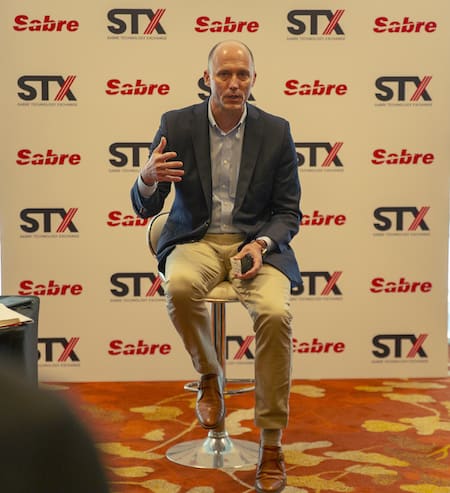
Sean Menke: “If we do it right, we can help the industry migrate. If we don’t, we actually have a business model that works right now. It’s about the willingness to take risks on change.”
“The GDS advantage in becoming the platform at the centre of travel”
He is aware that there are other players vying to become the platform at the centre of travel – companies such as Airbnb, or Google, or Expedia, to name a few.
But Menke believes the GDS has an advantage. “There is no one doing it at the scope that we are. From a commercial perspective, we have the capability of selling products and services through this platform. We have systems that manage airlines and hotels – why can’t we make sure they are interconnected? If a flight is delayed, why can’t it go down the line to hotels? If we have the systems, why don’t we improve the traveller experience?
“We have the advantage because of the operations – I don’t think people understand that.”
It’s investing US$1b in tech and he feels it’s enough to compete with the tech giants. “It’s a question of how much can you spend and get things done. You don’t want to waste dollars too and you have to do it at the pace of change that customers want.
“GDSes have been painted into a specific box. Our approach is to provide an alternative on how the company can transform – airlines will have to make decisions on where they want to go, some may not be ready to do that. If we do it right, we can help the industry migrate. If we don’t, we actually have a business model that works right now. It’s about the willingness to take risks on change.”
He said he was optimistic about the industry’s readiness to change. “I am finding a real willingness to get together and talk about issues at a higher level than before.”
“Tech and culture transformation the hardest thing to do”
Internally, to force change, he’s brought in technologists to the leadership team but is aware of the need to cascade digital literacy through the organisation. “That’s also cultural in nature and that’s the hardest thing to do, building trust with the employees.”
In Singapore, during the Town Hall, he spoke about how trust is a two-way street. “Our executive management team, all have less than three years with the company, so there are a lot of individuals without the history of Sabre so we have to have a clear understanding of what we are trying to achieve.”
He is aware that in Asia, Sabre probably has to do more to build trust with its employees in the region. It’s been three years since it acquired Abacus and even though Menke came in after the acquisition, he is mindful of the lessons to be learnt post-acquisition.
“There were joint ventures between Abacus and each of the airlines and how that facilitated business, I do believe more could have been done about that. On the other hand, any acquisition is tough. Asia is more unique than any other part of the world and business is done very differently. We need to understand those nuances better.”
With Asia the fastest growing market for the corporation, Menke said Sabre would be increasing subject matter experts’ presence and by co-locating product management and product development together in Bangalore, it would be easier to get product managers in front of customers.
When asked which was the toughest endurance race he’s ever had to run as a business, he cited his stint at Frontier Airlines. “It was in 2007, there was the financial crisis, oil prices were rising, I had to do a financial restructure and went through Chapter 11. It was financially falling apart, that was difficult.”
And if the endurance race at Sabre is a 100-mile race, he said, “We are currently at Mile 20.”
Here’s to the next 80.