In mid-2017 one of the biggest news that hit the world of online travel was Expedia Group investing US$350 million in Indonesian OTA Traveloka, making it South-east Asia’s first travel unicorn.
Greg Schulze, senior vice president, commercial strategy and services, Expedia Group, said then, “We’re excited to partner with and learn from Traveloka, which has made significant strides in the region. Our investment in Traveloka is complementary to our organic growth plans in the region …”
At last week’s WiT Singapore 2018 the two companies came together to share the lessons they have learnt from each other and the collaborative potential of this West-meet-East union, one from the US and one from Indonesia, leveraging on complementary strengths of global scale and local power for mutual growth.
For six-year-old Traveloka, the key of having a investor like Expedia is tapping the latter’s 20-odd year’s experience in the travel industry.
“It helps that Expedia has all this experience, but we do keep in mind that the context of South-east Asia is very different and what we’re trying to do is perhaps different from what Expedia has accomplished,” commented Henry Hendrawan, Traveloka’s group CFO.
There are, however. areas that Expedia does better than Traveloka: “Scaling and attention to areas that max its operations, its well-oiled machine delivering customer service in multi countries in a cost-efficient and effective way,” he said.

Sharing a light moment (from left) WiT’s Yeoh Siew Hoon, Expedia’s Greg Schulze, Traveloka’s Henry Hendrawan (Image credit: Shoot My Travel)
On what the Indonesian company does better, Schulze listed “an incredible team, engineering technical talent, and deep experience and knowledge of South-east Asian market” that it admits it is lacking.
“It builds products for local customers and builds a business round it. Lots of startups and tech companies want to be the Expedia of this or that, but Traveloka never thought like that, it just wants to build great products for their customers,” he added.
That perhaps explains the company’s rapid growth – expanding to neighbouring countries like Malaysia, the Philippines and Thailand and adding other services on top of travel like restaurants, spas and payments.
So is Traveloka’s goal to be a super app?
Said Hendrawan, “Not sure I am a believer in the concept of a super app, but we do believe this – that many consumers need to discover the world around them but the discovery process and the need process evolved around a certain theme – travel and lifestyle and we want to build our service and products around them, and not be a super app where we try to include every kind of products and services.”
One of the factors behind the Indonesian company’s success is its ability to tackle payments at a local level and across borders. It is now working on another innovation to help boost travel among local Indonesians – consumer loans.
Explained Hendrawan on the move: “People ask why would a travel company offer consumer loan product? Again it’s looking at the consumer lens and whether there’s a need from the consumer point of view. In Indonesia the credit card penetration is very low, only 12–13 million credit cards. We also look at the booking behaviour – a lot of the travel behaviour is last minute caused by people not having working credit or access to credit to enable them to book earlier, and this is what we’re trying to solve (with loans).”

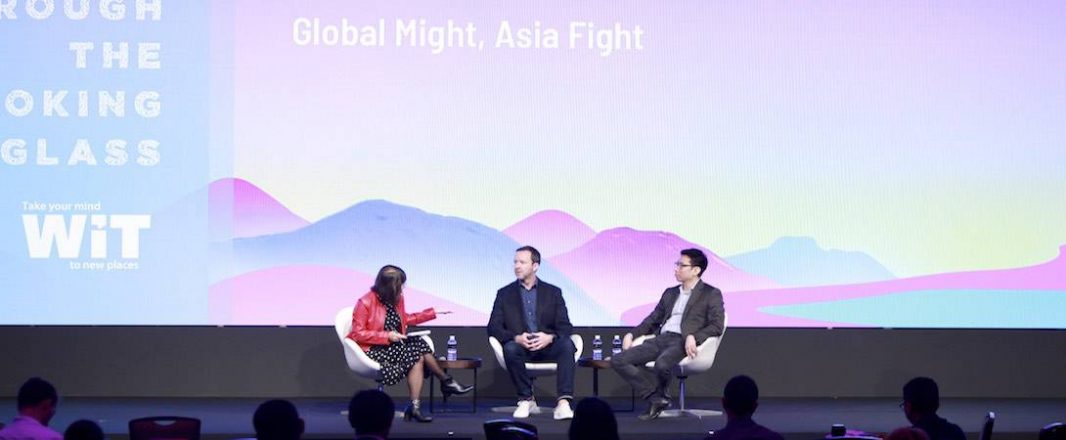
Global might Expedia’s Greg Schulze (left) and local power Traveloka’s Henry Hendrawan (Image credit: Shoot My Travel)
On expansion internationally, Hendrawan said it is important for a travel company to go beyond its shores because of access to global inventory.
“Whether you can be locally relevant on a global basis is not only a multi-bllion question but is a multi-trillion question because to be truly locally relevant on a global basis you must conquer the world.”
He said the company is locally relevant in the markets it has expanded to: “We’ll be expanding what we’re doing in Indonesia to other countries. In a way what we’re doing in Indonesia is probably the foster child of what we’re doing in other countries,”
Schulze feels that it is better for startups to stay on home turf and dig deeper instead of spreading their wings globally
“It’s always a trade-off decision there and each company has to decide for themselves whether access to the global inventory is manageable through partnerships or deals,” adding that even for Expedia it is a trade-off expanding in 90 countries and it faces challenges in countries like Indonesia because it lacks things such as payments.
He, however, added that the company is happy with the investment in Traveloka and will continue to invest “aggressively ourselves” in South-east Asia.
How does Expedia see Traveloka helping both companies grow exponentially?
Hendrawan’s response: “Not exponentially enough maybe.”
Schulze agreed: “Not yet. But it does help the Expedia team headquartered in the US and Europe think more of what’s happening in Asia and understand it better.”
What are the markets the two companies are most interested in for the next 12 months:
Hendrawan: “South-east Asia and Indonesia (being part of South-east Asia) geographically. The way we define the market may be different from the way Expedia defines what the market is in terms of categories, products and services.”
Schulze: “Asia is a big focus for the group. We’re also interested in Latin America as it has lots of potential there and has some amazing destinations; emerging market will be our focus.”