
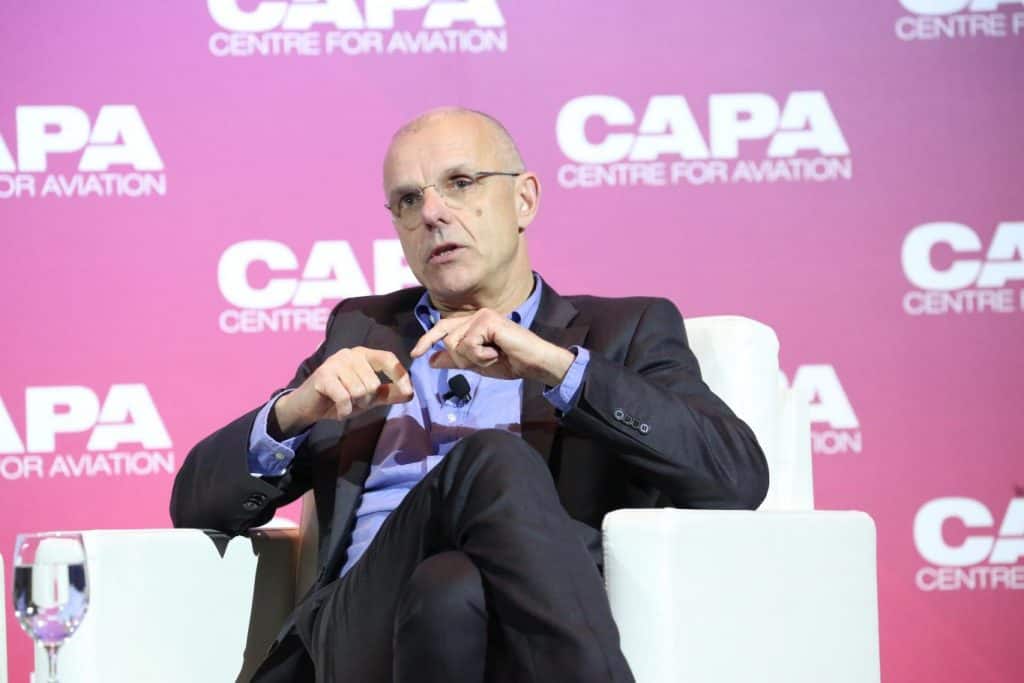
At the CAPA Global LCC Summit held in Singapore recently, a panel of experts offered a primer on NDC (New Distribution Capability). Specifically, the panel discussed how the NDC API has the potential to transform digital distribution for air travel.
To offer a brief overview, the NDC Program refers to an initiative launched by IATA, to develop a new “XML-based data transmission standard” (or the “NDC Standard”) that will set the basis for how air products are retailed to consumers, by virtue of how they are distributed.
According to IATA, current distribution limitations to be addressed by NDC include: product differentiation and time-to-market, access to full and rich air content and developing a more transparent shopping experience.
Currently, airline content and airline products come from different and inconsistent sources. The vast majority of product transactions happen through legacy information transmission systems where the form and structure of messages – EDIFACT – largely constrain the contained information.
The NDC Program aims to streamline airlines’ distribution channels (sending fares, schedule and availability information), so that it can offer third parties with the same rich content as it does on its direct channels. That way, the airline is in more control of the offer, it can push out rich content and is faster at pushing new products out to distribution partners.
IATA’s vision is to have at least 21 NDC Leaderboard Airlines committed to transacting at least 20% of their third party sales via an IATA NDC API by end 2020.
“Those 21 airlines represent a significant proportion of the airline industry, but a multiplicity of different business models and geographies, offering a really good cross-section of the industry,” said Damian Hickey (Global Head of Air, Travelport) at the CAPA Global LCC Summit.
Beyond the 21 airlines that made this declared commitment, there are at least 54 airlines that are already NDC-certified. The point being, according to Hickey, NDC is no longer a buzzword but “it’s happening now”.

Is NDC the holy grail of airline distribution?
Naturally, the promise of new technology and unlocking revenue potential has marked NDC as a sort of ‘holy grail’ for traditional airlines that have struggled to evolve digitally, as compared to LCCs.
On a more practical level, IATA is aiming to modernise airline distribution technology and set a new norm so that airlines will be better placed to regard advancing technology as attainable developments rather than disruptions.
In its earlier stages, Hickey made the case that NDC was largely seen as an airline initiative rather than what is more accurately an industry initiative. Now, the travel agency community has become more engaged and understood that for the programme to be successful, it must go across all players, not just airlines.
Martin Warner (Principal, MW Travel Consultancy) concurred, “NDC brought an acceleration of change and capability in a digital world. No matter how it started out, it’s brought a significant number of new players.”
Sanghamitra Bose (General Manager Singapore & Thailand, American Express Global Business Travel) expressed her excitement about NDC and what it would enable for business travel. However, for a TMC, the NDC Standard would need to be clear on how it delivers a better solution than the traditional GDS.
“We apply five principles [to our business]… an accessible point of sale, it has to be cost efficient, not impact service quality negatively, boost value for the customer and driver the customer experience. In that, NDC-enabled or not, our distribution channel of choice would be the GDS because that’s the platform where you can aggregate that content,” said Bose. “We want the content but in a unified manner.”
NDC’s key promise of streamlining and enabling the delivery of richer content will grease many of the friction points airlines have when communicating their availability, fares and schedules to distribution partners. More efficient communication will hopefully allow airlines to flex greater sales capability and test new commercial models that will ultimately improve their bottom line.
In summary, NDC is largely touted as a way for FSCs to gain the same sales agility and capabilities as LCCs. Admittedly, it will take some time for the new API to be widely adopted as the new norm.
Its benefits are believed to include:
- Greater control over airlines’ respective content, fares, offers and ancillaries to indirect channels
- Improved sales capability, in terms of how airlines merchandise their own products, helping airlines to compete more dynamically
- Flexibility to experiment with different commercial models that yield the greatest returns
- Greater independence and freedom interacting with different partners
- An opportunity for greater innovation
LCCs should pay attention, here’s why
On a structural level, XML-based API connectivity is not exactly new technology. GDSs distribute low cost carriers using the same type of connectivity; meaning IATA’s NDC standard may not directly apply to their business. Though that isn’t to say LCCs shouldn’t pay attention.
Pushing legacy airlines to adopt the same technology standards as LCCs means “it will allow them to compete on a more level playing field with low cost carriers,” argued Hickey.
Yanik Hoyles, director, Industry Distribution Programs, IATA, stated that the key reason is that the convergence of FSC and LCC models over time will only be reinforce that. “NDC is to provide legacy carriers with that [same] API agility, simple as that.”
LCCs therefore need to consider what their competitive edge is and whether it needs to be re-evaluated as traditional airlines catch up – for example whether air fares will become increasingly commoditised as airlines compete on price or cost-effectiveness.
But should an LCC see any value in the NDC for itself?
“As NDC becomes mainstream, it could be a much more cost-effective way for LCCs to deploy their own API capability,” said Hoyles. By setting a fix standard, it will hopefully reduce the price of the technology.
Furthermore, Warner argued, “there is an opportunity in this distribution segment for LCCs to respond to FSCs playing in their sandpit…and think about how they can more efficiently deploy sales through travel agents.”
While LCCs and travel agents have traditionally worked closely together, Warner believes that an efficient use of NDC could drive that percentage and overall volume up.
The more obvious benefit is inter-lining – a pain point that has plagued travellers trying to make flight connections between multiple carriers for years. IATA’s grand ambition would be to make inter-lining between FSCs and LCCs more achievable through an NDC API as that same information can be streamlined through a single source.
Hoyles argued that the biggest challenge for inter-lining is that LCCs are ticketless while airlines have PNRs (what you reserve) and tickets (what you pay for) – two necessary bits of information that are kept separate based on current distribution architecture.
“When our industry puts tickets and PNRs into a single order, that would make inter-lining with low-cost much more customer-friendly and much more cost-effective because it would be simpler,” argued Hoyles.
By having a single distribution standard, communication would be more efficient and cheaper to process.
However, the NDC Standard would only be a first step. There are currently too many inconsistencies between players that make interoperability very difficult; making seamless inter-lining is a deceptively simple goal that cannot be solved with a new NDC Standard.

Will the new standard overcome old systems?
New technology often brings promise of innovation, fresh approaches to old problems and new methods of practice. That promise is futile unless airline companies can practically apply the technology to their businesses properly.
A new standard does not guarantee that airlines will change the way transactions are managed and whether their back-end systems are capable of creating content-rich offers too. The back-end systems that still rely on legacy technology are not well designed enough to handle the complex offers being given to consumers on the front-end. Advancing this technology would require heavy investment from all players in order to really make it work.
Nevertheless, Hoyles claimed that “you can see that airlines are investing in something that is more about incremental revenue, instead of cost-saving, which is a new behaviour.”
Warner, citing British Airways as an example said, “the incremental changes in prices are in much shorter, narrower steps, which will help [the end traveller]. Having [multiple] potential price points has got to be a win for the airline.”
Training companies – airlines, travel agents and TMCs – to use an NDC API optimally will be crucial for it to be successful, said Bose. “You can have all the content coming in, but how are you enabling travel agents to sell that?”
“We are actually building our own supply management platform where we aggregate the content, then deliver it at every point of sale and make it easy for the agent to access it, sell it and so on.”
Hoyles agreed saying, “one of the challenges airlines still have today is for their sales force to be educated enough to be able to explain to a TMC what the new value proposition and relationship will be.”
Finally, Bose crucially warned that airlines and agents must ensure that travellers also get the right experience when booking. If the API allows airlines to introduce more content and provide more options, it may over-complicate the booking experience at the detriment of the customer.
Thus, there is actually opportunity for startups to develop more sophisticated online booking tools that can provide travellers and agents with a breadth of airline content, displayed in a comprehensible and non-confusing way. A business capable of building a system that can create and manage offers in the sales process could come out on top.
Ultimately, IATA’s NDC Standard is a strong display of initiative by the air travel industry to address the pressing need to overhaul much of the legacy technology that continues to hinder airlines’ digital capabilities. Whether NDC is the ultimate solution is still up for debate, as much more needs to change before airlines can truly pick up the pace.