Making a quick exit from Berlin – can’t help but think how ironic I just attended the world’s largest travel trade fair where there was a lot of talk about technology and how that’s changing travel but there’s not much evidence of that in real life.
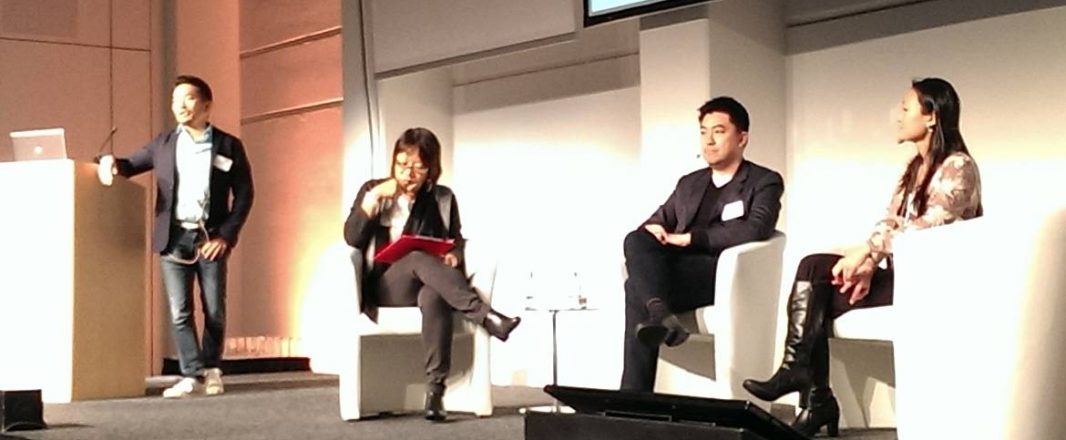
Pictured above (L-R): Kei Shibata, Yeoh Siew Hoon, Morris Sim, Lily Cheng
Check-out at hotel was manual. The automatic check-in machines don’t work for my international e-ticket. There is no free wifi at Tegel airport.
Oh well … talk is one thing, real life is another.
At the ITB Asia session run by yours truly, we talked of trends to watch and heed in Asia – given that it is projected that there will be one billion travellers from Asia by 2030, 60% of whom is expected to come from China, I guess there is some interest in our region from suppliers in Europe.
 She also spoke of how demand was coming from all over China from over 60 different cities. “Counter to popular belief, less than 30% of the outbound travel demand comes from the top four famous metropolitan cities in China: Shanghai, Beijing, Guangzhou and Shenzhen.
“Outbound travellers are coming from all over China. To reach 70% of the demand, you need to cover 60 cities all over the country – there are Implications on how to efficiently reach and serve this valuable segment.”
She also gave advice on how to get Chinese visitors to trade up and the three biggest categories are hotel, restaurants and Shopping. She shared the datapoint that 25% of the world’s luxury travel goods are bought by mainland Chinese, 60% of which is bought when they are travelling.
“As Chinese travellers gain more wealth and travel experience, they are increasingly willing to spend more on accommodation and seeing it as a valuable part of the travel experience (and not just to save money.”
As for what Chinese travellers are looking for in hotels and restaurants, their needs do not appear that much different from other travellers – with wifi being a key requirement and a kettle in the room. Restaurants should also look at using pictures over words for their menus, she advised.
Kei Shibata, CEO, Venture Republic (pictured below right), Japan came with three clear messages.
1. Mobile dominates Asia
While Google search queries for travel related keywords on smartphones was only 18.6% in Germany, the corresponding figures for Indonesia and Japan were 30% and 55.2% respectively.
.gif) He showed data from Google Japan which showed Asian markets consistently ahead in Google search queries for travel related keywords by devices and in growth in smartphone queries – which China, Japan and Korea leading the pack.
He showed data from Google Japan which showed Asian markets consistently ahead in Google search queries for travel related keywords by devices and in growth in smartphone queries – which China, Japan and Korea leading the pack.
On his two meta search sites, travel.jp and hotel.jp, 40% of all traffic was coming through smartphones.
2.Legacy in Asia still rules
Despite the increased adoption of online travel in the region, packages and traditional travel agents still prevail due to the complicated distribution systems in markets such as Japan.
Of top 20 travel agencies in Japan by gross sales volume in 2012, only three were online plays with Recruit coming in at fifth position, Rakuten Travel at seventh and JTB at 15th. The top four remain JTB, Hankyu Travel, NTA and HIS.
And tour packages still command 39% of the overseas trips market compared with 55% for individually arranged trips and 6% large scale corporate tours, according to data from the Japan Association of Travel Agents.
On his two meta-search sites, packages formed 57% of lead generations compared with 23% for flights and 21% for hotels.
3. Diversified customers in Asia
He said that Asia comprised a wide spectrum of customers – from ageing travellers in Japan, Korea and China to young travelers in Indonesia, Vietnam. And the women-only group travel was a growing segment in Japan.
.gif) Morris Sim, CEO of Circos Brand Karma (pictured left), spoke of Instagen – the ‘Instagrammable’ generation, the generation of people who instantly share content at all times. This generation is not defined by age or gender but by behaviour. He said suppliers should look at creating “Instagrammable” moments in their customer experiences and facilitate this desire to share.
Morris Sim, CEO of Circos Brand Karma (pictured left), spoke of Instagen – the ‘Instagrammable’ generation, the generation of people who instantly share content at all times. This generation is not defined by age or gender but by behaviour. He said suppliers should look at creating “Instagrammable” moments in their customer experiences and facilitate this desire to share.
Each generation of devices was creating more data – and the first generation wearable devices are here. This creation of big data was creating opportunities for geek entrepreneurs, niche businesses and deeply local plays.
And this trend is exacerbated by the sharing economy which he said was potentially the biggest disruptor to the travel industry.
The rise of Instagram and Snapchat and new innovations such as KickStarter, Airbnb and Uber were enabling individuals to become micro-businesses.
And the biggest sharers are in emerging markets. According to Ipsos, which measured the percentage of respondents indicating they share “everything’ or “most things online”, the top 10 sharers, by order, are Saudi Arabia, India, Indonesia, South Korea, Turkey, China, Poland, South Africa, Italy and Brazil.
In Asia, the rise of Instant Messaging apps was particularly staggering and Facebook’s acquisition of What’sapp was an interesting development to watch as to how that would play out in Asia against WeChat and Line.
Cheng cited an example of budget hotel group 7 Days Inn, which has more than one million members on WeChat and was quoted in a newspaper as saying it sells 10,000 rooms a day on the platform.
Cheng said that WeChat was becoming its own mobile eco-system offering payment options and that could completely change e-commerce in China.