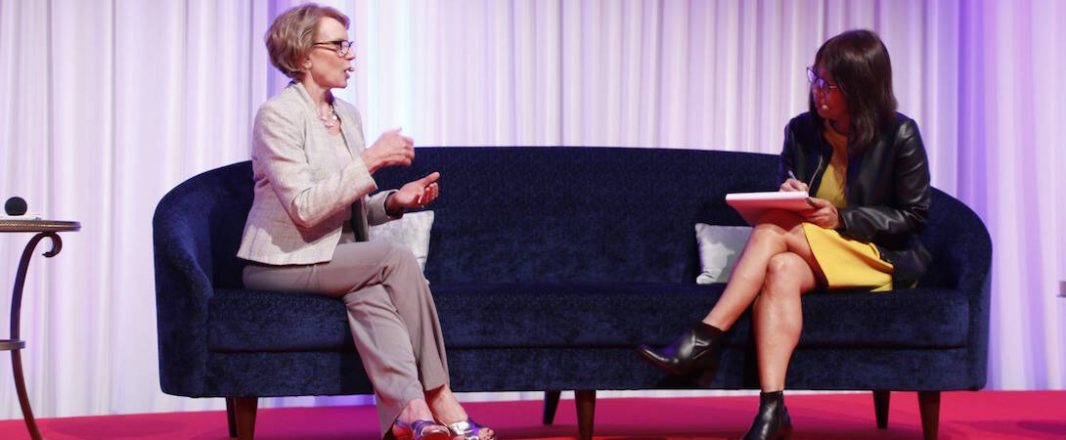
At WiT Japan & North Asia earlier this month, ADARA’s chief marketing officer, Carolyn Corda openly discussed the changing forces in marketing travel brands and how companies can leverage data to better understand their customers.
We are in an age where marketing is driven by data and consumers are more aware than ever about brands’ attempts to interact with them to drive sales. Travel companies are being confronted by the challenge of how they develop personal bonds with customers that transcend the transactional, into something more sustainable and long-term.
“How we personalise interactions for consumers in the next five years will be most interesting,” said Corda.
The biggest common problem faced by travel brands and marketers, says Corda, is the fact that no one has a single, unified view of the customer at any point in time, and understanding what their individual needs and interests are.
Secondly, travel brands are “most familiar with [how customers travel] a customer when they travel with [their] brand, but they get very little visibility, if anything, with what’s happening when they’re travelling with other brands, airlines, hotels or tour operators.”
She was clear about the fact that just like the industry as a whole, travel marketers have a highly fragmented view of the customers they serve – understanding them only in terms of how they interact with their brand directly, rather than how they interact with brands in general.
Thus, travel marketers need a single and expanded view of their customers, so they can understand them more holistically.
“What people tell you they’re going to do is very different from what they actually do”
However, travellers are becoming acutely aware of how a travel brand’s marketing efforts are ultimately intended to help the company drive sales. As a result, consumers are becoming weary of marketing efforts that do not seem to address their changing demands and offer better quality services.
Travel brands must strike a fine balance between being able to communicate the value of their product to consumers clearly, without falling into the trap of becoming another generic sales pitch in the sea of marketing messages that they face everyday.
Marketing is engineering now, explained Corda. CMOs of travel companies need to be able to combine the analytic and scientific component of marketing with the language and art dimension.
“Having empathy for what consumers are going through and understanding what it’s like to get a message that’s irrelevant… it demonstrates that the brand doesn’t really know them.”
Intuitively, blending science with art, marketing with selling and data with empathy is a challenge. Can you really use data to truly understand what customers want?
“The challenge is how well analytics and data predict consumer behaviour… [but] we’re finding more and more, without being creepy, that it can be useful… What people tell you they’re going to do is very different from what they actually do.”
Loyalty programmes lacking in “surprise”
Nevertheless, despite the uniqueness of each customer, there are underlying commonalities that make good marketing easier to achieve at scale.
Corda stated, “The underlying thread is what you consider to be valuable.” She cited the example of how loyalty programmes can be understood in terms of what consumers prioritise – whether it is prestige, convenience, or the benefit of added services.
“It’s all different interpretations of what individuals value,” she explained. However, “one thing that is missing in programmes is surprise’ – today’s loyalty programmes are so regimented… and it hasn’t left enough room for ‘oh I didn’t expect that’.”
Yet according to the report, “Understanding the Secret Lives of Top Tier Travellers” (ADARA), 17% of all top tier air travellers belong to multiple airlines loyalty programmes, and 40% of top tier air travellers searched for more than one brand during the booking process. For hotels, 24% of guests were members of more than one loyalty programme and 51% searched for more than one hotel brand when booking.
Fostering genuine loyalty beyond the schemes and programmes is therefore still an issue, if brands cannot truly connect with their customer base, leaving customers open to booking anything with the best deal.
Corda alluded back to the added services that reinforce individual customers’ relationships with particular brands. “It’s the recipe for making their loyalty more meaningful.”
To do that, owning a relationship with the customer is fundamental as it acts as the foundation upon which travel brands can build a direct connection with the customer.
For hotels, that direct customer is of great value
In the context of hospitality, this is understandably difficult given the power of OTAs over the hotel distribution landscape. While it may be tempting for a small or medium-sized hotel chain to consider yielding their distribution to an OTA, because of the investment needed to run an effective website, Corda warned that it comes at a steep cost of truly understanding its customer base.
“Allowing OTAs to own your distribution really limits your ability to treat that direct bond with your customers… booking direct gives a hotel a lot of advantage in understanding that individual and leveraging post-booking merchandising opportunities.”
Corda recommended implementing a clear strategy about identifying what types of customers are most inclined to return.
“Focus on the ones with the potential to return over and over again,” she said. “Be judicious about which consumers you work to attract to your website and which you nurture all the way to a booking to balance that marketing spend.”