I had my first ART yesterday. I wished I could say this involved me splashing blobs of paint on a blank canvas like Pollock or Picasso; rather it was having cotton buds stuck up my nostrils. Honestly, the Antigen Rapid Test wasn’t as bad as I had feared, it felt more like the tingling you get from overdosing on good wasabi.
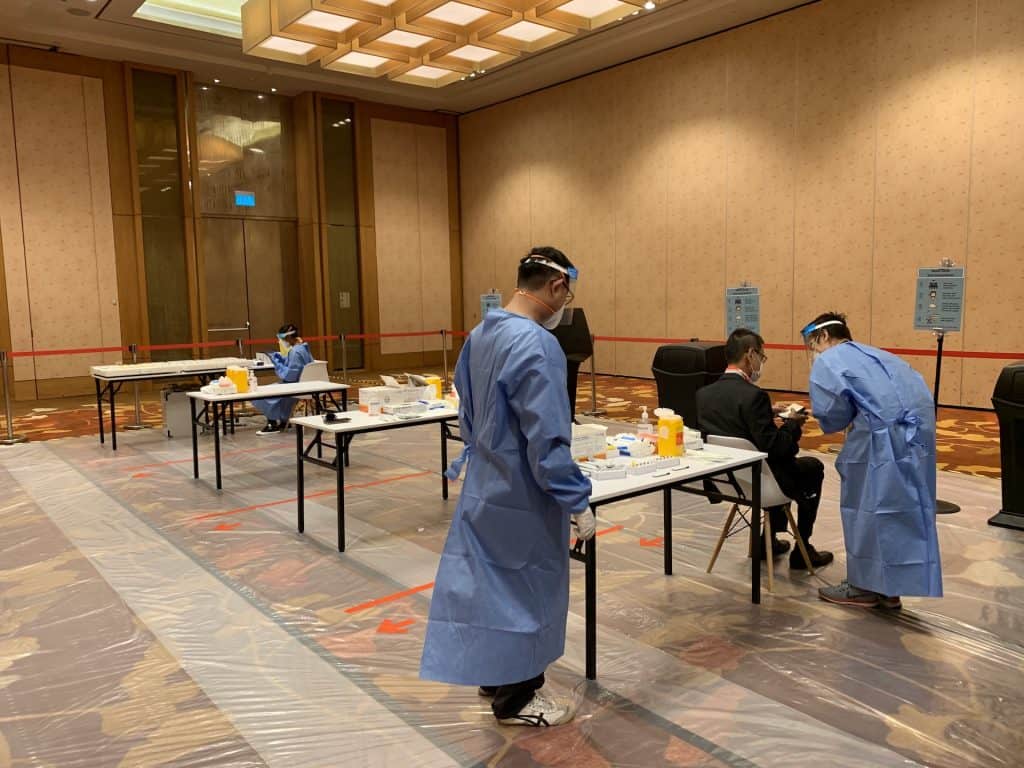
I did ask the tester the “what if” question and he said, “You will be evacuated and taken to hospital.” Thankfully, I tested negative and so was allowed entry into the event I was attending, Singapore’s first hybrid trade show, TravelRevive, on its second day which focused on the conferences and exhibitions industry.
I was curious to experience what an event about events would be like in the new circumstances and this was Singapore’s biggest event since Covid shut us down and thus, the biggest symbolism of the revival of the multi-billion dollar industry on which the fortunes of Singapore, and so many other Asian countries, are reliant.
For those attending physically, it did feel like a revival of spirits – to see bigger crowds together in one space, to say hello to old friends and to have honest conversations about the tough times we’ve all been through together. Through the masks, it was hard to recognize faces but we have now become astute at reading eyes.
In fact, while I was waiting for my result in a holding room in my designated Zone A, I had an interesting conversation with two exhibition professionals – one in cyber security and the other, a mega exhibition organiser – and we bonded instantly.
The cyber security guy was a straight-shooter. He said, “I have tried all the tech platforms. What I can tell you is none of the platforms work and as far as security is concerned, it’s non-existent and this is particularly important when you are running ministerial or high-level security meetings.”
They both shared horror stories of glitches that had happened. One spoke of a time when an exhibitor who had paid for a virtual booth found three unauthorized strangers using the space. That prompted her to work with an events startup to develop a customized business matching platform which has since improved lead generation and conversions for its exhibitors.
Roughly 15-20 minutes into our conversation, our results arrived. We congratulated each other on our negative result. I know, you’re asking, what if one of us had tested positive? Well, the good news was – and I did ask the tester too – during the two days of tests, no one tested positive. And I suppose you have to have a level of trust and accept a level of risk, otherwise you might as well stay home forever.
We were then ushered down cordoned-off corridors to ensure no “cohorting” – that is, we were not supposed to mingle outside our zones – and subsequently given a track-and-trace pod that I suppose would beep if we strayed. Mine did not make one squeak the whole time I was at the event.
The official statistics said there were 1,000 delegates over two days, out of which 65 were visitors from 14 countries.
I can just imagine the processes the Singapore Tourism Board had to go through to bring in their foreign guests and to ensure they keep to “bubble-wrapped” itineraries. But it was great to see foreign industry visitors on our shoes again. Who knew we’d be so excited about the handful of visitors we get these days? I mean, the news that Thailand received 1,201 foreign visitors in October, compared to the 3.07m in the same month last year, made headlines just this week.

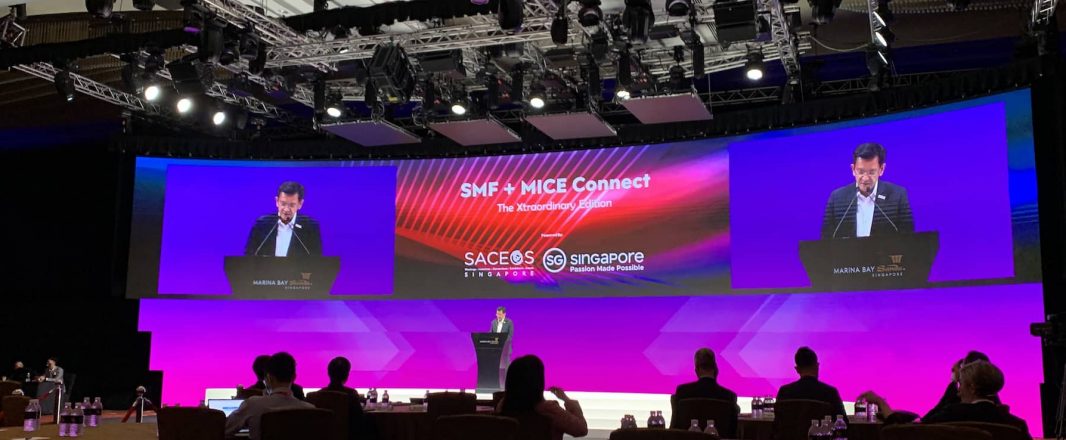
Speaking at the Singapore MICE Forum (SMF) and MICE Connect, Hosea Andreas Runkat, chairman, Asperapi (the Indonesia Exhibition Companies Association), who flew in from Jakarta, said he made the trip “to show people back home it can be done”.
Even though it’s meant “having my nose cleaned everyday”, he jested in reference to the daily ART tests he had to take, he’d been sending lots of photos back home as evidence that safe opening of events is possible and he hoped that domestic events could soon be staged in Indonesia in early 2021.
For him, it was the urgency of getting events to open again safely and less about what the future could look like.
The future is divided – “Asia loves hybrid”
Speakers at the event, from countries such as Thailand, Philippines and China, gave updates on what was happening in their markets. As is the case with travel in general, China is ahead with exhibitions in full swing and the good news is, there is no lack of consumer appetite to return to physical events, reported Fiona Chiew, Deputy General Manager, Messe Frankfurt (HK) Co Ltd, calling in from her home base.

Even though this is a market that has developed impressive event tech this year, there is clear pent-up demand to return to physical events after months of deprivation.
But my sense is, regardless of how long that pent-up demand stays up, it is clear events have moved on, forced by Covid, and will be carried forward by a blend of technology (which will get better) and customer expectations (which have changed), and the industry also has to move on.
Gu Xuebin, CEO, WeMeet and IAEE (International Association of Exhibitions and Events) Asia Council Chair, calling in from China, declared, “Asia loves hybrid.”
Sharing a survey of members, the executive, who’s been focused on event technology solutions for the last two decades, said 39% in Asia will offer hybrid events vs 19% globally and only 20% said they would stop virtual or hybrid once Covid was over. “Whether it’s due to tech or culture, Asia is leading the way in hybrid,” he said, adding that Asia would provide key lessons for other organisers around the world.

His counterparts, representing the industry in Europe, felt differently. I sense that for Kai Hattendorf, CEO of UFI (The Global Association of the Exhibition Industry), who flew from Paris to Singapore for the event, his physical presence was a declaration of his firm belief in a physical future, and that face-to-face was absolutely necessary for the important work of exhibitions to be fully realized.
Ilaria Cicero, General Counsel and M&A Director, Fiera Milano Group, which recently set up headquarters in Singapore, also echoed his views, saying the sentiment was similar in Italy.
Giant panels, Mixed Reality, Cool Tech
Singapore is betting on both. It has put stakes in the ground for a hybrid future, making sure its events infrastructure is adapted for the new world, as well as committed to a physical world with events lined up to 2028. It signed an MOU with Informa Tech to create a new technology B2B show in Singapore this week.
The Marina Bay Sands used the opportunity to showcase its new tech for hybrid gatherings. Panels blended speakers on stage physically with virtual speakers whose images were shown on giant iPad-like panels, and the event was live streamed.

On the exhibitions floor, booths were designed with masses of space around them while meeting pods looked more like boxes and rules were strict over how many buyers you could meet at any one time. Not that there were too many buyers – let’s face it, this event was more symbolism than transaction – and everyone accepts that.
Marina Bay Sands also took the opportunity to unveil its new Mixed Reality (MR) capabilities which takes its Hybrid Broadcasting Studio up another notch. It’s pretty cool tech, allowing presenters to take storytelling to the next level by integrating virtual and physical, and I can imagine having lots of fun with it as an event organiser myself.
I will let the video I took of Ong Wee Min, vice president, MICE, tell the story.
Overall, I was impressed with the new tech in display but you also know that no matter how cool the tech is, it doesn’t matter much if the content is poor.
Is it tech or culture? Or is it customer expectations?
So referencing WeMeet’s Gue, is it about the tech or the culture that organisers in Asia are embracing hybrid more enthusiastically than their counterparts in Europe? I suspect it’s both. The technology coming out of China from tech giants such as Tencent and Alibaba is leading the way and as the tech gets better, virtual events will also evolve.
Just this week, Tencent launched a speech recognition and automatic subtitle generation solution called Al Transfy – imagine what it could do for conferences across Asia.
Consumers in Asia have embraced new tech such as live streaming even more fervently during Covid and remember, this is the region that also led the way in mobile adoption and innovation. Webinars were never as big a thing in Asia as they were in Europe or the US, prior to Covid, but just like Asia took the leapfrog with mobile, it will do something similar with events – events will take on a new culture.
Covid has changed customer expectations as well as habits. We now know what virtual events can or can’t do and we have choices. We are going to ask, could I have attended this event on Zoom or any other platform? Is it necessary for me to be here physically? These questions are going to be around, long after Covid is over.
No one wants any longer to sit in darkened ballrooms, listening to one-way monologues, with minimal engagement between speakers and audience, and with our heads down, looking at our mobiles. We might as well do that at home, where at least we can go to the fridge whenever we want. No one wants to sit in isolated booths, waiting for the next buyer to walk in.
The world of events has to move on, in tandem with their customers.
It’s the difference between listening to a singer on Spotify and showing up live in a stadium. Is it worth it for you?