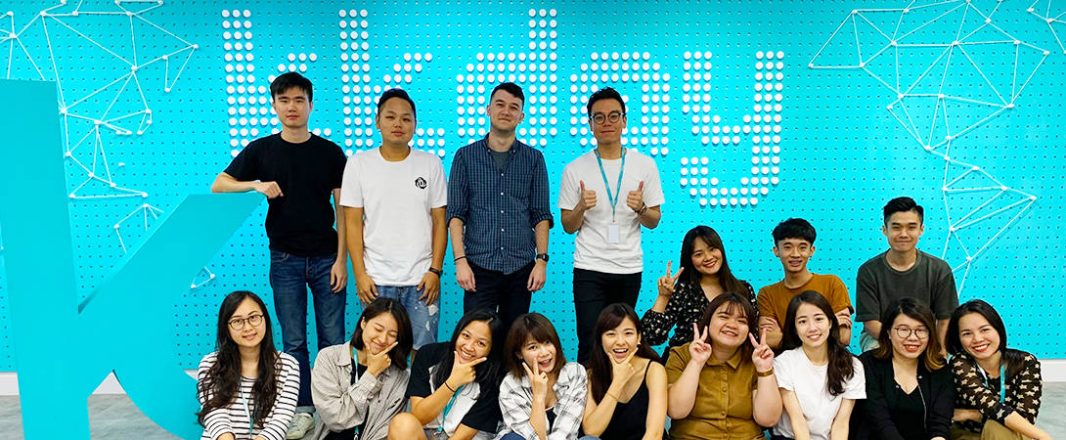
“Curated experiences” marketplace embeds deeper local roots, launches Fine Day for luxury and scales Rezio
WHEN Weichun Liu told her parents she was giving up investment banking to join KKday in 2016, they thought she was joining KKBox, the “Spotify of Taiwan”. “I didn’t want to tell them otherwise,” she laughed.
Fast forward to now and Liu, who came onboard as co-founder and CFO a year after KKday was founded, still speaks with the same zeal and fervour about the Taiwan-based curated experiences platform whose aspiration is to build the first global consumer brand out of Taiwan.

Catching up with Liu in Singapore, where she now lives and has taken on the role of executive vice president, she told me, “I don’t think I can go back to corporate life again. Everyone who joins startups tell you they want to make a difference, it’s a cliché – but the truth it, we want to make some impact.”
Taiwan has not had much success building a home-grown global consumer brand, said Liu, partly because it is a small market and unlike Singapore, which is “the headquarters for everyone”, Taiwan is fairly closed. “All the best talent work elsewhere and travel is not everyone’s first choice.”
But times are changing, she said. “A new generation is more open to working with tech startups and are looking for more than money – they want autonomy, to make a difference and to know their decisions can make an impact. Our mission is to make travel experiences easy for everyone and to build a global brand out of Taiwan,” she reiterates.
Covid has put global vs local to the test
And this period in travel history has certainly thrown up interesting lessons in the global vs local debate especially where the Asian market is concerned.
Said Liu, “You had two types of unicorns – the global ones which were US-centric, had strong product teams in the US and didn’t need huge teams in Asia or elsewhere but could get revenues everywhere.
“Then you had the Asia unicorns – Shoppee, Traveloka, Trip.com – they try to localise as much as they can but it’s a very fragmented market. With Covid has come this realisation that you need localised teams – what can you do for your users in each individual market? And it is those that were really able to localise in the true sense of the word that did well at this time.”
With roots in Taiwan, a market that accounts for 50% of its users, KKday has ridden out Covid relatively unscathed. “For some of our markets, current sales exceed pre-Covid. Taiwan as well as Hong Kong are doing better this first quarter than last year. Before Covid users in Hong Kong bought our products for overseas destinations. We didn’t do domestic travel but after our pivot, we are now enjoying higher frequency sales, higher everything,” smiled Weichun. “We have customers buying something every weekend – the same is true of our customers in Taiwan.”
She said it was seeing some recovery in Vietnam and South Korea, although Japan, which was doing well, has flattened.
And in many ways, her being “stuck” in Singapore since her move last September to expand KKday’s business in South-east Asia has been a blessing in disguise. “We saw Singapore as a base but it was never a priority as a market, since it’s so small. It was the perfect opportunity for a smaller company like us, it forced me to stay in Singapore. Previously, I travelled a lot and didn’t understand the Singapore market. Now I realise what can be done for the market, we are curating events, and trying to differentiate from the usual offerings.”
It is expanding the team in Singapore. While it is not one of the five platforms appointed to sell the SingapoRediscover vouchers, Liu said the programme has been good for Singapore. “We talked to a lot of attractions and they say a lot of Singaporeans are visiting them for the first time, which is a good thing.”

“You need to have something that Google cannot take away”
KKday sees itself as a curated marketplace where it handpicks the products – one vendor for each activity in one place. It used to operate KKday Signature Tours and had 100 of them pre-Covid, but Liu said these have since stopped amid the pandemic.
The pandemic has seen it branched into “really longtail product” to cater to local tastes. “Locals want to see places beyond the usual. Now we have products all across Taiwan, beyond Taipei, Tainan and Kaoshiung. It’s good preparation when borders open up and we can start selling these products.”
It is also piloting a new brand called Fine Day for the luxury segment, while KKday will be aimed at the mass market. “Luxury will come back first. Travel will return in stages,” said Liu.
She is very clear that KKday doesn’t want to be known for “cheapest price” but for “unique, interesting products”. “It’s hard to sustain business if it’s all about price. There is always someone out there with deeper pockets. You need to have something that Google cannot take away.”
“Someone has to step up and standardise the industry”
Beyond the consumer-facing products, KKday has also built Rezio, its booking management platform for suppliers in its bid to standardise the industry. The company raised US$75 million Series C funding last September, and said it would use the new capital to grow its new B2B product billed as “Asia’s No 1 Booking System Designed for Tourism Industry”.
Rezio, launched with pilots in Taiwan and Japan, offers three functionalities – a storefront function to enable suppliers to set up their own shop, channel management and integration with offline.
“It is one thing for suppliers to expand their distribution channels but another to aggregate all the platforms – payments, delivery, Covid-related functions, shopfront and back end – for them,” said Liu.
It’s seen huge adoption in Taiwan. In Japan, major tour operator HIS is migrating to Rezio and it is pushing adoption in South-east Asia. “Any revenues we get from Rezio will be the cherry on top. We are giving it for free because we want to standardise the industry. Imagine the hotel or airline world if they hadn’t been standardised – if no industry player comes up to standardize the industry, it can’t grow. This is not a ‘winner takes all’ market, everyone gains. Tours and activities is so fragmented.”
Through Covid, it found ways to keep customers engaged, from sending wishes with lanterns and having fortunes told. “We had a lot of debate internally about how to do these activities virtually,” said Liu. “Watching a video doesn’t work, so how do we do it virtually? The key point was to have customers participate in the entire process.”
So it literally broke down the process, book your Zoom call, select a time, invite your friends, write your wishes and a team in Taiwan sent the lanterns with the wishes skywards (see video below). For fortune telling with a particular temple popular with Japanese tourists, it set up a Zoom call between the temple and Japanese customers who got their fortunes told virtually.
“It wasn’t very technical and these activities weren’t revenue generating, they were a way to remain engaged with customers.”
And again, this is where localisation comes in – having local teams connect the dots between global product and local demand.
While KKday’s aspiration is still to build a global brand the biggest question it is now asking is, how does it leverage local, how does it localise the huge inventory it has? And Liu believes scale and localisation are not opposing ideas, “tech can help you to customise, for example, across multi-languages”.
“It’s a question of being smart and local about it.”
Note: Wenchun Liu will be speaking at the WiT Travel Roadshow Episode 2 on April 29. Sign up here.
• All images credit (featured image is of KKday’s South-east Asia team): KKday