
More than 68m travellers have opted for Skyscanner’s “Greener Choice”; Travalyst coalition working on standardised score
FRESH from attending his first physical airline conference, the CAPA Aviation Summit in Manchester, since the pandemic, Hugh Aitken, vice president of flights of Skyscanner, is filled with optimism for the continued recovery of travel.
Notwithstanding the war in Ukraine and the volatility of the global economy, the pent-up demand for travel is being translated into actual trips and the global travel marketplace is seeing growth in Monthly Active Users. In 2019, its MAU was 100 million and it’s reaching 75 million currently.
“We have 100 million app downloads, and are seeing user numbers return and they are finding us organically, as a brand,” said Aitken.

Hugh Aitken: “More travellers are looking at sustainability and prioritising sustainable choices but we are not getting standardised data across to travellers in the right way.”
Sharing the results of its “Skyscanner Horizons: Travel’s resilience and trends shaping recovery”, Aitken said the findings from this third report, which combines consumer polling with extensive flight search and booking data from each region – APAC, the Americas and EMEA, was a “big leap forward” compared to the second report issued this time last year.
Said Aitken, “This time last year, there were still lots of border restrictions especially in Asia Pacific. Now we are starting to realise the pent-up demand. People are prioritising travel this year – they want to travel and they want to trade up. There is a willingness to spend more and invest in accommodation upgrades.
“Domestic is up, shorthaul is returning in Europe and Americas, APAC is behind. Longhaul is lagging everywhere, due to complexities of networks and borders.”
Key APAC findings from the report include:
- Longer booking horizons surge in Q1, specifically segments +90 days, 60-89 days and 30-59 days.
- Domestic travel in Q1 2022 is significantly higher than in 2019, however both long haul and short haul have seen strong growth over the quarter following rising demand after many APAC countries ease travel restrictions.
- Longer trip lengths peak in July and December; in particular trips of two weeks to a month and longer than a month.
- As restrictions ease across the region, trending destinations travellers are searching for include Newcastle (Australia), Hyderabad (India) and Boston (US).
Even as it ramps up for recovery, focusing on three core elements – growing its global audience, reinvent flight search and planning and driving conversions for its partners – Aitken singled out sustainability as a key issue “that could hold us back as an industry”.
“More travellers are looking at sustainability and prioritising sustainable choices but we are not getting standardised data across to travellers in the right way,” he said.
 Skyscanner introduced the “Greener Choice” label for its flights in early 2019, highlighting flights that have less-than-average CO₂ emissions for the particular route being searched. Its calculations are based on aircraft type, aircraft capacity and route and distance. Based on these considerations, if a flight has at least 4% less-than-average CO₂ for that route, it is marked as a “Greener Choice” on Skyscanner.
Since the feature launched, more than 68 million travellers have already selected lower emissions flights for their chosen route, according to an analysis from January 2019 to September 2021.
Consumer testing on its site in 2021 showed that on average 78% of travellers globally who were presented with a Greener Choice option in their flight search results selected it for their chosen route. This equates to approximately 35,000 travellers per day.
On average, Greener Choice labelled flights across its site globally contribute 11% less CO2 emissions than the average for their route, according to Skyscanner.
The problem though is each OTA or travel organisation is doing its own thing and using its own method of calculations so that there is no standardised score easily understood by consumers.
This is where Travalyst is attempting to make a difference. The coalition, comprising Booking.com, Skyscanner, Trip.com Group, Tripadvisor, Visa, Google and recently, Expedia have aligned on a shared framework to collect and display flight emissions data, meaning that when consumers want to book a flight with lower emissions, they will be able to easily find the information they need. The framework consists of a set of shared principles and preferred methodology for estimating carbon emissions from air travel, agreed and committed to by all Travalyst travel distribution partners.
“The key thing here is making it easy for consumers to understand with a standardised score at the point of purchase. Collectively the brands now involved will be able to reach and influence a large amount of the worlds travellers,” said Aitken.
“The challenge in making these calculations transparent and accurate is having the right data, especially with regards to things like aircraft load factor and fuel burn. This is data that is not easily accessible for Travalyst at the present time.”
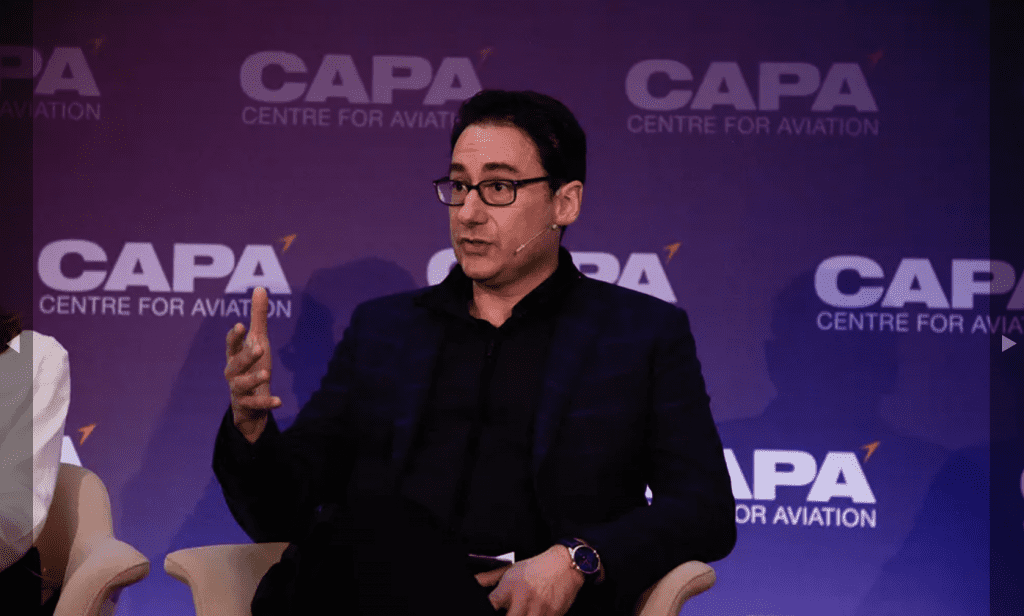
Piero Sierra: “Our job is to also educate consumers not just to capture the demand for sustainable choices but to encourage them with transparency and clarity.”
At the CAPA conference, Skyscanner’s chief product officer Piero Sierra, who called on organisations like IATA to make its data available to the coalition, said, “We really do care about this, and we see ourselves as a bridge for consumers and travellers.
“Overall, I think there’s still from a consumer perspective a gap between their values and the actions they take, they’re willing to do something if it’s easy but if there are stumbling blocks that may change
“The efficacy of the solution also concerns the consumer, our job is to also educate consumers not just to capture the demand for sustainable choices but to encourage them with transparency and clarity.”