Beyond numbers, destinations need to rethink what they really want from tourism, says Miguel Sanz Castedo
With European tourism at a critical juncture, coming under pressure on several fronts, including environmental and social, the new president of the European Tourism Commission (ETC) says it is even more timely to remind Europeans of the original objective of the organisation.
Speaking at Phocuswright WiT Middle East on May 3, Miguel Sanz Castedo, who’s also Director General, Spanish Tourism Institute (TURESPAÑA), said the ETC was founded in 1948 to bring peace and prosperity to the continent after World War 2. “It’s interesting that 75 years ago after the Second World War, people thought tourism was a tool for peace and prosperity. And 75 years later, we have to use that tool as much as possible.
“There are headwinds in the world – the Russian invasion of Ukraine, the situation in the Middle East. We have to remind ourselves that tourism is a tool designed to bring peoples together and create economic prosperity.”
He added, “Tourism in Europe is undergoing a complete transformation of its model not only economic, but social and environmental. Europe is the world’s biggest destination and some of the biggest destinations in the world are in Europe – Spain and France, for example. We need to make the world understand that tourism is not only an important economic activity, but an important human activity.”
Asked if tourism bodies needed to change its language so that people don’t see tourism as just numbers, in light of the recent march in Canary Islands for example where locals are protesting over-tourism, he said, “Defining and deciding on the right KPIs for the industry is important. The biggest KPI so far has been volume of visitors – is it still valid today? Is it valid for all destinations? Should Spain and France be always competing for this podium? My answer is no, or at least no without taking into account other KPIs.
“Now when I am asked about Spanish tourism, I don’t say we received 85m visitors, 3% more than last year – I talk about expenditure, 108b Euros that add to the prosperity of the country, for instance.
“Other KPIs are also important – number of jobs, salaries, hotel nights, investment, carbon footprint. And it’s not just monetary KPIs – there’s also social value. For example, in Spain, we have some places that are losing population because of migration and tourism is helping these places to generate economic activity, that is jobs and opportunities.
“It’s not just about the money. It’s about the impact on the local community. A visitor who spends less but engages with local experiences can have higher added value.”
He noted that the UNWTO has produced a framework for measurement of social and environmental sustainability, which is up for approval by the UN General Assembly in September. “It will be a game changer in identifying key indicators.”
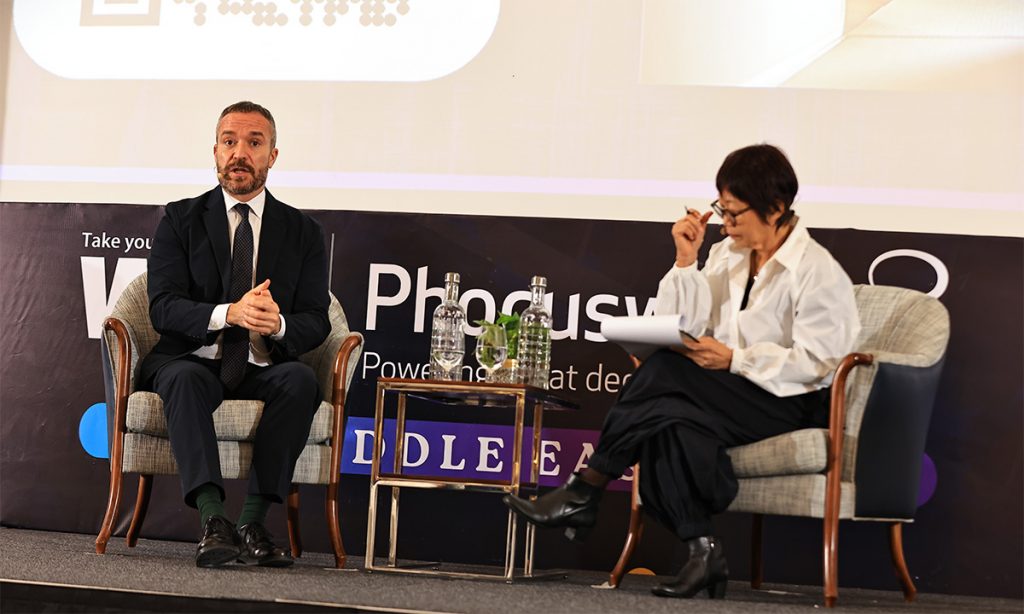
Miguel Sanz Castedo: “It’s not just about the money. It’s about the impact on the local community. A visitor who spends less but engages with local experiences can have higher added value.”
“Every visitor has to contribute to the well-being of citizens”
Castedo said destinations are increasingly evaluating tourism’s contribution to residents’ quality of life, shifting from visitor-centric models to community-focused approaches. “The Netherlands has a 2030 strategy that says every visitor has to contribute to the well-being of citizens. It’s about asking what you really want from tourism.”
Another way of tackling over-crowding in popular spots is to develop new destinations in Europe, even if they are just a few kilometers from established ones, to take pressure away from the main attractions and keep the attractiveness of Europe as a never ending global destination.
Balancing tourism seasonality can also ease local tensions during peak seasons and provide more stable employment opportunities. “We think that we have to level up seasonality… to ease tensions in the summer season and provide more stable jobs in the winter season.”
He added that regulatory measures were also needed to address housing imbalances caused by short-term rentals in tourist areas, ensuring accessibility for local residents. “In the Canary Islands and many other destinations in Spain, local and regional government are working to produce regulations needed so things can be balanced again regarding housing for residents and tourists.”
There’s also pressure on flights and airports – could we be facing a future of constrained tourism in Europe because of this, Castedo was asked.
“It’s a tricky one. The first thing we have to do is commit to reduce the carbon footprint of air aviation – we have an undertaking to make air travel net zero by 2050. So we need to help the industry reduce carbon emissions with the technology available right now – and that’s SAF, and that’s not dependent on tourism but the energy sector. We need to encourage them to speed up production.
“Restricting airports and flights – that should be the very very last resort. We must speed up the tech or regulations that allows significant reductions in carbon emissions. For example, single skies in Europe would help us reduce by 9-10%, so let’s try everything else first.
“It would be bad for everyone if only elites could travel.”
At the same time, he said, “we need to encourage people to move in a more sustainable way.”
He said that introducing competition in sectors like rail has helped reduce prices and make sustainable transportation options more accessible for travellers in Europe. “Spain has the largest high-speed rail network in Europe. You can go from Barcelona to Madrid in just two and a half hours but it was expensive a few years back. How did we take train prices down in Spain? Instead of just one state-owned company operating rail services, we have three now. So there’s more competition, and prices have gone down.”
On Digital Marketing Act and its implications for small businesses
There’s also the Digital Marketing Act recently introduced to restrict power of gatekeepers such as Google. In this blog, Adam Cohen, director, Economic Policy of Google, argued, “Under the DMA, we’ve had to remove useful Google Search features for flights, hotels and local businesses. This means that if you search for a flight in Europe, we can no longer show a full array of information about carriers, flight times and prices. This benefits a small number of online travel aggregators, but harms a wider range of airlines, hotel operators and small firms who now find it harder to reach customers directly.”
Cohen added that “we’ve seen increased traffic to a small number of successful intermediary services and significantly less engagement with a wide range of businesses like airlines, hotels, local merchants and restaurants.
“Hotels are concerned that direct booking clicks are down as much as 30% since our compliance changes were implemented. These businesses now have to connect with customers via a handful of intermediaries that typically charge large commissions, while traffic from Google was free. European airlines and local businesses have expressed similar concerns.”
Asked to comment on this, Castedo said, “The whole purpose of the Digital Marketing Act was to give easier access to small and medium-sized businesses to reach the consumer.”
Renewing social contract between tourism and local communities
Castedo highlighted two other “pressing and fundamental tasks ahead of us in our industry, which are somehow connected”.
“The first one is to renew the social contract between the travel industry and local communities by which tourism contributes to the well-being and prosperity of local residents. This has to do with the social sustainability of tourism, which is as important as the environmental challenge that the industry is undergoing.
“The second part is to make tourism careers attractive to new generations. At ETC we have even published two children’s book s Dee and Flee at the Theme Park by Julia Hubery and Searchlight: The Rock by Ann Bryant aimed at promoting tourism as a professional career.”
As for his top three priorities, he said, “We have elections for the EU Parliament in a few weeks. The first priority will be to engage with the new European Commission leadership and Members of the European Parliament to work in the EU tourism agenda for the coming years.
“I would mention three strategic areas of work: 1) Europe is a very powerful umbrella brand that benefits all of our members. It is important to invest in the notoriety as well as the values and attributes of brand Europe as a destination. 2) A focus on Asia. This part of the world will probably be among the fastest growing markets, Europe need to be there; and 3) Research and sustainable transition. ETC will continue to provide its members with tools and knowledge to accelerate the transition to more competitive, responsible and greener tourism models. ”
And the human quality that will be needed to unite 36 NTOs in Europe around a common purpose? Empathy, he said.
“ETC is made of many different countries with different cultures, traditions and languages. Some are big and diverse like Germany, Turkey or Ukraine or very small like San Marino, Monaco or Luxemburg; some are net outbound markets, some are yet to be fully discovered and some are very popular international destinations. It is important to be able to understand each member and their needs, as they are all equally important in keeping Europe as the world’s favorite destination.”