
 Caught in the first snowfall in Seoul, Yeoh Siew Hoon has time to thaw out her brains while the plane is being de-iced on the tarmac to reflect on the key takeaways from WiT Seoul 2024.
The Koreans believe that first snowfall is auspicious. If this is true, then Seoul’s travel industry is in for much abundance and prosperity in the new year to come.
The first snowfall of winter 2024, which happened on the day of WiT Seoul (November 27), was the third heaviest in the capital, since records began in 1907, grounding flights, ferries and trains, and causing travel disruptions throughout the country.
My Korean Air flight was delayed by seven hours or so – a couple of hours spent sitting in the aircraft waiting for it to be de-iced. But as travel disruptions go, Incheon Airport’s efficiency still impressed, especially compared to my experience in San Francisco just days prior.
It’s this same efficiency, paired with strategic investments, that speakers at WiT Seoul believe could elevate Incheon into a critical hub connecting North America and Asia. However, industry leaders, like Bo Young Song, senior vice president, passenger business division, Korean Air stress that achieving this potential will require government support and significant technological advancements in immigration, security, and boarding processes.
Amid these challenges, Korea’s outbound travel surge is driving growth across the sector, attracting global OTAs, splintering the market into new segments, and accelerating the adoption of AI.
Here are the key takeaways from WiT Seoul:
1. Outbound Rush Fuels Growth: Global and Local OTAs Compete
When asked why he had a soft spot for the Korean market, where Agoda has a huge presence, Timothy Hughes, vice president of corporate development, said, “Koreans love to travel, that’s why we love this market.”
Agoda is not alone. Klook, which went from having one employee in 2016, has grown to 80, said James Lee, general manager, who was employee #1, as it taps into a younger generation of travellers willing to spend on experiences.
Year to date, October, the number of outbound travellers in 2024 stands at 23.5m, just slightly under 2019’s 24.2m. Said Min Yoon, CEO of TIDESQUARE, and co-founder of WiT Seoul, “The performance of OTAs continues to improve. Post-pandemic, the trend is accelerating, and the two major OTAs, Yanolja and Good Choice, are continuing to see double-digit growth.”
However, competition from global OTAs is on the rise and because of their international coverage, Min said they are gaining market share against the local players. “Considering the significant increase in international travel after the pandemic, this seems understandable,” he said.
An exciting trend to watch, he said, is the booming growth in tours and activities. “MyRealTrip and Klook are carving out larger market shares as more individual travellers seek unique experiences. This shift highlights a natural evolution in travel, where memorable adventures are becoming essential to the journey,” said Min Yoon.

Said Min Yoon (left), CEO of TIDESQUARE, and co-founder of WiT Seoul, “The performance of OTAs continues to improve. Post-pandemic, the trend is accelerating, and the two major OTAs, Yanolja and Good Choice, are continuing to see double-digit growth.”
2. AI Personalization and the Pursuit of Next Gen Travellers
Almost every travel brand is going after the younger segment, Millennials and Generation Z. Even Hanatour, once the most traditional of tour operators, has had success broadening its target to include younger, independent travellers with product innovations such as ‘Just Us (우리끼리; Woori ggiri)’ and “Mingling” tours.
CEO Mi Sun Song said the “Mingling” tours were tailored for small groups with special interests, whether it be for walking or wining. Currently, it has about 20 such tours but she said it could increase to 200 types, depending on interests.
This splintering of the market is interesting, driven by the evolution of outbound tastes as well as the deployment of AI by companies to better tailor recommendations to specific travellers.
Every travel company spoke of using AI and data to target travellers with personalised recommendations. Song said Hana Tour was in the early stages of deploying AI – 50% of it on back-office operations and 50% on consumer-facing innovations.
Klook’s James Lee spoke of using AI in translation to localise content for Korean travellers. It has taken on an “AI language trainer” to work with Google LLM models to ensure its translations are accurate and contextual for the market. “When we started, it was like a two-year-old baby translating, within three months, it’s like a 12-year-old, that’s how fast it is improving,” he said.
Luiz Rodrigues De Paula, Regional Manager Partner Services, North APAC, Booking.com, said the new era of AI will usher in a new era of travel and a pathway to connect travellers in the world to local cultures and experiences. He said tools such as Booking’s AI Trip Planner would enable travellers to “embrace spontaneity and curiosity and choose off-the-beaten-path destinations”.
He identified most promising Next Gen traveller segments as GenZ/Millennials, Intergeneration Travellers and Boyz II Zen – men only solo or group travels.
Jay Lee, Country Director, South Korea, Agoda, sees Korean travellers going beyond typical tourist hotspots, making spontaneous vacation decisions and demanding flexibility in travel arrangements.
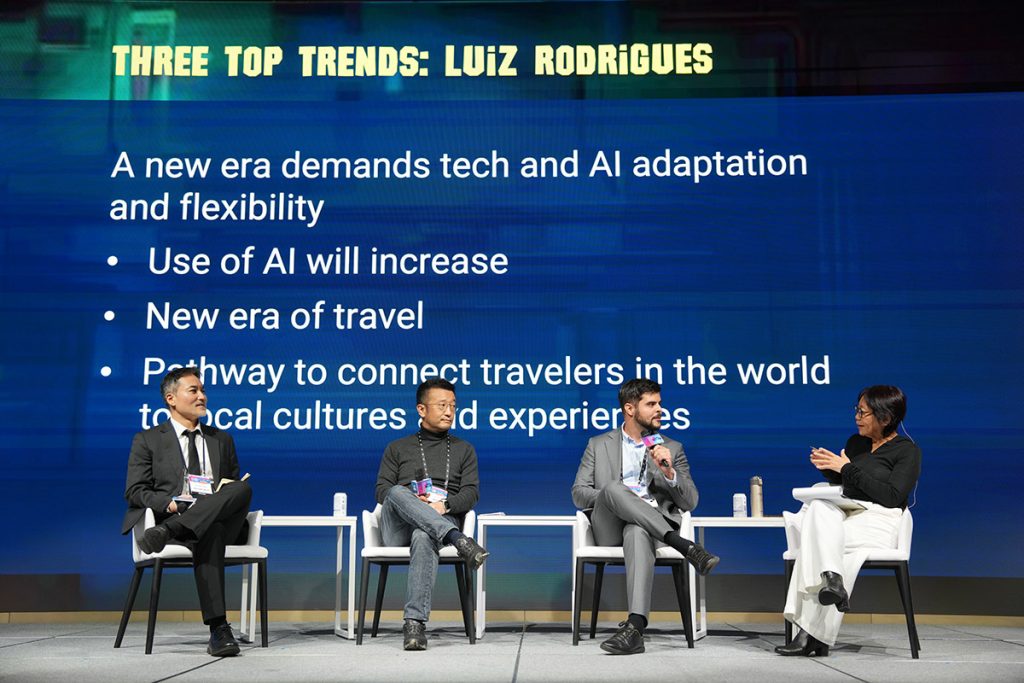
From right: Yeoh Siew Hoon, Founder, WiT | Luiz Rodrigues, Regional Manager Japan & South Korea, Booking.com | Jay Lee, Director, South Korea, Agoda | Justin Hong, General Manager, Korea, Trip.com Group |
He sees local motels becoming popular with international travellers to Korea and there would be expansion of inbound to non-core regions/secondary cities and provinces, along with expanding payment options for global travellers and the rise in solo adventurers. With that, would come growing demand for the “connected trip”.
Justin Hong, General Manager, South Korea, Trip.com Group, said the group’s AI tools such as TripGenie and Trip.Best were seeing strong adoption in the market. He sees opportunities for entertainment + travel products for Asian markets as well as food tourism.
Observed Min Yoon, “We are on the edge of big changes in technology. AI is certainly being utilized in real business across various sectors, and in the travel industry, new standards like NDC are emerging. Major hotel chains are strengthening their direct sales and also enhancing digital transformation.”

Hanatour CEO, Mi Sun Song (Left) said the “Mingling” tours were tailored for small groups with special interests. It currently has about 20 tours, which could increase to 200 depending on interests.
3. Targeting The 20-29s: Highly Social, Micro Trends and Heavy Planners
When asked to picked the most promising Next Generation traveller segment, Agoda’s Jay Lee cited, “20-30s single travellers”.
This happened to be the demographic Min-Hwa Kim, Director, Research & Data Tech, Consumer Insight, focused on in her presentation, “Characteristics of Korean Outbound Travellers Aged 20-29”.
Firstly this segment favours international travel over domestic, more so with females than males. However post-pandemic, males in their 20s have become the more prominent segment, she said. A high percentage, 70-80%, favour independent travel and their top three destinations are Japan, Vietnam and Thailand.
Here’s what you need to know about this demographic.
- Digital and Social Media Influence
This age group relies on platforms like Instagram and Naver for inspiration and planning. Sharing social media feeds is common even in social situations like blind dates, underscoring the importance of personalized, curated content. Mobile phones are indispensable for trip planning and execution. - Travel Preferences: Micro-Trends and Price SensitivitySmall, individualized activities dominate, such as private tours or local, niche experiences like culinary and sports events (e.g., pork belly dinners paired with baseball games). Young Korean travellers are critical and detail-oriented, often seeking value-for-money options. Customer service plays a pivotal role in ensuring satisfaction.
- Booking BehaviourThey prefer platforms offering localized and detailed information and the Enquiry-to-Booking Ratio for Korean travellers in this group is double the global average, reflecting their thorough research before making travel decisions.
4. Community and Belonging: Constant Craving By the Next Generation
Other than AI, the other most commonly used word at WiT Seoul was “community” with almost every travel brand and startup talking about how they were forming “communities” around their services and products.
There’s been much talk of the “loneliness” epidemic in South Korea, given the ageing population, the low fertility rate and an increasing divide between the haves and the have-nots. Ironically, it would seem that it is the most digitally connected generation – digital natives – that is most desirous of physical, social connections.
Jiha Jung, CEO and founder of Tripbtoz, the social OTA using videos by influencers to inspire and convert hotel bookings, said that unlike their parents, “this digital generation cannot afford to own or buy a house and so for them, the digital world is like their house and they do everything in this world”.
He called AI the game-changer for Next Generation social models such as his, as it would provide more glue around community-building.
Dongwoo Hong said he started Don’t Worry Village (DMV) to solve the loneliness issue among young Koreans, particularly among young men. “In recent years the number of suicides have steadily increased accounting for over half the deaths of South Koreans in their 20s,” he said.
His startup aims to transform underutilized small cities into vibrant hubs for young travellers and long-term visitors by creating affordable, community-oriented, and hyper-local travel experiences. It focuses on addressing regional depopulation, enhancing mental well-being, and fostering sustainable communities.

Jiha Jung, CEO and founder of Tripbtoz: “This digital generation cannot afford to own or buy a house and so for them, the digital world is like their house, and they do everything in this world”.
It offers a staycation platform, community and shared spaces, local partnerships and hyper-local experiences and it wants to replicate its model in other small cities globally. “Loneliness is everywhere,” said Hong.
This need for “community” is not restricted to South Korea. In Japan, Howard Ho and his two co-founders created Section L, an apartment-style accommodation concept which sits between Airbnb and a traditional hotel, to offer a hybrid model that would allow short-stay guests to mingle freely with long-stayers.
From a self-professed novice in AI six months ago, an enthusiastic Ho said he and his team are now using AI in their back-end processes and sees great promise in how it can leverage AI and data to curate more relevant content around its communities, thus creating more stickiness and reasons to belong to their “hotels without strangers” universe.
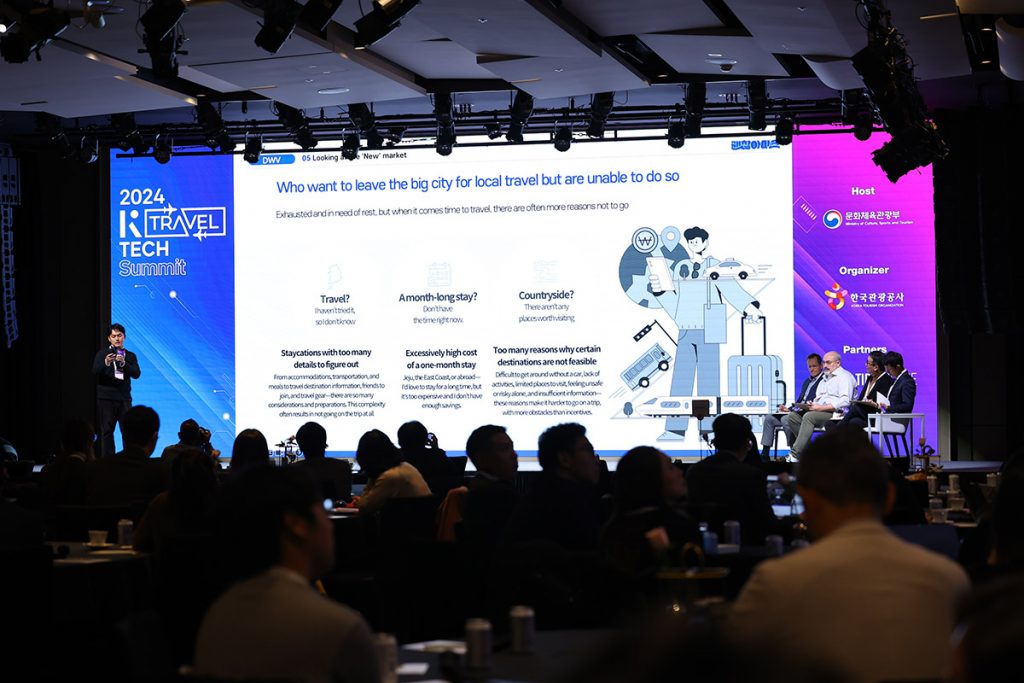
Dongwoo Hong said his startup, Don’t Worry Village (DMV), aims to transform underutilised small cities into vibrant hubs for young travellers and long-term visitors by creating affordable, community-oriented, and hyper-local travel experiences.
5. From Squid to Dogs: Love And Belonging Rule This Season
I don’t know whether this is a sign of changing times but a couple of years ago, “Squid Game” was the most talked-about Netflix series, with many likening it to the competition in the online travel market in Korea. This winter, the most-talked-about Korean movie is “Dog Days”, a feel-good holiday film about how the love of dogs brings a community of people together. And yes, there’s lots of snow in it.
As Korea’s travel industry embraces rapid technological change and the rise of Next Generation travellers, one theme remains constant: the human need for connection. Whether through AI personalization, unique experiences, or vibrant communities, the future of travel is as much about mingling and belonging as it is about exploration.

Image credit: Dog Days (2024)