One gave up a high-paying job in a multinational, the other left a family business. Together, Ashwin Jeyapalasingam and Viren Doshi launched a start-up, CatchThatBus, to do exactly that – help travellers in South-east Asia catch that bus online.
 Ashwin Jeyapalasingam, COO (pictured left in photo), and Viren Doshi, CEO (pictured right) formed the company a year ago “to bring about a positive change in the travel and transportation industry through the delivery of demand-driven revolutionary and innovative ideas.”
“We have been friends for 15 years and always wanted to do something together and this is the perfect fit,” they said.
The two, aged 33, want to make the whole bus experience more pleasant and more personal for travellers – first in Malaysia and later throughout South-east Asia.
Viren, who has lived outside Malaysia and travelled extensively, found that moving around by public transport in Malaysia challenging at times. Not only were tickets unavailable, but purchasing them was difficult.
“I lived overseas for a while and on my return I travelled around the country, but faced issues when travelling around by bus. Buying a bus ticket was a bit of a painful process. The bus companies, typical brick and mortar businesses, don’t market their services, some don’t have websites and their main concern is in selling the tickets. Most lack focus, and the real consumer experience is lacking, as is the stickiness factor in service.”
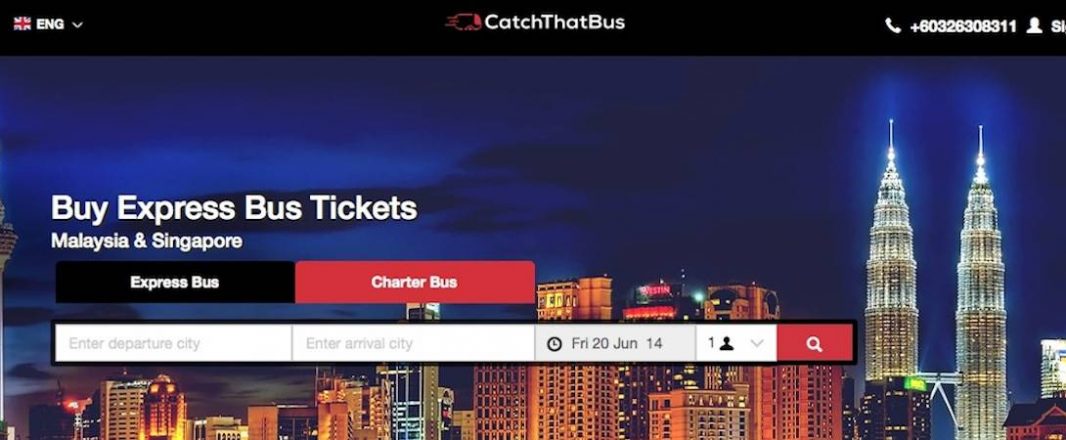
This is where CatchThatBus comes in. ”We create ease of access in buying tickets via our website, and deliver personalised experience with a call line for customers to contact us.”
Although formed a year ago with a staff of five, the company only started selling tickets on August 20. A lot of work had to be done on the backend to bring its partners in line with the system.
It currently works with Plusliner, Nice Bus, Transnasional and StarMart Express, which collectively cover about 500 routes within the country, as well as to Singapore.
CatchThatBus also does charters, working with the same companies. Said Viren, “A friend wanted to charter a bus at about the time we started the company and came to us. We thought why not as it’s an additional source of income, and we have been doing charters a year now.”
 Websites selling bus tickets are not new in Malaysia – there are a couple of other sites such as Easibook.com and BusOnlineTicket.com – but both Ashwin and Viren are encouraged by the positive booking response they have seen in the two months since launch. “Our customers are tourists, students and regular intercity commuters.”
Their goal is to be to bus travel what Expedia is to flights, hotels and activities and Agoda to hotels – in other words, they want to be South-east Asia’s leading online bus ticket platform.
On their website, they state, “By 2020, Catch That Bus aims to be the #1 choice of travellers across South-east Asia to purchase bus travel tickets in and around the region in a manner that is transparent, secure and easy.”
Bus travel in Asia is seen as a lucrative but hard-to-aggregate sector. However redBus’ success in India has become a source of inspiration for entrepreneurs trying to get into travel. In June this year, Phanindra Sama and Charan Padmaraju, who created redBusseven years ago, sold their stake in the venture to the Ibibo Group, a subsidiary of South Africa’s Naspers. China’s Tencent holds a 20% in Ibibo Group.
Other investors in the company – Seedfund, Kanwal Rekhi’s Inventus and Helion Venture Partners – also exited for what is said to be an enterprise value of Rs 600-700 crore, making it the biggest overseas strategic acquisition of an Indian internet asset.
CatchThatBus’s revenue model is based on commissions on transactions and from charters, which currently form the company’s main revenue stream. “But we are looking at other areas to raise revenue,” said Viren.
To raise awareness and acquire customers, CatchThatBus depends on Google ads, participation in IT shows, and publicity through flyers at bus terminals around the country.
As with any start-up, funds are tight but the company did receive a grant of RM150,000 from Cradle Fund, an arm within Malaysia’s Ministry of Finance set up to help entrepreneurs launch prototypes.
On why customers should use CatchThatBus over other portals or bus companies’ websites, Ashwin said, “Simplicity, variety, convenience is what we promise and what we deliver. We strive to give very personal experience, listen to feedback and be on call no matter the time of day, and build the sticky factor.”
He said they also act as a feedback channel for bus companies to improve their service. “Bus operators have many issues – drivers not observing traffic rules, not keeping time, etc. Consumers find it hard to channel their complaints to the bus companies as calls tend to be unanswered or they don’t know where to call.”
Singapore will be next, followed by Indonesia, Thailand, Cambodia and the Philippines. “It’s doable,” said Viren. “Work on our portal is still in progress. We are improving it in terms of design, usability, add in more languages, services and other offerings.”
A Malay version will be available by the end of October.
.gif) CatchThatBus has developed an Android app downloadable from Google Play store, while the iOS app is waiting for approval from Apple.
CatchThatBus has developed an Android app downloadable from Google Play store, while the iOS app is waiting for approval from Apple.
I gave the app a test and found it to be fast, not unlike booking an airline ticket via the AirAsia or Malaysia Airlines mobile app.
I also tested the CatchThatBus site and found it user friendly with its simple, no frills interface. Booking is fast and easy. I chose the destinations and dates from a drop down menu. Once I made the booking, details – bus operator, bus types, fares, time/place of departures and arrival – are listed on the site’s left side. There are options to buy insurance (RM1, covers lost luggage, accidents etc) and buy seats or meals, the latter two depending on the companies. Once payment is accepted, I can print my e-ticket.
Both Ashwin and Viren said that while the start-up has not been easy – working with transportation companies and fund-raising has its challenges – they have no regrets.
“I do miss the security of a job and a monthly salary. It’s a different lifestyle now but I have more control of my life,” said Ashwin, who was a consultant with PricewaterhouseCoopers for seven years. “There are ups and downs, but these are the challenges of running your own business.”
Added Viren, “There are challenges month by month, and it’s tough when bootstrapping. The challenge is to get more traction, and therein lies the excitement in the work.”