
In aviation, size is usually equated with safety. Mega-carriers boast fortress hubs, massive balance sheets, and hundreds of widebodies. Yet when regional conflict shut down Kuwait’s airspace earlier this year, grounding 44 other airlines – including the national carrier – it was a compact, 22-aircraft low-cost carrier (LCC) that kept an entire nation connected to the world.
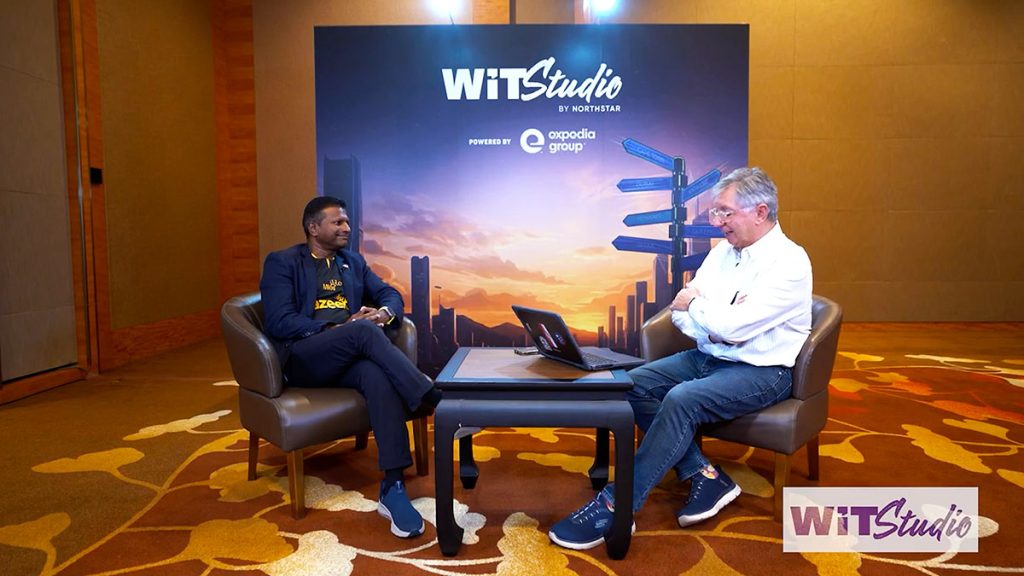
When I sat down with Jazeera Airways CEO Barathan Pasupathi at the WiT Studio in Singapore in October 2026, the irony of the setting wasn’t lost on either of us. Singapore is where “Bara” was born, and it is where he spent years at the helm of Jetstar Asia, building a scrappy low-cost contender in the shadow of one of the world’s premier full-service airlines, Singapore Airlines. Watching Jetstar Asia shut down after two decades was, in his words, heartbreaking. He flew to Manila just to board the final Jetstar Asia flight back to Singapore, celebrating the team’s 20-year legacy even as the curtain fell.
That experience – surviving and thriving in one of Asia’s most fiercely competitive markets, only to witness the realities of industry consolidation – left an indelible mark on him. While the operational playbook of Southeast Asia does not copy-paste neatly onto the Persian Gulf, the core DNA of a true LCC leader – ruthless cost discipline, speed to market, and operational agility – translates universally.
The secret sauce when everything stops
Larger legacy carriers, bogged down by rigid hub-and-spoke dependencies and layers of bureaucracy, must look at Jazeera’s response to the Gulf conflict with a mixture of envy and disbelief. As Bara put it, an airline’s single greatest financial bleed is aircraft parked on the ground.
When the conflict erupted and Kuwait’s airport closed, Jazeera didn’t wait for normalcy to return. They scrambled. Within days, the airline redeployed its entire 22-plane fleet outside its home base. Two aircraft went to Cairo for wet-lease operations serving European travelers. Six were positioned in Jeddah and Medina to serve Hajj and Umrah pilgrims. The remaining 14 were deployed across the border in Saudi Arabia – operating out of Dammam and Qaisumah – while Jazeera bussed passengers across the desert from Kuwait. Check-in opened 12 to 16 hours before departure, and through sheer operational grit – dubbed “Mission Baraka” – Jazeera single-handedly maintained Kuwait’s lifeline to the outside world until home airspace reopened.
How does an airline pull off a logistical pivot that would paralyze a carrier ten times its size? By empowering its front line. Bara held daily and weekly calls across the organization with a simple mandate: we will find a solution. More than 80 percent of the operational fixes that kept the airline airborne came not from the C-suite, but from the staff on the ground.
Watch the full interview:
The evolution of the LCC: Beyond cheap tickets
Throughout the conversation, Bara pushed back against the current pessimism surrounding the LCC model in Western markets. Over the last 22 years, low-cost carriers have driven 35 to 40 percent of airport traffic growth in Singapore and up to 80 percent in markets like Indonesia and the Philippines. Where LCCs vanish – as Singapore is now seeing post-Jetstar Asia – competition erodes and airfares inch upward.
However, Bara’s tenure across Asia and the Middle East reflects an evolution in how low-cost airlines must operate to survive. In an industry where everyone to the “left” of the airline – OEMs, engine manufacturers, ground handlers, distribution platforms – captures healthy margins while carriers fight for one or two percent on a lucky day, an LCC cannot afford to outsource its destiny.
At Jazeera, staying true to the founding mission of making travel affordable and connecting underserved city pairs means owning the entire customer journey. Jazeera is one of the few airlines in the world that owns and operates its own terminal. Now, Bara is systematically bringing outsourced costs back in-house – securing a ground-handling license, ordering buses, building a flight simulator for pilot training, and constructing a three-bay hangar to bring heavy C-check maintenance under Jazeera’s roof. When he took over in March 2024 following two quarters of losses, his first move was restoring “true-blue” LCC fundamentals: reconfiguring the fleet from 162 seats to 180, effectively gaining two extra aircraft worth of capacity without spending a dime on new airframes.
Rationality in fleet, network, and AI
Navigating the Middle East requires a cold-eyed, rational acceptance of geopolitical and economic realities. With fuel prices elevated and regional airspaces restricted – cutting off lucrative routes into Russia, Central Asia, and Iran – Jazeera has pulled back on longer-range ambitions like London Luton. Why fight mega-carriers like Emirates or Qatar Airways on long-haul sixth-freedom routes when Kuwait itself is vastly underserved?
Instead, Jazeera is doubling down on high-demand, short-to-medium-haul markets across the GCC, India, and the Levant – ramping Damascus and Amman up to 21 weekly services each. Looking ahead, Bara and his team are back at the drawing board. Beyond their existing order book of 26 Airbus A320neos, they are evaluating smaller-gauge aircraft like the Airbus A220 or Embraer E195-E2 to profitably unlock thinner secondary markets across the Caucasus and Eastern Europe – and they are prepared to play manufacturers against each other to get the right economics.
That same disciplined pragmatism governs Jazeera’s approach to artificial intelligence. With thin airline margins, Bara has zero patience for expensive tech “bells and whistles”. Jazeera doesn’t have $200 million to burn on vanity AI projects. Instead, his team is incubating 12 to 15 targeted use cases tied strictly to ROI, yield, and cost reduction – using terminal cameras to generate passenger heat maps that dynamically open check-in counters, optimizing gate allocations at their proprietary terminal, streamlining crew rostering, and running predictive engine maintenance.
The horizon beyond the conflict
Despite the immediate headwinds of war and airspace closures, Bara remains quietly bullish. Crisis has a way of clarifying opportunity. Kuwait – a wealthy nation of 5.1 million people with a high propensity to travel – is investing heavily in aviation infrastructure, boasting three runways capable of handling A380s, two control towers, and massive new terminal capacity.
For Bara, the ultimate prize is an integrated, collaborative aviation hub policy in Kuwait paired with a broader public-private tourism ecosystem – linking Jazeera Holidays, local hotels, and platforms like Trip.com to transform Kuwait from an overlooked stopover into a destination in its own right.
When the geopolitical clouds eventually part and regional airspaces reopen, the carriers that thrive won’t necessarily be the largest ones. They will be the ones that proved they could pivot overnight, protect their unit costs, and never lose sight of why an airline exists in the first place: to serve its people, its country, and the simple, enduring human need to connect.
About the author: With over 40 years of experience in the travel and distribution technology industry, Timothy O’Neil-Dunne is the Principal at T2Impact, LLC, an analysis and consulting firm that specializes in aviation, travel, and leisure.