Airports are making large strides towards ameliorating traveller experiences through technology, according to both Sabre Travel Network APAC and SITA reports, and Asia is unsurprisingly at the forefront.
The top three positions in Skytrax’s World Airport Awards 2017 were awarded to Singapore Changi Airport, Tokyo International Airport (Haneda) and Incheon International Airport.
Said Sabre’s VP of Technology, “While specific operating models are vastly different, they all utilise a common underlying technology-based ecosystem… to create a truly ‘smart’ airport.”
These efforts reflect a focus on developing a ‘seamless customer journey’ (a buzzword so often associated with travel) for air passengers.
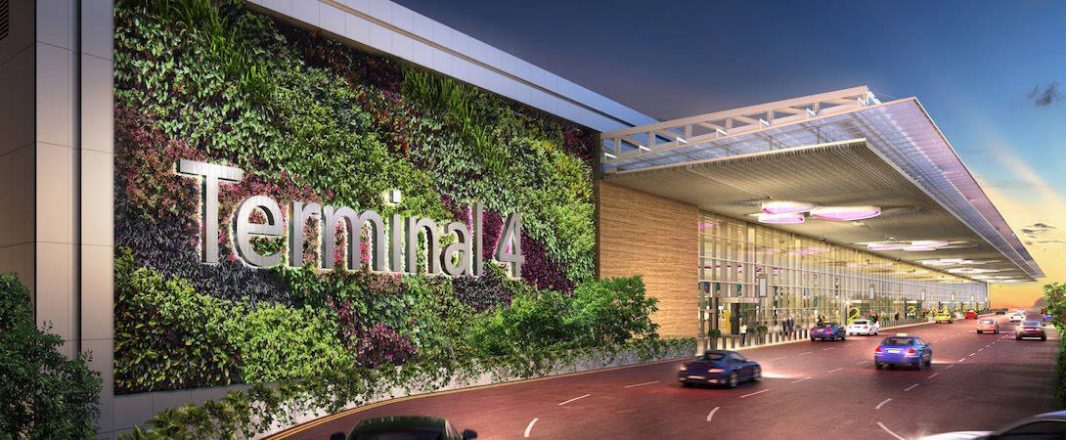
It comes as no surprise then that the new Terminal 4 at Singapore Changi Airport (set to open on October 31, 2017) is slated to be a leader in technology, through its inclusion of smart features like: facial recognition stations, centralised security screening and end-to-end self-service options (check-in, bag drop, etc.).
It also demonstrates Changi Airport Group’s (CAG) responsiveness to trends that have recently been identified in the SITA 2017 Air Transport IT Trends Insights report published this week.
In it, the trends survey revealed that airport IT spend is predicted to rise to 5.05% (USD $8.4b), with 71% of surveyed airports indicating an intent to raise IT investment in 2017 and 69% expecting a further increase the following year. This follows a dip to 4.42% in 2016.
SITA reports airports are prioritising investments in cyber security, cloud services, self-service kiosks and, unsurprisingly, mobile.
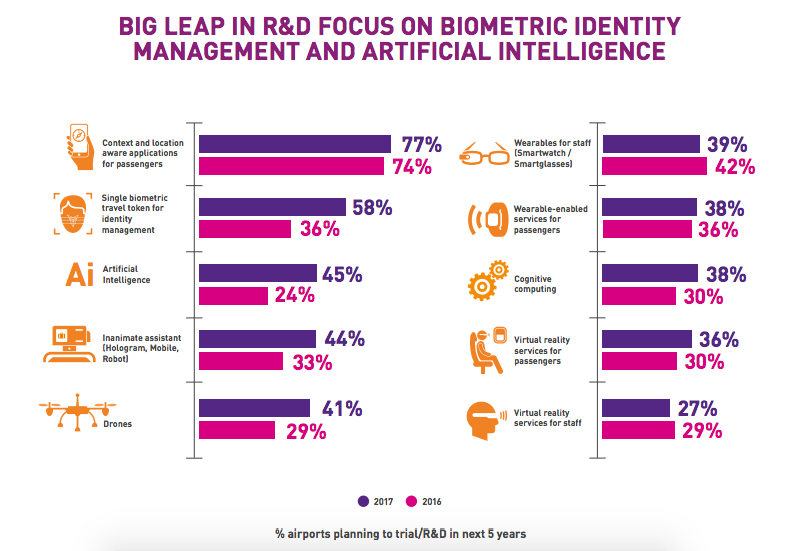
Changi Airport’s new terminal conforms to many, if not all of these trends. However, it positions itself as a leader particularly with respect to developing its biometric capabilities through facial recognition stations. While a higher proportion of airports are planning to trial biometric tokens for identity management in the next year, only 29% plan to implement secure single tokens as far as 2020.
Of course, CAG has invested heavily in self-service features (alongside 89% of surveyed airports), with the new terminal even calling its suite FAST – an acronym for Fast And Seamless Travel.
There is also an increase in planned investment in cloud services (to 85% from 78% of airports in the last 3 years) to enable better passenger flow through measures such as real-time wait monitoring systems and accessibility to staff services through mobile.
More generally, cyber security seems to be a leading priority, with 96% of airports intending to increase IT investment in this area. It is reflective of a greater attention to non-physical security, particularly as mobile is predicted to become the key channel through which airports and airlines communicate with passengers.
“Cyber-attacks are a very real threat in the highly interwoven air transport industry so building solid defenses is essential,” said Ilya Gutlin (President, Air Travel Solutions, SITA), with airports focusing attentions on protecting both businesses and passengers. It is marked as a leading challenge for the industry, with SITA stating that currently on 30% of airports are equipped to handle such a threat today.