Studies show stronger appetite in region for virtual and hybrid
ONE-and-a-half years into Covid, and attending a conference in person still feels like a novel activity. Even the driver who dropped me off at Marina Bay Sands this Monday was curious. “You going to an event? How many people? Got testing or not?”
Covid vocabulary has become street patois. I told him I had been advised as a vaccinated person, I didn’t need testing. “Good. Good. Maybe things will get better soon.”

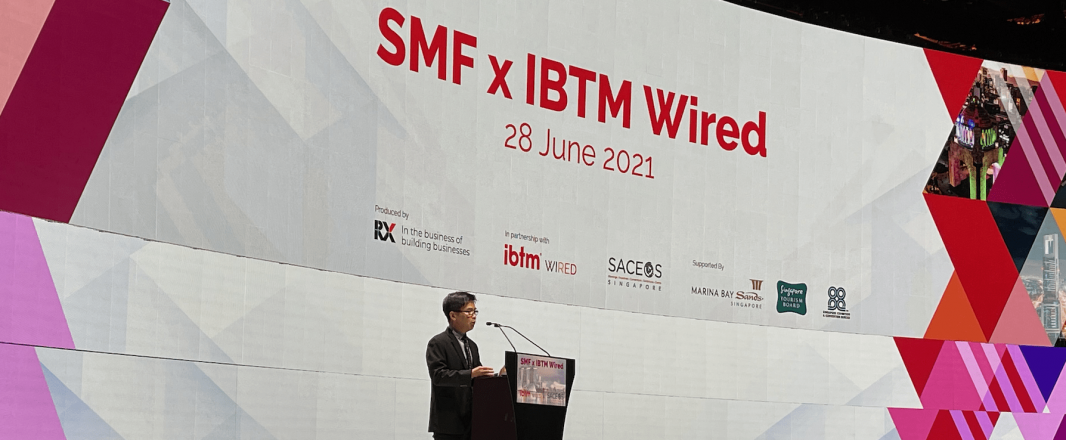
His sentiment was echoed by speaker after speaker at the first hybrid Singapore MICE Forum and IBTM Wired, with 250 on-site delegates and an online audience. They know that as much as the industry wants to get people together again at physical events, the current format, with attendant restrictions in place such as at this event, is not ideal.
Kai Hattendorf, CEO of UFI (The Global Association of the Exhibition Industry), had to jump through all kinds of hoops (numerous tests and restricted movements) to fly from Europe to Singapore to attend the event. He did it because he wants to fly the flag for physical events but we know few executives will.

Within the venue, limited mingling within zones, coffee and meals served at your table, set for one – so you eat and drink alone. The delegates who are there are from the industry, so they are also there for support and symbolism – but will our customers return to physical events if they remain restrictive this way?
“Events are about content, products and people. Can we as an industry offer true value to our clients until full, experiential and (dare I say) fun networking returns?” wondered one delegate when he asked the question during the panel session I was moderating.
The panel had been asked to “Reimagine the future of business events” and right now, it seems we are swinging between two extremes. We swung fully digital at the start and now that physical events are back in the US, Europe and China, we have swung fully physical because of pent-up demand to be with people.
The question is, what will it look like in two years’ time when the dust settles? Well, for us in travel who rely on the huge events sector, that’s a trend we need to watch and follow and, according to numerous industry surveys, organisers in Asia Pacific see a more digital future ahead than their counterparts in the US or Europe.
Data from the upcoming “Global Recovery Insights Report” by UFI, Explori and Society of Independent Show Organizers (SISO) show that exhibitions in Asia show a stronger appetite for digital or hybrid events from respondents in Asia – they are more than twice as likely to have participated in such events than respondents from other regions.
Said Hattendorf, “Just as there was a big rush to digital only, there is now a big rush to physical only – and we are seeing this in Europe, US and China. I think it will be interesting to watch Asia because in our survey, we find APAC audiences most open to digital innovation. And I forsee in two years’ time, we will see the co-mingling of online and onsite – where online provides the pre-show, post-show, omni-channel year-long engagement to the tentpole onsite events, and could account for up to 15% of total revenues.”
PCMA (Professional Convention Management Association Dashboard) APAC Survey reflects similar findings. A greater proportion of planners in Asia Pacific (38%) were planning to simultaneously stream their in-person events to virtual audiences, compared to their North American counterparts (17%). Of the APAC respondents planning a hybrid 2021 event, nearly 80% planned for their in-person and virtual audiences to interact, compared with 27% of North American planners.
Karen Bolinger, managing director APAC for PCMA, said, “We see similar trends as UFI – where APAC is most open to digital adoption and embracing virtual and hybrid. Possibly, it’s both cultural and generational – Singapore and Australia are island nations and we have to travel overseas, so virtual/hybrid will remain a big part of conferences.”
Veemal Gungadin, founder and CEO of GEVME, an event tech platform, said, “We’ve been talking about virtual for a long time. The biggest change is now people have started seeing value in it. Virtual is now a given and there was a study that showed the NPS score for an event was the same, whether it’s physical or virtual. So virtual has arrived and people see value, and will work to extract more value from it.”
Andrew Phua, executive director, exhibitions and conferences of Singapore Tourism Board (STB), observing how physical trade shows and conferences are back in other markets, said Singapore was taking a calibrated and sustained approach. It piloted a total of 90 events last year. The key lesson, he said, “is to be agile, nimble and take a modular approach.”
Currently, the Singapore travel and business events sector is waiting in anticipation for borders to reopen so that they can restart their engines. The government has signalled that the pandemic has moved to a new phase – that it is endemic and society will have to learn with it – and its goal is to fully vaccinate 75% of the population by National Day, August 9.
The MICE sector is one it cannot afford to lose. In 2017, the sector supported more than 34,000 direct and indirect jobs, with a value-add of S$3.8 billion, or close to one per cent of Singapore’s GDP. Globally, the business events industry supported nearly 26 million jobs and contributed US$1.5 trillion to global GDP in 2017, which would rank it as the 13th largest economy globally.
The good news is, it is clawing its way back.
PCMA’s Covid-19 Recovery Dashboard survey (January 2021) showed that 25% of planners and 31% of suppliers were willing to travel any distance necessary if the programme was worth it. And for those who attended a recent physical event, 63% of planners and 77% of suppliers said it was worth all the additional precautions and safety measures and would do so again.
More planners and suppliers are feeling hopeful – 69% of planners and 64% of suppliers shared this sentiment in June 2021, compared to 48% and 47% respectively in January 2021.
Revenues have also started to pick up in the exhibitions sector, which is expected to grow globally by 106% this year compared to 2020.
What this means is that when the events sector returns, in whatever shapes and forms, venues, hotels and other suppliers in Asia Pacific will have to continue to evolve their digital offerings – from studios and broadcast venues to live streaming, production capabilities and new tech tools and working with clients to offer a superior omni-channel experience that embraces both online and onsite.
Hattendorf believes it would be an opportunity squandered if the industry, caught up in the current euphoria of a return to physical, just went back to its old ways instead of taking the best of digital to enable events to become 365-day year-round engagement.
A White Paper, “Reimagining Business Events – Through Covid-90 and Beyond”, released by the STB, PCMA (Professional Convention Management Association) and UFI, singled out three areas that had to be tackled to take the events industry into the future – business models, delegate experience and talent & capabilities.
All three are up in the air and it would appear that the industry stands at the threshold of a new beginning.
Click here to download the White Paper.