If Oliver Dlouhý, founder and chief executive officer of Kiwi.com, has his way, one day he will be able to fly on an unmanned civilian flight from Brno, the small town where he lives in Czech Republic, to any major European airport and connect to anywhere in the world.
Indeed, that was the reason the Czech startup, which got its “moonshot” moment last week with the stepping in of General Atlantic as a major investor, made a small investment in Zuri, a project aiming to introduce unmanned civilian flights.
Said Dlouhý, “I come from a city of 1,000 to 2,000 inhabitants, there are no connections to the world. I am a great believer in the idea of unmanned flights – four-seater aircraft which can land anywhere, soccer fields, city squares, fly about 300km – and connect people to global transportation hubs. With Zuri, we can bring connectivity to small cities.”

Oliver Dlouhý: “I am a great believer in the idea of unmanned flights …”
That’s just one piece of the transportation problem he wants to solve. Growing up in a small town has clearly not limited his imagination. In fact, he says it’s precisely “because it’s so small I wanted to fly away somewhere and I felt I had to build it myself”.
“It” refers to the business he and co-founder and chief technology officer Jozef Képesi started in 2012. Skypicker was meant to be a meta-search for low cost flights to allow travellers to connect between airlines. Six months into the business and the partners, with no experience in the airline business, realised they had made the wrong assumptions. “We thought people would go to airline.com to finish the booking and we’d collect the commission. We didn’t realise that LCCs do not offer any commissions.”
That’s when they pivoted to an OTA model and went beyond low cost carriers but stuck to the virtual interlining model, allowing travellers to connect between airlines, regardless of alliances or any affiliations. “We started charging consumers a small fee on top of airline commissions. That’s how the Kiwi.com model basically emerged.”
In 2016, they decided to throw out the Skypicker name. “The company was growing and we found customers couldn’t remember Skypicker and they were always mis-spelling it. We had global ambitions and so we thought, this is now or never and we wanted a name that means the same thing all round the world.”
A list of five words surfaced, among them “siesta” and “kiwi” “which is exotic to everyone except New Zealanders,” laughed Dlouhý . “It’s not a fruit or a bird, just kiwi.”
He’s not lost to the irony that a kiwi is a flightless bird. “Maybe that’s why he has to buy a ticket,” he quipped.
General Atlantic deal “the most important thing in the life of the company”
For Dlouhý, the General Atlantic development is “the most important thing in the life of the company”. Bootstrapped since the beginning, Kiwi.com has grown with the $1.5m funds raised over the last eight years.
He called the deal “an investor swap”. “Our angel and Series A investors wanted to get out and General Atlantic bought them out, and they want to support the company in its future development.”
General Atlantic has invested in many travel startups including Airbnb, Meituan, Uber, Smiles and Despegar. Dlouhý and Képesi remain “significant shareholders”. “We didn’t sell any of our shares because we believe in the future of this company.”
General Atlantic, he said, would give Kiwi.com wings to scale and build a brand globally, as well as innovate and build for the future. “We became successful because we have a great product and great team. But with increased competition, it is necessary to have a strong partner to support future growth. I am so grateful to the whole team – not too many companies make it to such a big scale with such little investment.”
Today, Kiwi.com claims to connect up to 700 airlines, and sell 40,000 seats everyday. It processes 300 TB of data every single minute and processes 100 million searches a day. It offers refunds for missed connections (with conditions), a necessary step it had to take to win customer confidence, said Dlhouy.
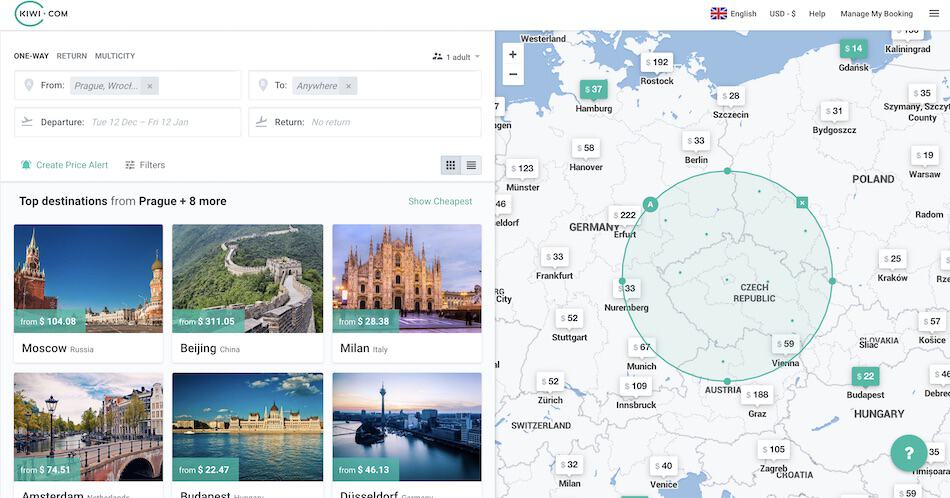
“We do guarantee if connections are not made and refunds may happen. Usually we try to find alternative connections. If the traveller has to stay in a connecting city due to unforeseen circumstances, we cover hotel stays and/or meals.”
He said that thanks to “machine learning and experience”, it had reduced missed connections rate from 5% to 0.5%. “We started to play with minimum connecting times at airports which are crowded. There are 45 factors that we account into the formula and we have managed to reduce the missed connection rate.”
He is aware that not all reviews of Kiwi.com are positive, with complaints mostly around missed connections, visa issues and difficulty of getting refunds. “We are monitoring the reviews every single day and yes, there are some bad ones. But we believe our experience is superior to other brands’.”
When “no experience” can be a good thing
It was an advantage because we didn’t follow the normal process. We just looked at a tech solution. I remember many people telling us, it won’t work, travel doesn’t work like that. We asked why because to us, it made perfect sense. Looking back, I can say we have succeeded because we ignored the rules while they are still following the old rules. – Oliver Dlouhý, Kiwi.com
Even though the lack of knowledge in aviation caused the team to make that first wrong assumption about the business model, Dlouhý believes this inexperience has helped them solve the virtual interlining problem that has plagued aviation for many years.
“It was an advantage because we didn’t follow the normal process. We just looked at a tech solution. I remember many people telling us, it won’t work, travel doesn’t work like that. We asked why because to us, it made perfect sense. Looking back, I can say we have succeeded because we ignored the rules while they are still following the old rules.”
While some critics may say that in “ignoring the rules”, Kiwi.com may in fact have bent some of them, Dlouhý stands by its model saying, “we just focused on cracking the problem and built our own tech, and convinced partners to work with us on our new tech”.
While the deal with General Atlantic certainly represents the first important milestone for the company, Dlouhý said that a personal milestone was when the company made enough to pay him a salary in 2015.
Baggage – solving the last pain point in virtual interlining
It is on trial and we have managed to make it happen on a couple of routes and we hope, in the next few weeks, to be able to revolutionise the airline industry by solving the last pain point in virtual interlining so that travellers can have a completely seamless journey. – Oliver Dlouhý, Kiwi.com
The next big problem Kiwi.com is in the midst of solving is baggage – that it gets transferred between connecting flights booked on the site – and it is working with Stansted airport on a solution that involves both software and hardware. “It is on trial and we have managed to make it happen on a couple of routes and we hope, in the next few weeks, to be able to revolutionise the airline industry by solving the last pain point in virtual interlining so that travellers can have a completely seamless journey.”
He said the solution was scalable and could be used by any airport interested in adopting the new tech. “The cost is not that important – 10 to 12 Euros per bag which can be absorbed by us – but the key is to get buy-in from airports and airlines.
“Usually in this industry, it is hard to convince them to try a new solution. That’s why we are grateful to Stansted who were open-minded enough for us to work with them.”
“Alliances are dead already, they just don’t know it yet”
This baggage pain point, if solved, could further erode the benefits of travellers choosing to fly on alliance-linked airlines and as far as Dlouhý is concerned, “alliances are dead already, they just don’t know it yet. In the current world, there is no reason for alliances to exist”.
In fact, he argues for a “super alliance” – a tech that aggregates all the global connections together and enables customers to find the best routing. “This is good for the customer, good for the environment – to have all airlines in one system.”
And beyond airlines, he argues, why not connect all modes of transportation in one system where people can travel from any point in the world, from any GPS address, to another. You mean like a super transportation app, I asked? Wouldn’t that lead to more monopolies? What would that do to competition and innovation?
He dismisses the notion that Kiwi.com aspires towards being a monopoly. “Monopolies kill innovation and choices, creates uniform behavior. We prefer a world with diversified behavior where everything is simplified for people to a maximum level so that people can do what they are good at, which is being creative.”
Doesn’t Google already do some of that, I asked.
“Google aggregates all suppliers into one single platform, what we are doing is taking inventory, processing them and creating unique inventory. We go beyond displaying, we create new content and that’s our USP.”
One thing he knows Kiwi.com needs to do though is build a brand so that it gets more direct business – right now, it is running mostly on partner traffic from sites such as Skyscanner, KAYAK and Google Flights.
“In the last seven years, we have focused on building content and product, and doing the hard stuff, and now we have to build a consumer brand and we are looking for answers. In the next two years, we want to build direct traffic to Kiwi.com and Kiwi.com app.”
Work is progressing on the Kiwi.com app, which he envisions will be “the only channel where you can consume Kiwi.com content to its full extent without limitation.”
Note: Oliver Dlouhý will be speaking at WiT Japan & North Asia in Tokyo, on July 4-5.
• Featured image credit: suriya-silsaksom/Getty Images