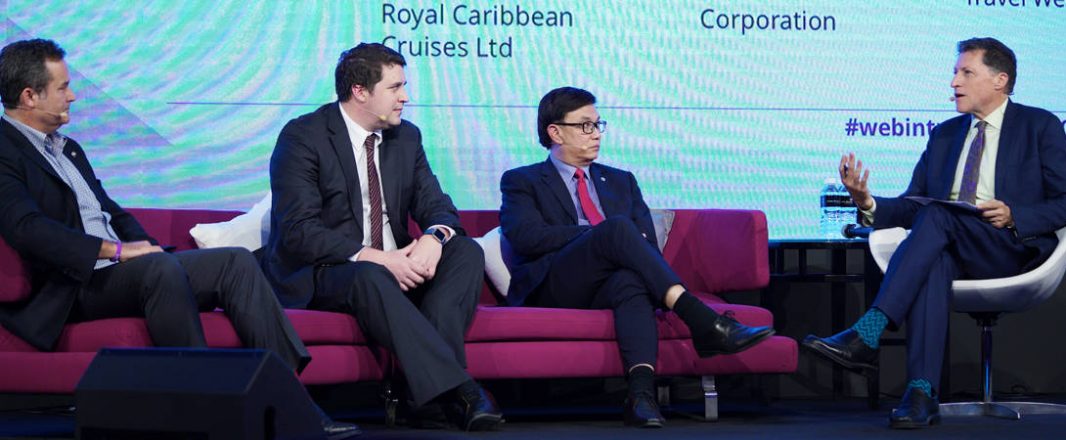
As Asia looks set to become the largest cruise market in the world, sea and river cruises companies said they have their eyes set on secondary cities in the region’s emerging markets.

Sean Treacy (right), managing director, Asia Pacific, Royal Caribbean Cruises, said the market he finds “really exciting” is Indonesia.
“If you look at the latest statistics in Indonesia, in 2015 there were about 40,000 cruises in Indonesia. Half the population, by 2020, will be able to afford cruises. I think it is a very attractive market focus,” he said.
Thatcher Brown, president, Dream Cruises, agreed with him. He said secondary cities in Indonesia are especially attractive. “Bandung, Medan, Surabaya,” he said.
“We look at outbound travel, GDP growth, middle to upper middle class growth. Vietnam is also very interesting to us.”
Since 2010, the cruise market in Asia has grown by 250%, and passenger capacity up three-fold.
South-east Asia is great because of its proximity to huge markets such as India and China, said Treacy.
 For Robin Yap (pictured left), president Asia at Travel Corporation, his river cruises’ focus in Asia right now is in the Mekong River and the Ganges River.
On plans to attract even more people to cruises, the companies said there needs to be more ports to call at.
Treacy said: “The greatest limiting factor is ports of call. As bigger and better ships come into the market, we’ll need more ports to call on.”
For Brown, he sees an opportunity in technology. “We just had a gentleman join from Disney to help us digitise the whole experience onboard. From ordering drinks to having the crew know more about you. Personalising is something we need to do to stay competitive,” he said.
If he could have any technology he wanted, Brown said he would want virtual immigration clearances so passengers do not have to go on shore to clear immigration face-to-face.
Treacy said it was difficult to put their rooms online because cruises have so many different room and activity options, but he was open to online travel agencies coming in to help.
 Brown (right) added that they are looking at limiting the variety of rooms to six to eight so it is easier to list their options online.
Yap, however, thought technology — apart from installing Wifi for the younger crowd and making their boats available for chartering — was not as relevant for river cruises where people want to “sit on the deck and look at the view”. His cruises also have smaller capacity.
He said: “At this moment, our biggest capacity is 156. We’re traditionally a business-to-business company, where distribution is done through agents. It’s not difficult to manage that.
“It’s not so much about unlocking the door by scanning your eye, but the ability to have a great time with travellers of the same age group.”