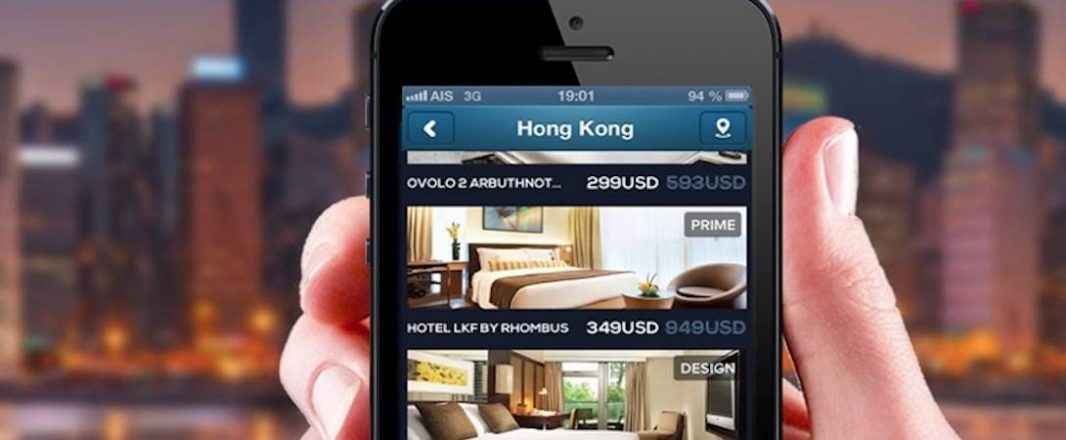
So will same-day booking apps disappear in three years? The statement made by HRS’ Tobias Ragge in this article has stirred a debate over the longterm viability of these models that allow travellers to book their accommodation within 24 hours.
.jpg)
Douglas Quinby
Douglas Quinby, senior director of research, PhoCusWright, admitting, “I am honestly not so sure about the last-minute booking market,” said, “The real question is, how big is the opportunity, really?
“A nice tuck-in for some OTAs? Almost certainly. Big enough for one or two standalone niche players? Probably. But large enough to support the endless onslaught of HotelTonight me-too’s, especially at some of the valuations being tossed about? Not a chance.”
For Quinby, what is more exciting about HotelTonight is the ease of the user experience. “With a curated list, stored payment and three taps and a swipe, there’s your booking. It’s a model for how to get mobile right and deliver a great user experience.
“It’s this principle – putting the user first with an intense focus on ease of use –that will change some of the big pain points in travel shopping: ground transportation (Uber is doing it already), in destination activities and tours, alternative accommodation, trip disruption (flight delays or cancellations) …”
Christian Mischler, COO of HotelQuickly, the Asian clone of HotelTonight, of course disagrees with Ragge’s contention – three months after launch, his app crossed 100,000 downloads, is now in 10 countries, has 300-plus hotels and is localized in six languages.
.jpg)
Christian Mischler
“He (Ragge) is simplifying/neglecting some important aspects of the model, which might be the reason why same-day mobile hotel booking will be around for much longer than he expects. He is right on the smartphone/tablet differentiation though.”
Mischler believes that even though giants currently dominate the global OTA market, there is room for new entrants to occupy their niche as the market grows, especially in Asia.
“OTAs are offering something for everyone, and need to please many different interests at once. A focused model with a clear value proposition such as HotelQuickly can target the needs of a specific user group much better than a generic player (simple comparison: even though you could also buy a shirt or trousers in a supermarket, you still prefer to go to a clothing shop, right?).
“This gives us a competitive advantage even over big and established players. The last-minute market (ie same-day booking) is estimated to account for more than US$90 billion globally. Even if we only manage to get a fraction of the market, we should do all right.”
Mischler said models like his are not here to replace OTAs – there will always be a need for pre-booking, or to find a hotel in a remote destination.
“We see our distribution channels as non-competing, as the positioning is clearly different from how OTAs position themselves. We don’t urge hotels to drop their partnerships with OTAs (unlike some of the big OTAs, which urge hotels to drop their partnership with HotelQuickly), co-existence is valuable in our opinion.
“Hotels appreciate an alternative distribution channel for selling off rooms in a semi-opaque environment – we don’t show room-types, shuffle inventory, etc, with that we protect brands and do not “educate” users to wait for the last-minute to book a certain hotel.
“This allows hotels to drop rate-parity concerns and truly optimize their RevPAR. OTAs are becoming (too) powerful for the hotels and can start to dictate terms and conditions, which is criticized a lot by hotels that we are talking to.”
.jpg) Weighing in on the discussion, Grahame Tate (left), managing director of IDeaS Asia Pacific, said, “App or no app, the propensity for on-the-day bookings is directly driven by the room availability in the destination city in the class of hotel you want to book at.
Weighing in on the discussion, Grahame Tate (left), managing director of IDeaS Asia Pacific, said, “App or no app, the propensity for on-the-day bookings is directly driven by the room availability in the destination city in the class of hotel you want to book at.
“In 5-star Hong Kong at the moment which is a fairly compressed market – risk an on-the-day-of-arrival booking at your peril, you may find yourself in a hotel that does not suit your needs or you may end up paying significantly more than a booking made further out.
“Regular travellers to Hong Kong know this and plan for it. Of course there will always be the last day booking traveller, leisure or business but an app is not going to make a huge difference to the volume of bookings.
“In markets where there is little or no compression then there is a much larger opportunity to secure a room on the day or the day before. I do it regularly – but I don’t use an app, I go to the hotel web site from an iPad (I don’t travel with laptop anymore) or iPhone or I simply call them – hey call me old fashioned.
“I don’t think the propensity to book is driven by the availability of an app.”
On a pure revenue management philosophy, Tate said that if a hotel thinks it’s going to fill or get close to filling but finds a day or two out that it was wrong in its forecast and unexpectedly has some distressed inventory, then putting this out on a channel dedicated to this (ie last minute less expensive rooms ) may work.
“Those people with “on the day apps” will be aware and can “pounce” and make a booking – any room that is sold that was going to go empty is a good deal for the hotel, right? But if the hotel is forecasting well and managing their inventory and pricing in line with industry best practice, their pricing should be consistent with the value and volume of demand to come regardless of whether the hotel will sell out or not.
“Consistently dropping your prices on the day of arrival to try and generate demand (or because your forecasts are not up to scratch) trains your bookers to wait till the last moment – rather than generate additional demand.”
Then of course there’s the hotel-branded same-day booking apps such as the one that China’s Jin Jiang Hotels recently launched.
Kathrina Gallogly, head of marketing for Mobile Travel Technologies (MTT), which developed the app, said, “Until recently, hotels had to go through an intermediary for their last minute inventory taking a further cut from an already discounted room. But if hotels, can do this directly through their own last minute channel, this is a key way for hotels to have a healthier yield on last minute rooms and to attract new customers to fill last minute rooms and then to leverage the relationship for future custom.”