After social, same-day booking apps are the most over-hyped subject in travel and Tobias Ragge, CEO of HRS, the hotel portal, believes most of them will not be around in three years.
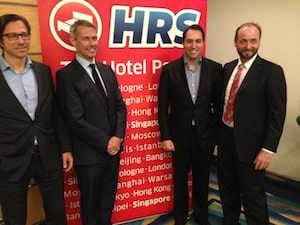
L-R: Ralf Priemer, board member, hotel.de; Jason Long, VP Business Development, HRS; Tobias Ragge and Christian Lukey
Here in Singapore to stake the claim of his company, founded by his father, to be the world’s number one in the managed business travel space, Ragge said same-day booking apps were not doing anything new that major OTAs and HRS weren’t already doing.
Even though he agrees that Asia will leapfrog Europe in terms of mobile activity, he said the same problem that faced Groupon will haunt same-day booking players. “You need huge sales force in inventory, you need to negotiate everyday rates. Bigger OTAs and companies like ours have network rates, we can activate it automatically. If I have to build up a system for a small volume of bookings, it’s not going to work.
“In Asia, you have a few of these players now. No one is making money, they will die out.”
He said even HotelsTonight, the leader in the space, which has raised US$35.7 million to date, would struggle. In July 2012, HotelsTonight reported two million downloads and in October, acquired Prima Table, a restaurant reservation start-up, an indication perhaps that it needs to go beyond hotels to scale the business.
HRS has a Hotels Now app with 750,000 downloads while its HRS App has 10 million downloads. Said Ragge, “You have to differentiate between smartphones and tablets. Smartphone bookings are dominated by business travellers – 75% are booking same day and 65% booking single rooms. The tablet is more of a couch device, usage spikes after 6pm and it’s used more by the leisure user. So the design of the user interface has to be different – smartphone is about transactional excellence, tablet is more about discovery.
“In Europe, we see activity at 6am in the morning and the second spike is between 5pm and 8pm.”
Ragge believes it’s too niche a market to make money and traction on normal hotel apps will be higher. “It’s an over-hype phenomenon like social – social is still more about engagement than transactions, no one has been able to monetize it.”
HRS, founded by his father 40 years ago to look after American travellers coming to Cologne, for meetings and exhibitions, has set up an office in Singapore to dig deeper into the markets in Asia. It’s been on an expansion path in the last decade; Tobias joined the company as head of marketing in 2004. It set up an office in China 10 years ago and in 1995, launched the first HRS website in multiple languages. Its acquisition of Tiscover and Hotel.de makes it the market leader in German-speaking markets with 51% market share compared with Booking.com’s 29%, the company claims.
In Asia, it will focus on its B2B offering of full hotel content to corporates, promising them 30% savings off negotiated rates, as well as work with partners like GDS.
HRS believes that its focus on independent hotel content in a market as fragmented as Asia will stand it in good stead against competitors such as the major TMCs like American Express, Carlson Wagonlit and others.
“In Asia, 35% of hotels belong to the top chains, 65% are independent, it’s a fragmented market. In the US, only 26% are independent. Our independent content is the key for adoption,” said Christian Lukey, the Singapore-based commercial director for APAC.
Over and above the 83,000 hotels in the GDSes, HRS has 167,000 independent hotels that’s been sourced by its own network. “You could say we are the world’s largest hotel chain,” said Lukey. The company doesn’t take commissions on negotiated rates and charges 15% on HRS market rates. An internal meta search within the HRS system also surfaces best available unrestricted rates to customers, offering up to 30% savings.
Ragge’s mantra is focus. Ask him if HRS will ever get into flights and he said, “Never ever.” Even if some corporates might prefer a one-stop shop where they can book flight and hotel? “No.”
He said, “Today’s world is way too fast, you need focus if you want to cover the world with what you have. Air doesn’t need an intermediary. With the development of IATA’s NDC, airlines will be able to build direct booking pathways. We have direct technology for those who want to use us directly (incidentally the bulk of their revenues) and for those who want to use us indirectly.”
Ragge also believes the “convenience of one-stop shopping” among corporates is legacy thinking and will be gone “sooner than we think”.
“The Asian corporate travel market is still immature – in the US, booking ratios using self-adoption tools are about 40%. In China, it’s below 10%. Labour costs are still low, offline transactions can still be done at a low price.
“But I am not so confident about the markets in Asia right now, China’s slowing down – there will be tightening of the Asian economies and pressure on companies to control costs and the second highest expenditure is travel costs.
“At the same time, the consumer in his private use is doing it himself. As self-booking tools get more sophisticated – the current tools are clumsy because they are pitched at a trapped audience – more corporates will adopt them. This leapfrogging will happen in a short time.”
To survive in hotel distribution, Ragge says you need to differentiate by providing excellent content especially in a fragmented market. “Players who build their own content, especially independent content, will survive – those tapping into chain content will be gone. Customers want coverage, only one third of the market here is chains, it’s not relevant to consumers and chains want direct distribution.”
But as badly as they want direct distribution, Ragge believes the market in Asia will still be dominated by OTAs. “Direct distribution might work in the US with 80% of content dominated by chains but here, OTAs will continue to dominate – the cost of direct distribution is too high, Google is now 25% more expensive. Essentially, Priceline buying Kayak is a hedge bet against Google.
“The concern is what happens if Kayak’s search begins to bias towards Priceline – well, if so, then the OTA model is dead.”
Citing the example of Roomkey, the hotel industry portal which raised US$7 million each from its six founding hotel partners, he asked, “How far do you get with $42 million? The owner of the property doesn’t want you to be pushing roomkey.com, they want you to push Marriott.com.”
Ultimately, Ragge’s aim is for HRS to “offer business process outsourcing” for companies. “Let us do it for you, we have more volume, more scale, you save on travel spending.”