
At WIT Seoul, the Representative Director & Executive Vice President of Korean Air, Kee Hong Woo took the hot seat to discuss how the national airline is faring in turbulent skies.
Woo was not shy about admitting that competition was heating up in the region. He pointed out how US carriers were making sizeable profits in domestic markets and are now looking outward to develop trans-Atlantic routes through joint venture partnerships.
“We are worried that all Chinese and US carriers are very price competitive and are going to make the economy very tough.” The next battleground he foresees is in trans-Pacific routes, which was the guiding rationale behind Korean Air’s joint venture with Delta Airlines.
Woo led the negotiations, which lasted an enduring several years. The hardest point to crack, he said, was that “it took a lot of to understand each other and accommodate each other.”
“US companies are very straightforward. They’re looking at the numbers. They have very extensive experience with JV agreements … they’ve done a lot of joint ventures with many players – European, South American, etc.”
Woo wanted a different approach and eventually, the two airlines agreed on a model of “incremental profit sharing”. “I think we can generate more synergies between the partners, than just sharing incremental revenue,” said Woo.
On top of that, Korean Air is one of many traditional airlines currently under pressure to keep their numbers up, as low-cost longhaul flights steal the spotlight in the eye of the consumer.
Asked who he had his eye on the most, Woo drew a laugh from the crowd as he remarked that ‘lowcost, long-haul’ is far from a new phenomenon.
“Actually, low-cost longhaul players have already been players for a while.” Citing airlines like Emirates, KLM and Air France, he said, “they are using [Boeing] 777s…just count how many seats are in the same row… that’s why they can set lower prices”.
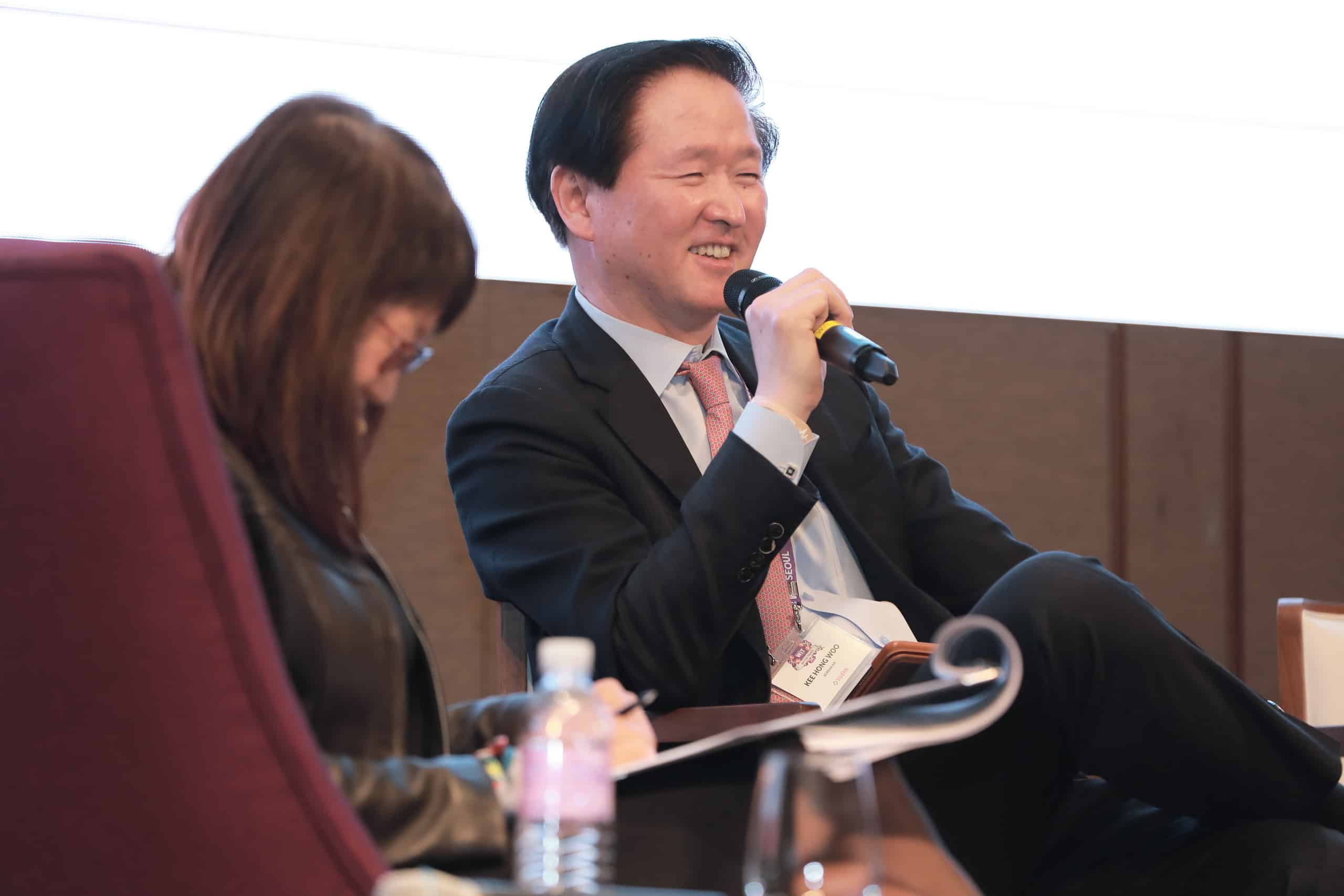
Korean Air, Kee Hong Woo discussed the national airline’s digital strategy at WIT Seoul 2018
To keep Korean Air ahead of the pack, Woo has made every necessary effort to ensure that the airline’s efforts in digital are kept up to speed.
For one, Woo was responsible for Korean Air’s host system development, which switched to Amadeus’ Altea back in 2014. “Before we migrated to a new system, we had different websites for Korea and other countries. We fully integrated into one. I cannot find a reason why a website in different countries should be different.”
“Before, we had a different booking engine in Korea, a different booking engine in the USA or Japan… it was not what was wanted but we could not develop just one website [at the time]… Now we have one global booking engine. It made Korean Air far more efficient, and fully automated.”
This is one of the reasons why the percentage of direct distribution is on a slow but noticeable rise. Woo admitted that the percentage was “not so big but it’s increasing… people choose Korean Airlines homepage because it’s convenient, it’s the same price and it’s reliable.”
He admits that there is definitely pressure to pick up the pace, as it gets ever more expensive to operate an airline, especially as global OTAs start to edge in on the market.
“GDS fees are huge for Korean Airlines” he said, not counting credit card fees. “There are a lot of fees.” As for ancillaries, Woo said Korean Air generates “very little”, compared to other airlines which have unbundled. “We provide two bags, meals… we provide a lot [for the passenger].”
When it comes to profit, he said Korean Air fared decently in spite of a difficult year in 2017.
“We are not the most profitable airline, but we did okay last year considering higher fuel prices and the [geopolitical] issues between Korea and China. We recorded about US$900 million in operational profits.”
Fortunately, there could be bluer skies ahead, given improved diplomatic relationship between South Korea, China and North Korea. Woo is cautiously optimistic, saying “it will take time for customers to feel more comfortable again,” before tourism numbers fully recover.