Estimated airline a la carte revenue worldwide in 2017 stood at US$57 billion, with European airlines leading at US$19.4 billion followed by Asian carriers at US$15.8 billion.
The estimates from the CarTrawler Global Statistics of a la Carte Revenue released by consultancy on airline ancillary revenues, IdeaWorksCompany, and leading B2B travel technology platform providing multimodal transport solutions, CarTrawler.
The report also adds regional details, comparisons to 2010 numbers, and a first-ever baggage revenue estimate to the projected airline ancillary revenue for 2017.

CarTrawler said in a statement the a la carte activity is a significant component of ancillary revenue and consists of the amenities consumers can add to their air travel experience.
“These include fees paid for checked baggage, assigned seats, buy-on-board meals, early boarding, and onboard entertainment. Of these, the revenue from checked baggage looms large with US$23.6 billion in estimated sales for 2017.”
According to the report, the prevalence of low cost carriers (LCCs) in a region drives the level of ancillary revenue, and a higher concentration of LCCs boosts ancillary revenue and a la carte results.
Commenting on the report Aileen McCormack, CarTrawler’s chief commercial officer, said: “The huge increase of 308% for a la carte revenue since 2010 offers testimony to the growing popularity of the low cost airline model and the a la carte approach to pricing.
“Be it global network airlines like Emirates in the Middle East, ancillary revenue champions such as AirAsia and Ryanair, and even traditional airlines like TAP Portugal, all are becoming better retailers to encourage consumer spending and to boost returns for investors.”
Car hire and hotel booking capabilities also allow airlines to better serve the entire spectrum of consumer travel needs, she added.
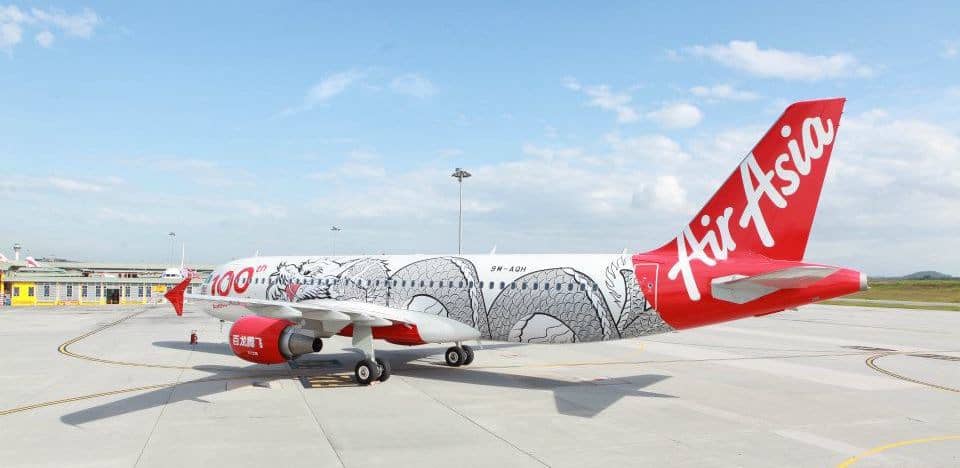
Ancillary revenue champions, such as AirAsia, are becoming better retailers. (Image credit: AirAsia)
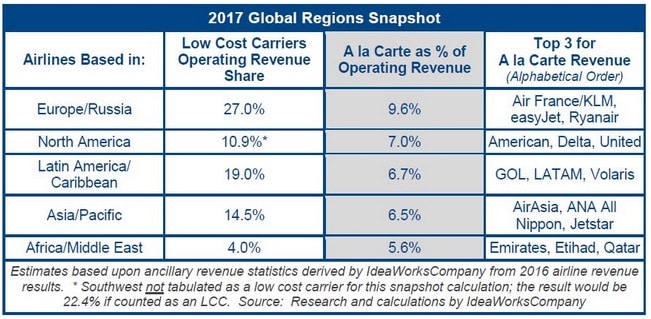
Here’s the 2017 Global Regions Snapshot from the report, which demonstrates how a la carte activity varies by region.
- Europe leads the world for a la carte activity and LCCs generate an impressive 27% of operating revenue for airlines based in Europe and Russia. It’s no surprise the region is also tops for a la carte revenue as a percent of overall airline revenue. Ancillary revenue champs easyJet, Norwegian, and Ryanair have broad networks that have influenced the business models of every airline in the region. This has lifted the a la carte result to nearly 10% of the operating revenue for airlines based in Europe and Russia.
- North America has lower LCC penetration, especially with Southwest operating more like a traditional airline in terms of a la carte services. But here, it’s major airlines such as Air Canada, Delta and United that have embraced a la carte methods. Look for increases here (and in Europe) as trans-atlantic airlines begin to add fees during 2018 for the first bag checked.
- Within Latin America, the market is rapidly changing with airlines such as GOL, JetSmart, and Volaris challenging the status quo of all-inclusive airline pricing. Regulations are also changing; during 2017 Brazil allowed airlines to charge fees for checked bags on domestic flights.
- The Asia Pacific region has a long LCC tradition with the vast network reach of the AirAsia group leading the way. However, the region’s global network and traditional airlines have been far slower to adopt the a la carte methods now embraced by US- and Europe-based network airlines. Only within the last couple of years have regulators in China started to voice support for LCC development. Once the low fare model becomes prevalent in China, it’s easy to imagine how quickly this will be embraced by its consumers.
- Africa and the Middle East lag in low cost carrier and ancillary revenue development. The top a la carte revenue producing airlines are rated as such because of their large size, and not for aggressive retail activities. The region’s significant low cost carriers are limited to Air Arabia and flydubai which each posted ancillary revenue in excess of $300 million for 2016. The growth of LCCs and ancillary revenue is stifled by entrenched government control and ownership of airlines.
Taking a quote from the classic movie Lawrence of Arabia, “Big things have small beginnings”, CarTrawler said the words applied to the growth of a la carte revenue.
“What once was largely absent from Africa, Latin America and the Middle East has grown more than threefold to be a global revenue phenomenon that touches every region of the world. It most certainly is led by low cost carriers, but now is relied upon by traditional airlines in search of more revenue.”
Within the region traditional airlines are compelled to match the pricing strategies of their LCC competitors starting on shorter routes and for long haul flights in the most developed regions.
IdeaWorksCompany predicts the world will eventually match the results produced by Europe. Global low cost carriers will achieve an operating revenue share in excess of 25% and a la carte activity will represent 10% of overall revenue.
“This is indeed a “big thing” which delivers an array of choices for consumers. Many more travellers in Asia, Africa, and South America will enjoy a newfound ability to choose the maximum savings of a basic fare product or more comfort and convenience from an a la carte menu. Business models are changing and only the most skilled of airline retailers will flourish in this rapidly evolving environment.” it added.
• Featured image credit: SAHACHAT/iStock-Getty Images