Two former employees of Expedia have launched their own startup, Zuzu Hotels, to help consumers find good quality budget hotels in Asia as well as help hotels in the 2 to 3-star category get better at branding, distribution and revenue management.
Vikram Malhi, who worked with Expedia for eight years, and Dan Lynn, who spent 10 years of his corporate career at Expedia, later HomeAway, said that the difference between their model and others operating in the increasingly competitive budget hotel space is that they will offer a curated model, ensuring quality and consistency, and act as consultants to these independent owners.
“Unlike consultants however, we will put our brand on it. We will be more than an OTA, we will be a virtual hotel management company but without the upfront capital needed by owners,,” said Malhi, who started working on the startup in January, a few months after leaving his last position at AirAsia Expedia.
“A hotel management company typically offers brand, expertise in revenue management and operations management and generating demand from OTAs and other channels. We will do three – brand, revenue management, generating demand from OTAs,” said Malhi.

Dan Lynn and Vikram Malhi: Bringing their corporate career expertise into their first startup focused on budget hotels.
“In terms of operations, budget hotels are pretty good at it and it’s a pretty simple model. They have no pool, no fancy restaurants. We will of course provide input and advise them on how they can improve the guest experience.”
He said he saw the opportunity for a hybrid budget hotel model after running Zuzu Hotels for the first few months when the original idea had been to offer an OTA model.
“The fundamental challenge is, if you want to offer good quality budget hotels, you have to stay true to that problem. If you have 6,000 hotels, you can’t control the quality and you then say I am going to be an OTA – and there’s room in the market, this is the segment not being looked after by the big OTAs like Expedia, Agoda or Booking.com.
“As we began talking to the owners, we found they needed beyond generating demand. Some of them could tell us their rates in December and you shouldn’t be able to do that if you know revenue management, so now we have a deeper partnership with our hotels.”
While this all sounds good, the challenge is consultancy is hard to scale while a pure tech play in creating a marketplace is relatively easier. Lynn, who came onboard this month after finishing his stint with HomeAway, is aware of the challenges but believes this is where ZuzuHotels can offer the most value to both consumers and hoteliers, and differentiate in a crowded marketplace where other competitors have more cash to spend.
Said Lynn, “We’ve been in the industry for long enough, and we want to help budget hoteliers – we understand the piece that’s missing. They are phenomenal in managing the guest experience but need help in distribution, marketing and promotion.
He acknowledges they are getting into a competitive space where models like OYO have raised $187.65m to date and Malaysia-based Nida Rooms recently raised US$4.2m in April.
“A lot of people have identified a big opportunity in budget accommodation, it is the most fragmented, largest segment that traditional OTAs haven’t focused on. A lot of companies are going after it in a different way. OYO has so much money, they can try five different models. Treebo and Fab Hotels, they work deeply with a few hotels and add value to the consumer. The market will figure out which will deliver value.”
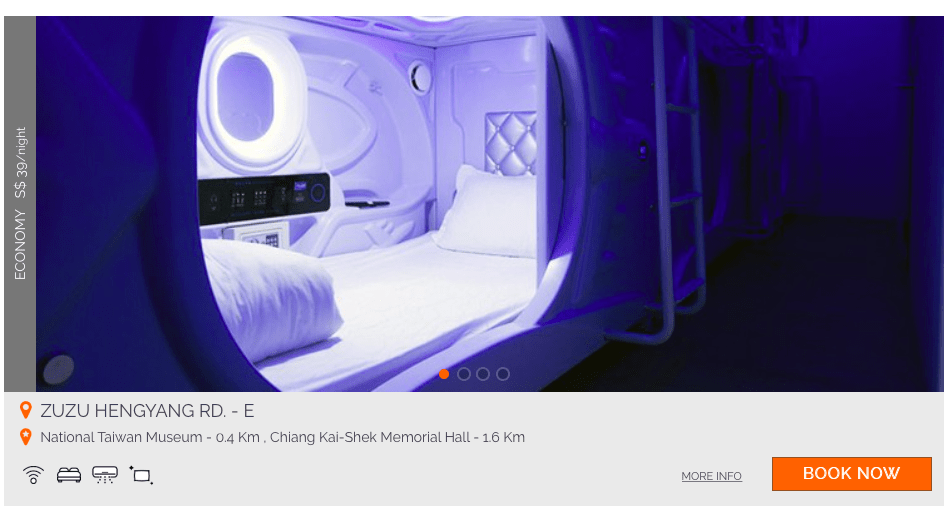
Example of a ZuzuHotel in Taipei
The company has US$500,000 in committed funding and a team of 12. It has about 300 hotels in Indonesia and Taiwan. Taiwan is what Lynn is most excited about. “That’s our biggest market and we will also be in Indonesia and India. Because we want to go deeper, we can be multiple in other countries pretty quietly.”
He said they were testing a few models – either taking a commission on online bookings or a cut of the profit. “We are testing a few models to see what owners like,” said Lynn.
“We are not trying to be everything to everyone – essentially we see two sets of customers, business travelers on short trips and the younger customer who doesn’t want to spend a lot of time in hotels but out there, experiencing,” said Malhi.
It’s built a loyalty programme similar to Hotels.com – stay 10 nights, get one free. Malhi, who was involved in that programme with the Expedia Inc brand, and Lynn believe it is the most compelling and rewarding proposition out there. “We already have one guy who won two free nights,” said Malhi.
Lynn said the loyalty programme worked from both investors’ and hoteliers’ perspectives. “You want to think about repeat rates, not constantly acquiring customers. It’s one way to grow slowly and cost-effectively. For hoteliers, it’s part of the proposition we offer.”
For both executives, it is their first startup. Laughed Vikram, “I am probably too old to do a startup but I saw an opportunity in the market that the big OTAs weren’t keen on. We want to be hoteliers, just tech-enabled hoteliers.”
Said Lynn, “I have wanted to work in travel since I was 13. Where I grew up, you were either a farmer or fisherman or you worked in tourism. In corporate life, I’ve learnt an awful lot of what to do, what not do to. Now after 10 years, I feel ready to put that into a startup.”
Added Malhi, “There are problems at local market level that big companies are not interested in solving, now I am asking, can I solve this problem? You also realise there’s no one you can call to do stuff – here, it’s you and you alone. But then you get to control and manage it, and you get much more immediate feedback so you move faster.”
Lynn said another change in mindset is around spending money. “You shift that when you put your own money into something. You are careful about spending that dollar.”
But the mindset that they will keep is the “test and learn” culture. “Now we get to apply it on our own,” said Lynn.
As for how they complement each other, Lynn said, “At the risk of sounding sentimental, it’s emotionally. It’s having someone you can bounce ideas off, or just to say, I am stuck, can you take over? We have pretty similar backgrounds, expertise-wise, but I know I couldn’t build a startup by myself.”
Asked if his experience in HomeAway, in alternative accommodation, would factor in the new startup, he said, “There is no reason why a budget hotel experience should be bland. Citizen M delivers a business model that also offers an experience. The industry is changing – rooms are smaller but communal spaces are getting bigger. The latest Tune Hotel is a very different design from the first. So I do see ways in which alternative accommodation can play a part.”
Their challenge is to be able to deliver value quickly to hotels and “as we do that, they become more confident in reinvesting. We must also make sure we keep our quality as we grow and scale,” said Malhi.
Finally, why the name Zuzu? “We wanted something fresh and modern,” said Lynn. “Something that rhymed,” chipped in Malhi. “And as Rich Barton (founder of Expedia) said, always create your names, build your brand and put an X or Z in it,” added Lynn.