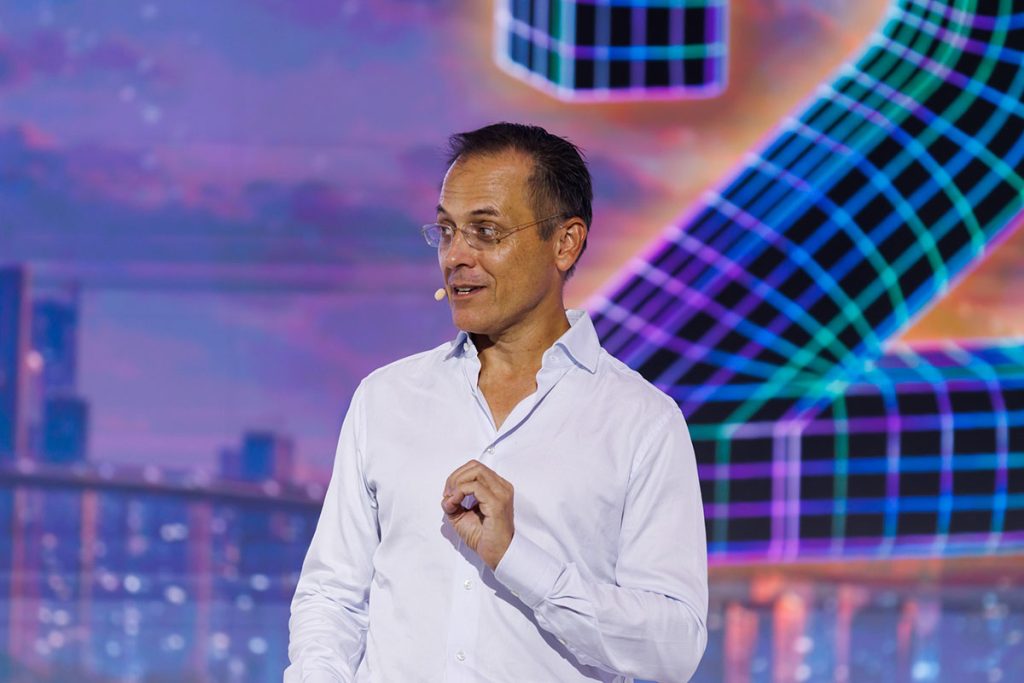
Every Big Bang is the end of something else. In his thought provocation at WiT Singapore 2026, Queen’s Road Capital CEO Fritz Demopoulos argued that the winners of travel’s next beginning won’t be the smartest people in the room, but the most intentional.
Fritz Demopoulos has built companies, sold them, and spent the last decade deciding which of the next ones deserve his money. The Qunar co-founder, who watched the company he helped start end up in Ctrip’s hands, opened Act 2 of WiT Singapore, “The Provocation Moment”, with a simple proposition.
Travel is a giant. It is second only to financial services, and edges out healthcare and pharmaceuticals. Asia, Europe and North America each account for US$3.2 to 3.6 trillion in business a year. But only one of them is growing at 7 to 9% a year, two to three times faster than North America.
“To use an F1 analogy, Asia is in pole position.”
The most interesting region, the most interesting people
Travel sells something no other product can, he said. “Psychological ROI is the most important. And anytime you have psychology involved in anything, infinite possibilities exist.”
Then came the test. Ask a North American where they’ve been and you’ll hear Cleveland, Providence, New York, Phoenix. “Is that interesting? Kind of.” A European offers Florence, London, Munich, Stockholm. “A little bit better.” Someone from this part of the world rattles off Ho Chi Minh City, Bangalore, Hong Kong, Tokyo, Osaka, Taipei, Delhi.
“Now we’re talking.”
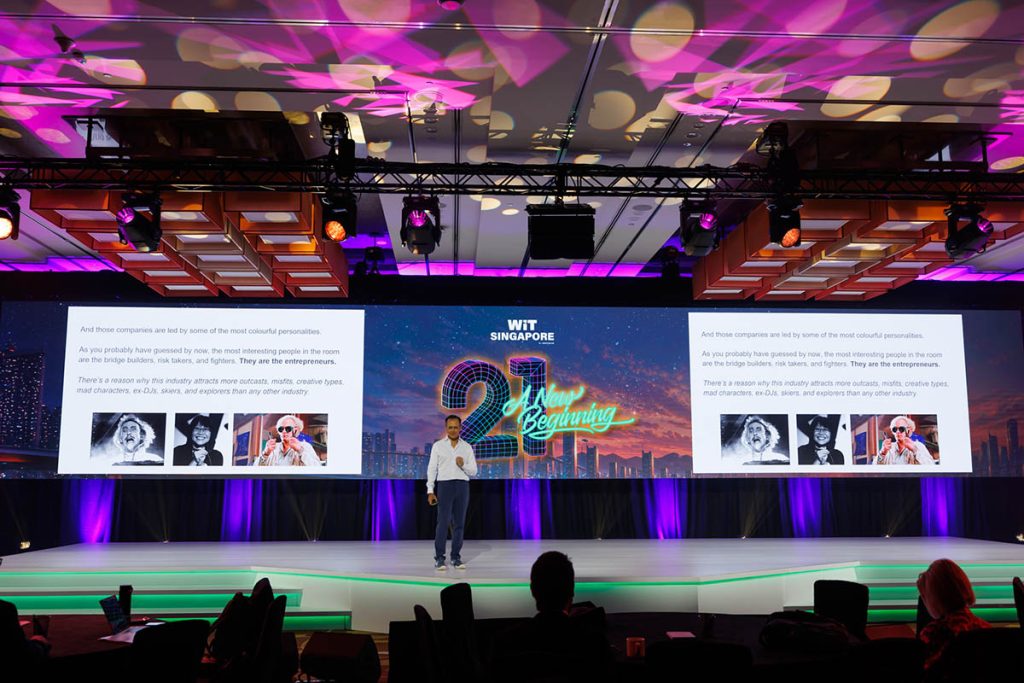
The region produces some of the industry’s most successful companies, led by some of its most colourful personalities. And the most interesting person in any room, Demopoulos said, is the bridge builder, the risk taker, the entrepreneur. He recalled WiT’s 20th anniversary, when the conference was described as a gathering of “the misfits, the outcasts, the mad characters, the ex-skiers, the ex-DJs, the explorers. More than any other industry.”
“So I’m grateful to be in travel and tourism, for sure.”
The universe before ours
Change is everywhere, and Demopoulos admitted he struggles to understand its nature. So he borrowed from physics. Sir Roger Penrose has suggested the Big Bang was not simply the beginning of our universe, but the end of the one before it.
Travel works the same way. “The industry doesn’t just stop. Old models collapse or they fade away so that a big bang of new products, experiences and businesses can begin.”
The forces are already visible: the shift towards experiences, ecotourism and sustainability, emerging markets like India, off-the-beaten-track adventure, new business models. And AI, which promises to upend not only how we discover and book travel, but how we experience it.
Who thrives? “Definitely not the smartest. Those who are fastest to change and adapt.” Then the investor’s grin: “If you’re both smart and you can change and adapt well, talk to me after this session. I’m happy to invest.”
The trouble is seeing change coming. “If you’re skiing off-piste in Hokkaido, you may not be aware of the avalanche until it’s only a few metres away.” Hence the questions every leader must keep asking: how to stay relevant, when to pivot, when to reinvent, what to learn next.
His twist on Woody Allen’s famous line: “80% of success is recognising that we must change.”
The intentional ones
To show what that looks like, Demopoulos turned to the people around him. A roll call of WiT regulars, each a study in reinvention:
- Omri Morgenshtern, CEO of Agoda, who has added global B2B business services for Booking to his portfolio.
- Ross Veitch and Craig Hewett, co-founders of Wego, who started in Singapore targeting Southeast Asia and became one of the top metasearch engines globally, especially in the Middle East. “These two founders love to slay dragons, and they love to do it with a grin.”
- Rod Cuthbert, “the godfather” of two verticals, tours and activities and multimodal search. “His strategic insights meet creativity.”
- James Liang, the empire builder, co-founder of Ctrip and Home Inns. “Enough said.”
- Kei Shibata, the fearless flyer, who co-founded Travel.jp and Trip101 and is a championship downhill skier, with “unlimited capacity for taking risk” despite being in semi-retirement.
- Aloke Bajpai and Rajnish Kumar, IIT hostel mates who founded ixigo and pivoted from flight metasearch to every mode of transport. As Aloke likes to say, they started their F1 race on a bicycle and still ended up on the winners’ podium.
- Stephan Ekbergh, who went from DJ to Swedish entrepreneur to building one of South Africa’s largest travel companies. “Music, passion and adventure equals Stephan.”
It might look random, he said. It isn’t. “They are all extremely intentional in how they react to change. They don’t let change define them. They create themselves.”
The rules for staying curious
Demopoulos then shared his own playbook for continuous learning:
- The rule of 3: Learn three new things every day to broaden your bucket of knowledge.
- The rule of 5: Borrowed from Toyota, ask “why” five times on any topic. Meet someone from Japan? Ask five questions about the Japanese market. India, same. Tours and activities, same.
- The rule of 20: Make friends with someone 20 years older and someone 20 years younger. “They might provide you a perspective you haven’t thought about.”
- The magazine stand: Pick up a magazine on a topic you’ve never considered. Flying out this week? Try it.
- Book the unexpected: Use Klook, GetYourGuide, KKday or Airbnb to book an experience you never thought you’d do.
- Raid the experts: Ask people what blogs, podcasts and books they rely on. “Try to understand what information they are absorbing.”
- Agoda’s Tim Hughes rule: Reach out. Tim did it effectively during COVID. “You might learn something by reconnecting with an old friend.”
- Go to class: Online courses are easy. Or attend a conference. To really spur creativity, some say, go to a science fiction convention like Worldcon.
From number two to number one
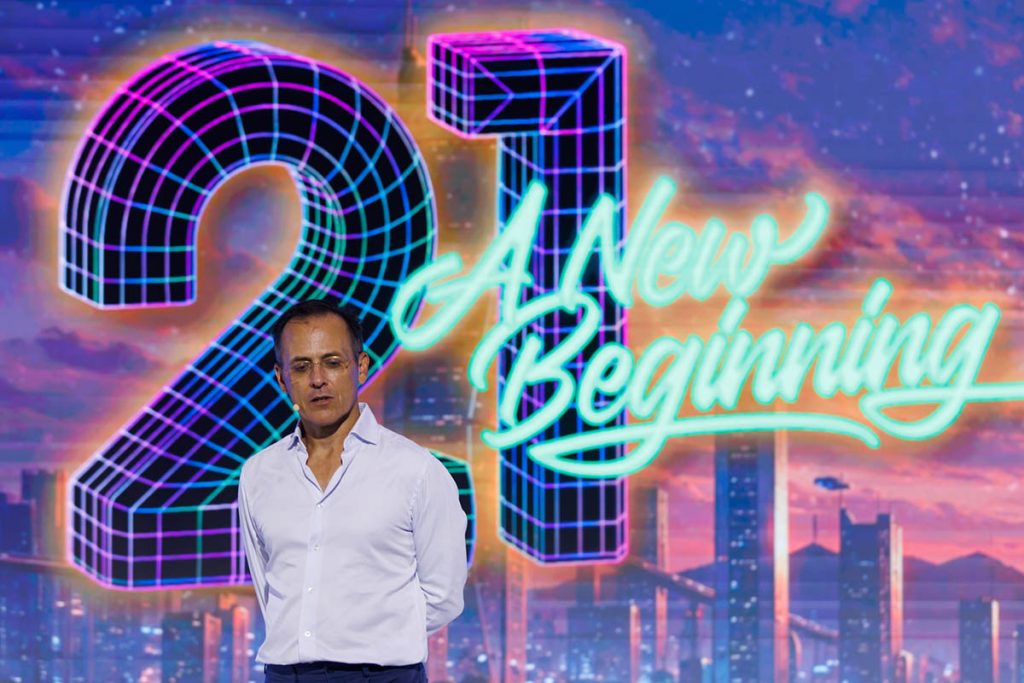
So what does a new beginning demand? Not genius, Demopoulos suggested, but intention. The founders he named didn’t wait for the avalanche. They organised, focused and chose who to become.
He closed with George Bernard Shaw: “Life isn’t about finding yourself. Life is about creating yourself.”
And a challenge to the room. Do that today, he said, and “make our industry not number two next to financial services, but number one.”
Watch the full session: