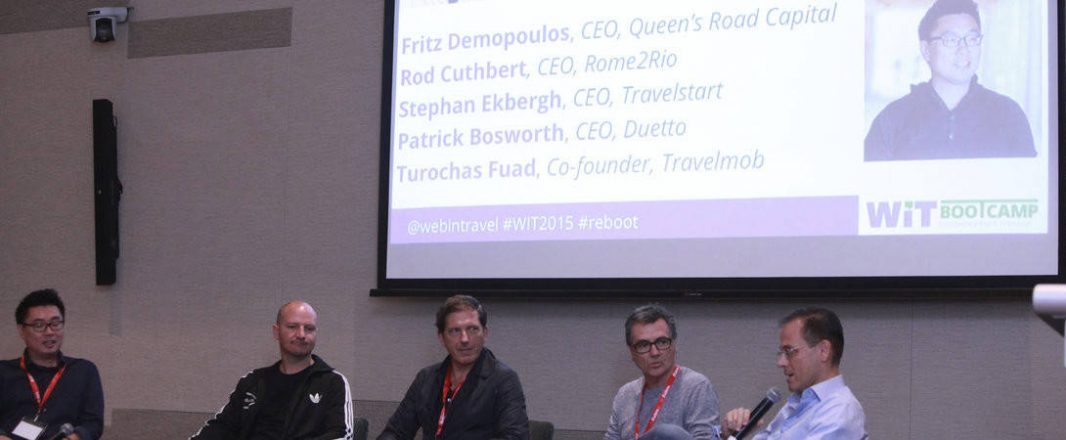
Travel industry leaders Fritz Demopoulos, CEO, Queen’s Road Capital; Rod Cuthbert, CEO, Rome2rio; Stephan Ekbergh, CEO & Founder, Travelstart; Patrick Bosworth, CEO & co-founder, Duetto and Turochas Fuad, Co-founder, Travelmob kicked off the first panel of the WIT Bootcamp on October 19 in Singapore, providing insights into the struggles and successes of their startup journey.
The panel began by sharing how they turned their competitive disadvantage into an advantage. Almost all panelists cited difficulties in gaining traction that amounted to ‘moving mountains’. For Fritz, it was that he had no domain expertise at all; a journalist asked if he believed he was “too old” to be in the Internet business. Rod described how at the start of his career (as founder of Viator) tours and activities played second fiddle to flights and hotels. However, this also proved to be an advantage as Viator was able to dominate the sector. “We stuck with it, even though we knew we were too early,” he added.
At the start of Stephan’s entrepreneurial career he struggled to raise money and had to bear rejection everyday. Ultimately it proved to be an advantage as the company stood the test of time and after the 9/11 tragedy it was the only company standing.
In Patrick’s case, knowing – and accepting – the level of technical difficulty of implementing a revenue management system for the hospitality industry allowed him to maintain a keen focus on his goal. His team were unified around a common understanding and rallied around the fact that they were addressing a huge need in the industry. In Turochas’ case, Travelmob was seen as the sixth or seventh player in the market, competing with travel giant Airbnb.
The panel also revealed critical mistakes made early in their careers and how they rebooted themselves. Bad hiring decisions were a common theme, with panelists admitting that human resources can make a significant difference in the success of the business. Determining the key audience for the product or service is also critical: often businesses build a B2C product and realize belatedly that reaching customers can often be difficult. The solution is to pivot their offering to cater to the B2B market, an approach commonly seen in the startup world. Building the right partnerships with investors is also of paramount importance. Already on his fourth round of funding, Patrick described how he interviews all the CEOs of the companies who invest in Duetto to understand how they would respond in various scenarios, including failure.
When targeting a new market, startups should try to understand the market, said the panelists. These included recognizing who the incumbent players and service providers are, the size of the market, a risk assessment on how hard it would be to integrate into the existing landscape, how influential the market is in the region as well as whether potential customers care about the product and service. The question to ask, said Rod, was whether you could build something interesting – and how hard it would be.
The panel concluded with a quickfire round of questions covering which companies they wish they had built and how panelists would describe the culture of their companies, as well as the most salient advice they had to offer. These included a reminder not to overvalue risk: “Risk is far less risky than you realize.” “Take everything with a pinch of salt,” “Keep your team small and effective,” and “Be first and think big – don’t work on anything too niche.”