In an era where human touch is not welcomed, baggage handling and retrieval are going the same way too, as discussed in SITA webinar on baggage solutions for the aviation industry in a post-Covid environment.
In his opening remarks Peter Drummond, portfolio director baggage, SITA, stated it has been a difficult year for the entire airline industry and the baggage community. On a positive note there has been a drop in the number of mishandled bags.
“Ordinarily seeing the low numbers of mishandled bag reports in WorldTracer (SITA/IATA service provided for the tracking of lost or delayed baggage) would be cause for celebration, but in this case our world has changed completely during this pandemic. And the effects are likely to be long lasting,” he added.

Apart from WorldTracer, the multinational information technology company also has SITA Bag Journey providing airlines and airports with tracing data that complies with IATA’s baggage tracking Resolution 753.
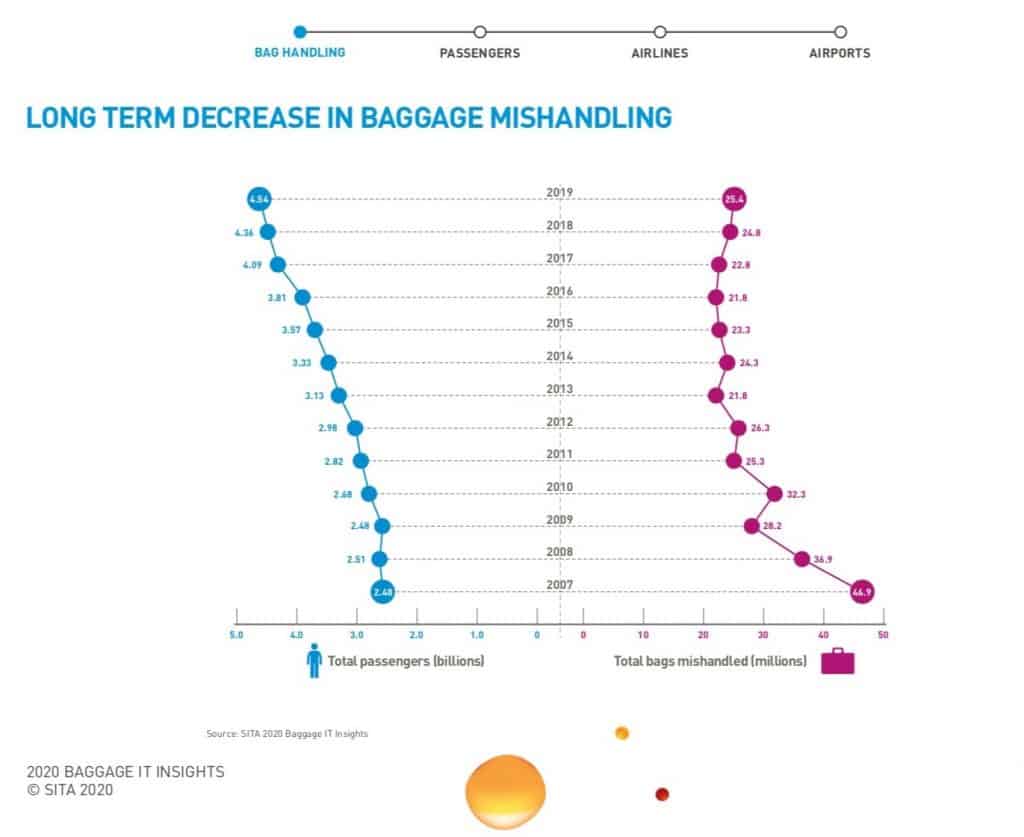
These solutions plus working together with air transport industry stakeholders had seen the number of mishandled bags “tumbled considerably by 45.8% from 46.9 million in 2007 to 25.4 million in 2019,” revealed Drummond. This reduction was achieved while passenger numbers were reaching 4.54 billion in 2019.
“The key milestone 2019 was a total rise of 2.4% on the mishandled bags, the lowest percentage increase since SITA started reported the mishandled bag trends since 2003” (see chart below)
Specific investments have helped deliver significant cost savings: automation, smart technology and, more recently, the International Air Transport Association’s Resolution 753, which requires airlines to track bags at the four main touchpoints (make-up, loading, transfer and arrival) across the journey, he added. The air transport industry’s annual bill for mishandled bags has been cut by 40.8% since 2007 to $2.5 billion last year.
SITA found that passengers who embrace self-service technology to process bags as find the experience less stressful than non-technology users. This difference is particularly marked at the end of the journey when travellers are waiting at the baggage carousel to be reunited with their luggage. Satisfaction among those who received real-time collection updates on their mobiles was 8.6% higher than those who relied on screens or public announcements.
According to SITA’s 2020 Baggage IT Insights (download here), a third of all passengers have already adopted self-service technologies to process or manage their bags throughout the journey. In 2018, 48% were comfortable using kiosks to self tag their luggage, while 20.5% were at ease with self-bag drop kiosks. On arrival, 26% of passengers were receiving bag collection updates on their mobiles.
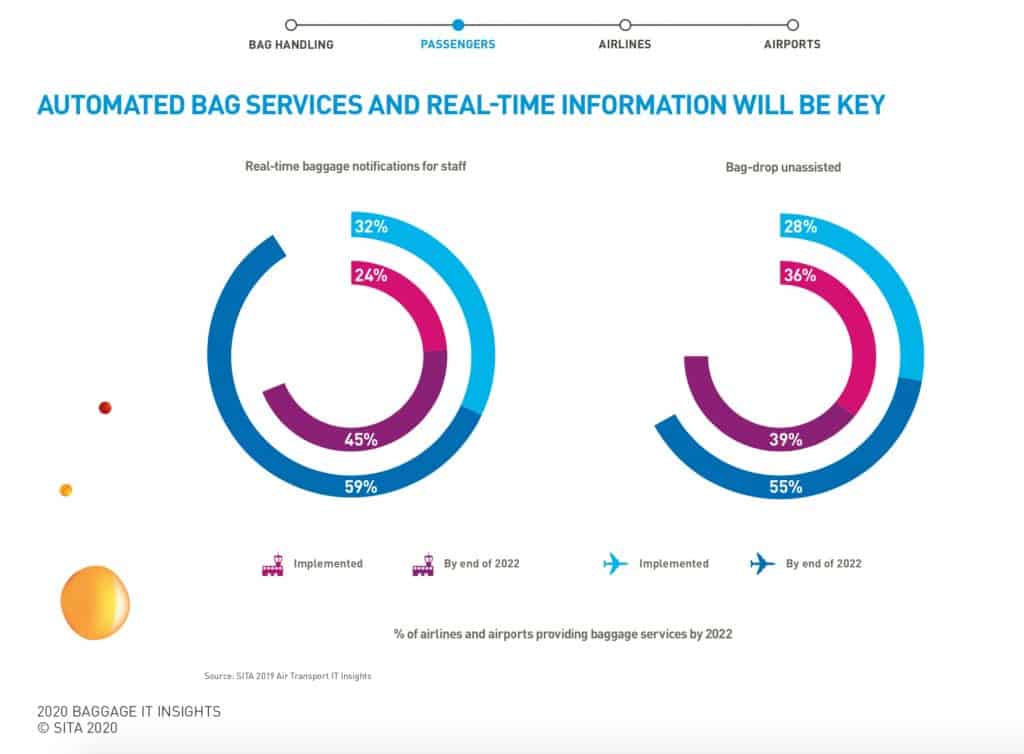
Airlines are responding to passengers’ desire for real-time bag tracking on their mobiles: 22% offer this service and implementations are projected to reach 77% by 2022.
Real-time bag tracking information for staff is more advanced, provided by 32% of airlines and forecast to grow to 91% by 2022. Airport implementation is slightly slower: 24% provide this information to staff and this is expected to rise to 69% over the next three years. (see chart below)
“And this is against previous thinking in this area where passengers really wanted to speak to a human when their bag has been mishandled. And it seems that increasingly people don’t want to talk to people about their problems.”
On the current situation and how it affects baggage Drummond that even though air travel would not return to pre-crisis levels until 2024 “implications for baggage management are significant and for must be addressed”
He said new protocols at airports would change the way baggage is managed.
“Airlines may begin restricting carry-on bags as an added safety measure and to reduce the flow of passengers onboard the aircraft. Emirates has already taken this step limiting committee cabin baggage to laptops, handbags and briefcases or baby items. And as a result, the percentage of passengers check in bags may actually increase, which is in contravention of the current situation before Covid.”
The need for social distancing also means that queues at the airport will require more physical space, and could lead to more off air or baggage check in services. There is also an increased demand for contactless and self service technologies on arrival and on departure. Changes that could take place in the baggage sector.
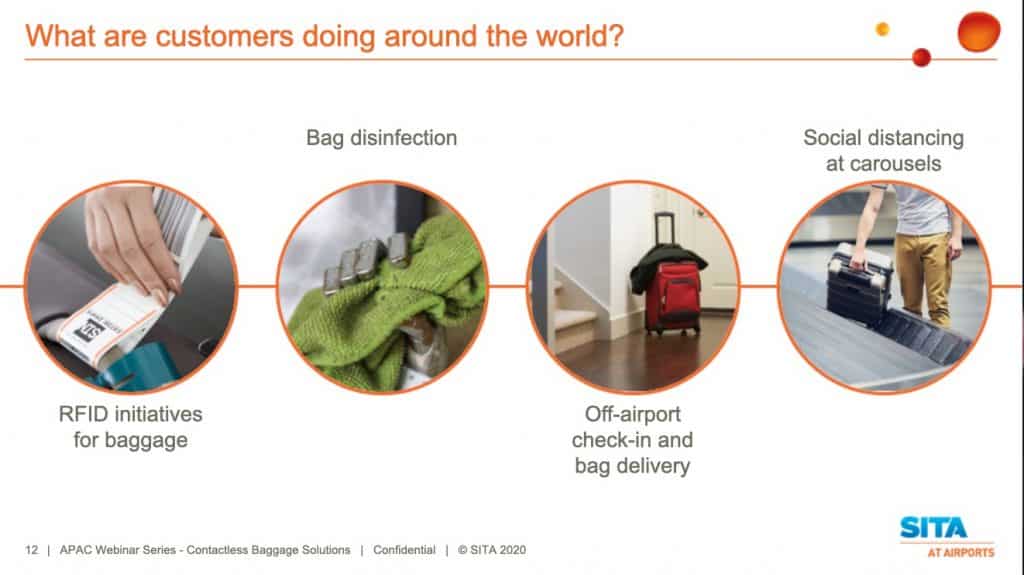
On what its aviation companies are doing around the world to meet challenges posed by the pandemic in baggage handling, Drummond cited as examples China airports resuming RFID initiatives for baggage, disinfection for baggage in some situation with robot and using UV light as another mechanism to disinfect the aircraft.
Smooth baggage handling is a key factor in reducing passenger stress and contributes to a positive experience, stressed Shanti John, senior manager, SITA’s business development at airports, Asia Pacific.
To achieve high levels of passenger satisfaction key performance indicators (KPIs) are defined and measured by airport stakeholders. Baggage handling KPIs are challenging because they are best achieved through community collaboration. Stakeholders therefore need to exchange accurate, timely information using a common language.
“Today when a flight arrives, passengers wouldn’t necessarily know when their bag is actually ready, as it physically on the belt, and hence there will be a tendency for them to head straight to the carousel. And this is what we want to avoid,” said Shanti.
The first step is to capture the bag status on a arrival. “Now in these times when airports are reducing costs, consolidating operations across various terminals, and also shutting down their baggage handling systems in some cases in favour of manual operations, there is less likely of an appetite for expensive automated fixed scanning infrastructure at arrivals”.
To ensure there’s no loss of operational data, mobile tracking solutions become very relevant. The mobile device is used to track a bag easily when used in conjunction with a bag tracking application.
“This enables an agent at the arrivals belt, the arrival area or breakdown area to use the camera on the phone, scan a bag and capture important information and timestamps related to that bag. For example, the delivery carousel but the bag will be delivered to the passenger information like seat and sequence number, as well as the flight information,” said Shanti.
Another solution is to use API to effectively manage physical distancing and arrival of passengers to the belt, Shanti disclosed. “It provides an easy way for you to take this data and consume it within your own environment, which means basically ingest it into an airport or an airline mobile application and share it directly with passengers.” (see chart below)
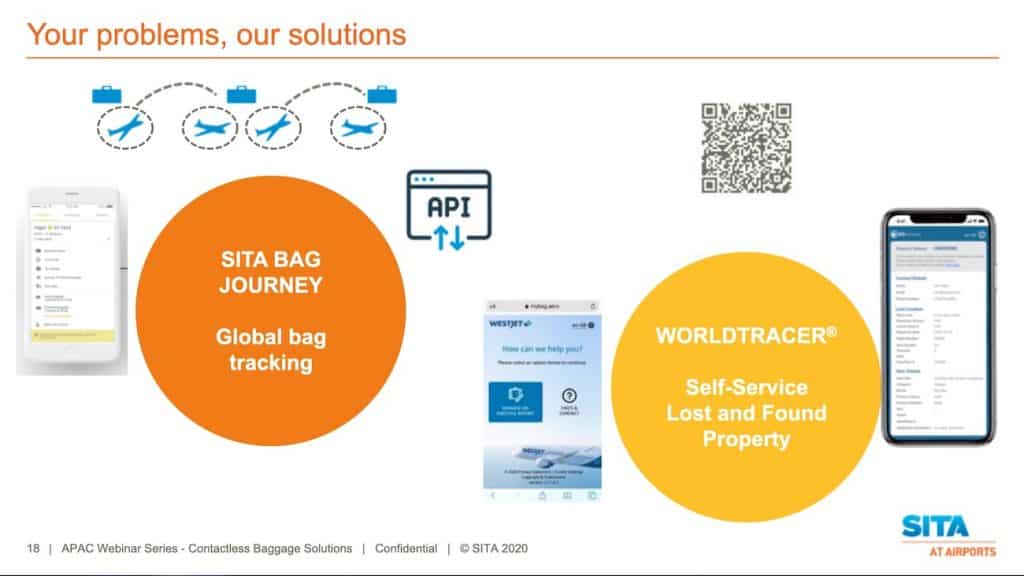
The mobile bag data can easily be integrated with an airline application, providing the passenger with a bag pickup ready or SMS notification, dependent on when the bag is actually on the belt. “As an example, I can receive a message on arrival saying ‘Hello Miss john your bag will be delivered to belt number 45 in 10 minutes, please arrive at the belt at this time.’”
API can also integrate with the airport fit system. The API data containing the passenger flight and bag information can be used to sequence bags, as they are loaded to the delivery belt and showed on split screens.
“So this is much like the McDonald’s takeout scenario where you order your burger and then you wait, away from the counter and look at a separate delivery counter where they will give you a cue number for when your burger is actually ready. This enables an airport to sequence bags, as they are unloaded to segregate them so that you can also space passenger arrivals at the belt.” said Shanti.
According to the 2020 Baggage IT Insights, SITA is introducing a fully- automated service to track delayed bags during the last stretches of their journey back to the passenger’s home or office, and to speed up the repatriation process. It also plans to trial a cloud-based app that uses artificial intelligence to automatically match and reunite passengers with their lost property.
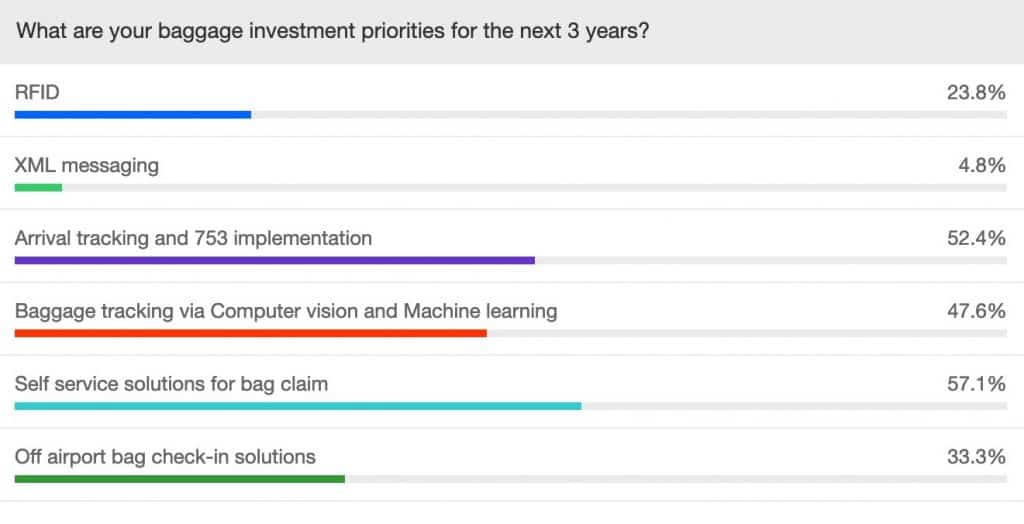
Aviation companies seem to favour self service solutions for bag claim judging from the results of the poll (see chart below) on what their baggage investment priorities are for the next three years, with a majority (57.1%) voting for this option. Arrival tracking and IATA 753 implementation (52.4%), as well as baggage tracking via computer and machine learning (47.6%) are also deemed worthy investments.
• Featured image credit: Chalabala/Getty Images