
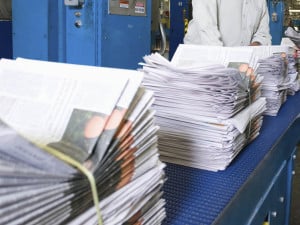
Photo credit (man and woman working in newspaper factory): www.istockphoto.com
I come from the world of print publishing. I cut my teeth in print journalism. In the newspaper where I trained as a cadet reporter, the presses were located in the basement of the building and each night, we would hear the presses roll.
I recall one morning the boss throwing a huge fit when he saw the early edition. Someone, a disgruntled employee perhaps, had tinkled with the printing plate and substituted the letter “C” with “T” in the words “Chief Minister”.
The boss was not amused by this early act of “hacking”.
I wonder what the boss would think now of how the Internet has turned the print world upside down. And if he had thought that the first wave was bad enough – that anybody could literally set up their own publication online – imagine what he would think now of this second wave.
This second wave, we call social media.
As I listened to Kathleen Tan, AirAsia’s regional head of commercial, talk about how her airline was using social media to communicate, promote and sell, I couldn’t help but think about how the boss would have reacted.
Here’s an example of a company and advertiser who has basically created its own media on an open social network. Call it the Facebook Times.
The terms used may be different but it uses similar principles of publishing. In the print world, you create an editorial product. You sell that content to readers. You then sell your circulation to companies who wish to advertise to your readers.
With AirAsia’s “Facebook Times” model, it’s got an “editorial” team, creating and “provoking” editorial content. Around that content it’s gathered “fans” (readers). Having created its own “circulation”, it then “sells” messages and products to the “community”.
There’s one fundamental difference. The first model costs a lot of money to establish – which is why my old newspaper closed down a long time ago. The second costs a fraction.
There’s another difference. You own that second model. And that’s a powerful proposition indeed.
With your own media platform, you can now use it to sell your products and services. There’s no need to advertise with external parties, offline or online. With its November campaign, which it ran through its Facebook Fan Page, AirAsia spent a mere 20% of what it used to spend in traditional media.
Of course, just as many companies aspire to but cannot set up The New York Times, neither can everyone achieve the same success as AirAsia seems to have done with its Facebook Fan Page.
You could argue that it’s got the right product and the right audience for the right medium. And it’s got the will and street smarts to get it right – it knows it needs people with the right mindset and skills to champion it.
Last year, there was much talk about how social media was more hype than substance and that it was difficult to measure return on investment unlike in search. This year, the story is playing out differently.
I am not convinced that print is dead – it will morph like everything else to fit into the new environment – but the fact that any company can create their own Facebook Times is something to be watched.
But as the boss would say, “It’s still about creating the right content for the right audience at the right time.”
And he would then throw back his head and laugh, “I am glad I am in editorial, not sales.”
The boss always believed that those who knew how to tell stories would do well in any age.
Featured image credit (Retro styled image of an old typewriter) : iStock