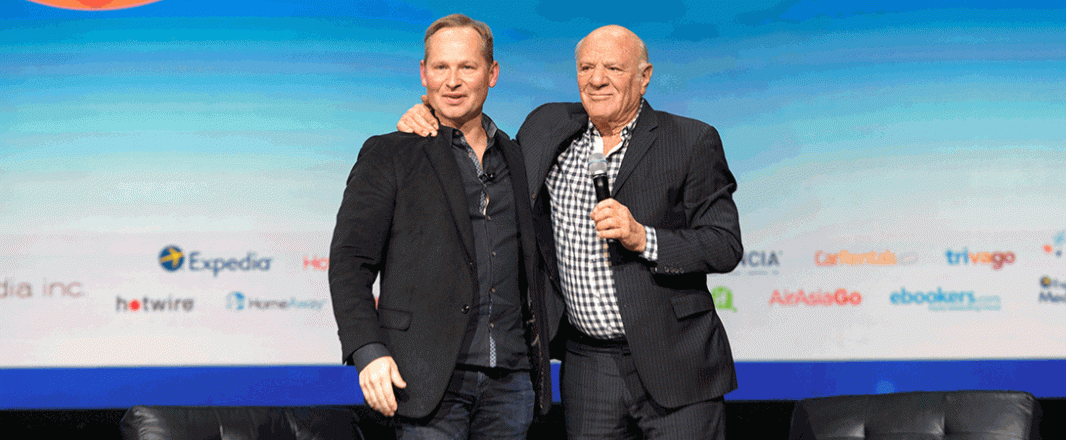
Long game or infinite game, whatever the term you choose to use, I am sure there was purpose behind the choice of Simon Sinek as keynote speaker at the Expedia Partner Conference held in Las Vegas last week.

Simon Sinek: “The goal is not to win every battle but outlast the competition” (Photographed by Adam Shane Productions on a Nikon D5)
Sinek, who’s working on a new book called “The Infinite Game”, drew an analogy between business and the Vietnam War in which Americans won every battle but still lost the war because “we were fighting to win, they were fighting for their lives”.
“We dropped out of the game because we lost the will,” he said, adding, “The goal is not to win every battle but outlast the competition.”
Sinek, author of “Start with Why”, outlined five rules in the infinite game:
- Just cause – is it inspiring enough for people to make sacrifices for it?
- Courageous leadership – sacrificing short-term goals for long-term interests of people. Don’t ask, how do I get the most out of people; ask, how do I care for my people?
- Vulnerable team – an environment where people feel safe and free to speak up and fail
- Worthy adversary – even though the only true competitor is yourself, you need someone to pace yourself against, just as in a race
- Open playbook – willingness to play by new rules even if it means having to blow yourself up.
Former CEO Dara Khosrowshahi has always stated that online travel is a game of inches and that Expedia is playing the long game, a mantra clearly embraced by his successor Mark Okerstrom.
During a media briefing when quizzed by a journalist about the company’s lackluster stock prices in the third quarter, Okerstrom said to focus on this was short-term thinking. “The math is in our favour and strategy is in our favour,” he said.
He referred to Expedia’s “Incredible role in the world”, adding, “This world is more interconnected than ever in tech, culture and news. Our role is to be the truly global platform to facilitate physical movement as a service to the world.”
Using tech to level the playing field for big and small, chains and independents

Cyril Ranque: “We don’t think an economy driven by global groups is healthy for travellers.”
Sinek’s speech clearly got Expedia senior executives thinking about their “just cause”, with Cyril Ranque, president of lodging services, saying, “Our just cause is to use our technology to make the travel ecosystem more efficient, effective and better.”
He said that the mission was to level the playing field with “competitive economics and tools” to allow small and independent properties to be as successful as chains.
And without a tinge of irony, he said, “We don’t think an economy driven by global groups is healthy for travellers. It is important we build an ecosystem that allows all players to be successful, the sustainability of our model depends on that.”
It is pretty obvious who Expedia’s “worthy adversaries” are. When asked to name worthy companies it paces itself against, Okerstrom named Booking.com, Google, Ctrip and Airbnb.
“Our Intrinsic motivation is we can do something different and better for customers and partners than any of our competitors by leveraging our global tech platform end to end.”
In evolving its model beyond distribution, the core of its business, and potentially disrupting itself, Expedia has also shown it is willing to embrace an open playbook.
Referring to Steve Jobs’ just cause as “empowering the individual to compete against huge corporations”, Sinek said the late Apple CEO embraced an open playbook, believing “it is better we blow ourselves up than to let someone else do it.”

Art along The High Line in New York City
Diller’s love for public spaces
In his closing interview, chairman Barry Diller talked about his love for public spaces and his admiration for people who put up statues in public spaces. “It’s not curing diseases but to be responsible for giving great pleasure to people in communities is something without which we would be bereft.”
Projects like the High Line in New York City have exceeded expectations. “When we did it, we thought we’d get 350,000 people. The first year, we got three million, last year, we got 6.5 million. It’s influenced city planners around the world who want to create their own kind of High Line.”
“I don’t delude myself that we will have an effect like the Gates Foundation but I hope 50 years from now, millions of people will be surprised by pleasure that hadn’t existed before.”
The day Dara got THE job
Diller also made no doubt about his loyalty to Khosrowshahi, his CEO for 12 years, who left to head Uber, and that his sense of humour remains unaffected by the loss.
When Okerstrom asked him to pick between Uber and Lyft, Diller said, “As long as our Dara is with Uber, everyone in this room must never use Lyft.”
Asked to relate the story on what unfolded on August 27, the day Uber announced Khosrowshahi as its new CEO, Diller responded, “It’s a great story, not a great story for Expedia but that depends on you.”
Recalling how ironically he turned out to be the one who told Khosrowshahi he had got the job, Diller spoke of he had tried to convince him to stay and not go over to the “completely dysfunctional” Uber.
“But the challenge of revolutionising Uber was too compelling and I said, alright, if that’s what you want to do, let me help the process.”
He said succession planning is hard for most companies and people to do but “it took us 90 seconds and here you are,” he told Okerstrom, “You were there and in a position to succeed and hopefully you will.”
If you work in travel, this is your just cause
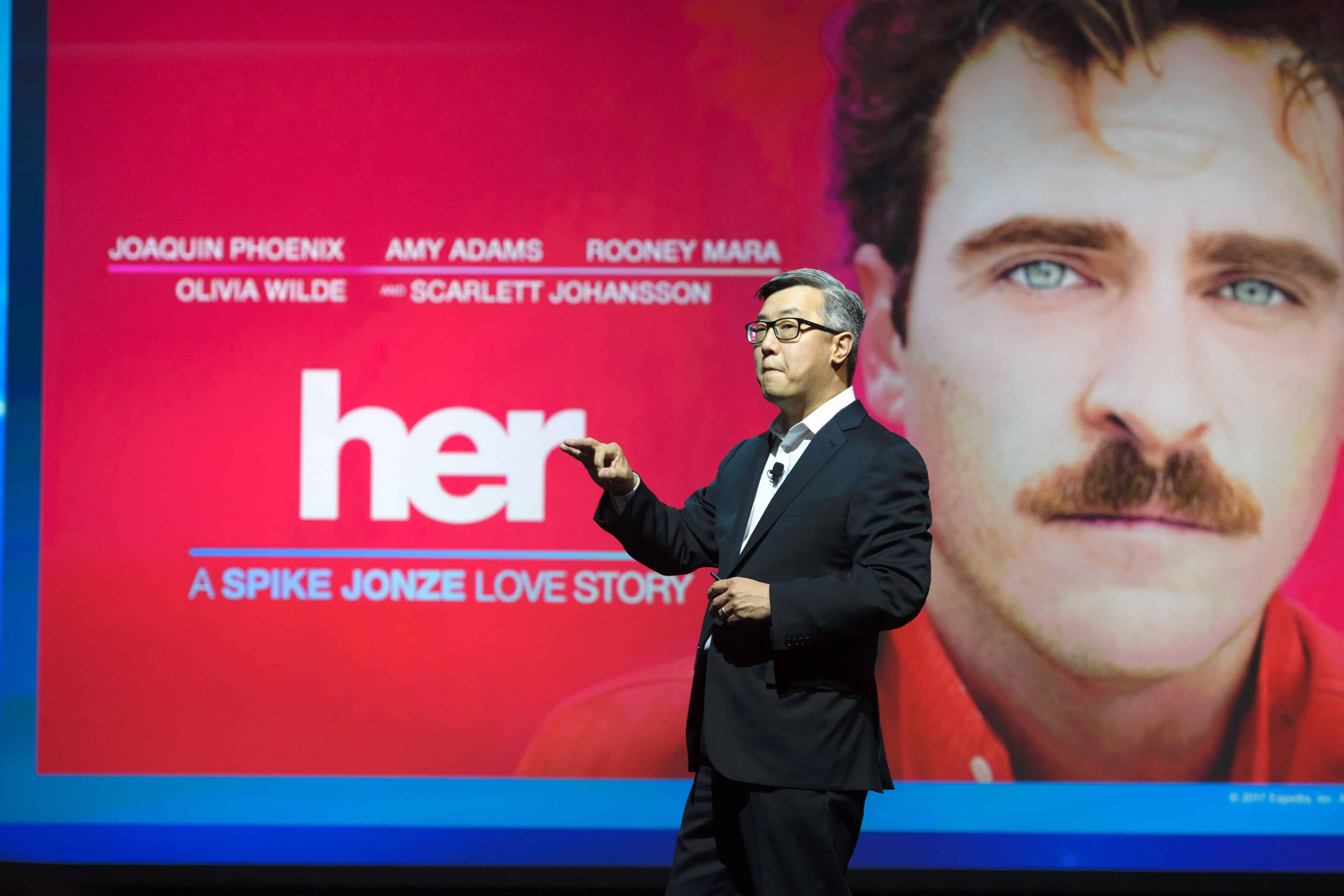
John Kim: ““While the world seems obsessed with replacing people, I am happy to be in travel, a job engine for the future.” (Photographed by Adam Shane Productions on a Nikon D5)
In his presentation, John Kim, CEO of HomeAway, offered the just cause for everyone working in travel. As we move towards an uncertain future where tech will threaten traditional jobs, kids do not know what jobs will be there for them when they graduate and youths are feeling lonelier with less dating, less hanging out with friends and less sleep, he said, travel is the cure.
“While the world seems obsessed with replacing people, I am happy to be in travel, a job engine for the future, to be in the front line of the battle to keep people connected to travel.”
Calling it an era of exponential change, Kim said, “Ideas are spreading faster than ever before.” The last Youtube viral sensation, Gangnam Style, took two years to reach 2.9b views; Justin Bieber’s Despacito reached 4.6b views in six months.
While Gangnam Style’s growth was linear, with Despacito, every single country saw the lift at the same time. Calling it a global unified culture, he said, “We are trending towards something.”
He said 10b people would have Internet access seven years from now and the iPhone was created 10 years ago. “We are closer to the next seminal moment in tech than to the past, and we’re just getting started.”
Destruction before production
When Diller was asked by Okerstrom how he felt about the current tech revolution in machine learning/AI and fears that it will replace jobs, he said he believed there would be replacements in all sorts of areas we can’t even conceive yet.
Referring to the Industrial Revolution when it was asked “what will we do with all these people”, he said, “There’s always a dislocation period – there is the luck of timing in almost everything – and there will be a period of destruction before production. It will be disquieting for some but out of it will come bounty for everyone.”
He believes “voice near term is going to change so many things, and it’s just at the beginning” and as for autonomous cars, he declared, “I will be the last person driving and still making dangerous moves.”
In his keynote, Sinek, author of “Always Ask Why”, said beyond thinking of business as the infinite game, we should also ask ourselves, how do I live the infinite life? Life may be finite but we can still live the infinite life, he said.
“There’s a choice in how we play the game. How do we improve people’s lives after we’ve gone? How do we help people become better version of themselves and leave the world in better shape than when we came in?
“It’s more inspiring to live that life because then you can live forever.”
• Featured image credit: Expedia