
Male travellers could save up to $48,000 a year by booking the same way women do, according to a recent study conducted by Carlson Wagonlit Travel (CWT) Solutions Group.
That is the estimated savings amount for a company with 1,000 travellers, of which 70% are presumed to be men.
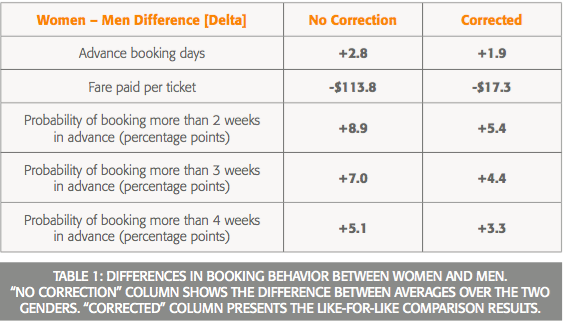
The propensity for female business travellers to book slightly ahead (by an average of 1.9 days) was calculated to save $17.30 on the average paid fare in comparison to male travellers. Whilst the amount only makes up to approximately 2% of the average ticket price, its aggregate impact is difficult to ignore.
To look at it another way, a traveller base of 21,000 would aggregate over $1 million if men exhibited the same advance booking habits as women.
CWT conducted the study on a data set of 6.4 million air-booking transactions during 2014 (limited to round-trips with at least 100 tickets) by a sample of 1.8 million travellers aged between 25 and 70 years old, with a 70:30 male-female ratio.
It was intended to identify any potential gender differences in “advance purchasing behaviours” (number of days between booking and departure dates) amongst business travellers and the financial impact they have on travel spend.
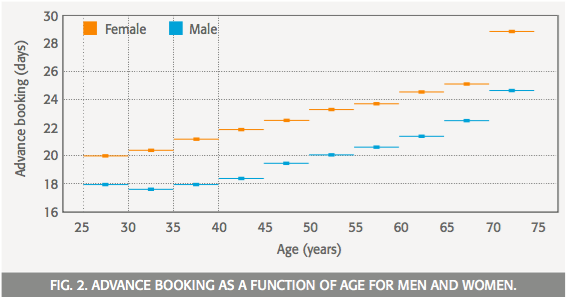
Women consistently ranked higher for advanced bookings than male counterparts across all age categories.
The report also declared that age played a role. Older travellers (between 30 and 70) tended to book trips farther in advance by an average of 5 days. Nevertheless, women consistently ranked higher for advanced bookings than male counterparts across all 10 age categories.
However, an employee’s travel frequency (as measured by number of business trips per year) correlated with a decrease in advance bookings. This was attributed to the percentage of short-haul flights and lower lead time (time between the decision to travel and actual booking).
Higher travel frequency also saw the gender gap between advanced booking behaviour diminish. The gap was highest for lowest frequency travellers (1-2 trips per year). This may reflect how travel planning habits differ in other contexts like leisure.
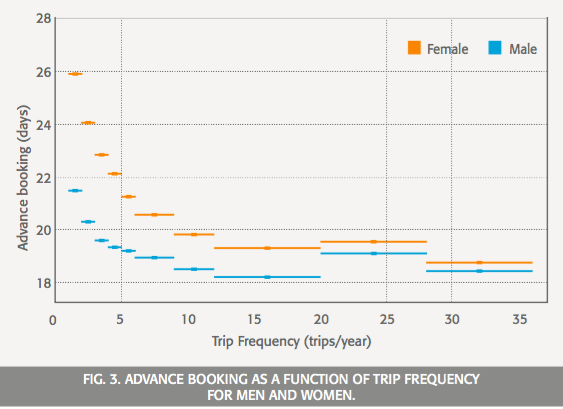
Higher travel frequency also saw the gender gap between advanced booking behaviour diminish.
This is supported by CWTs observation that when controlling for corporate travel policies (therefore assuming that travel planning habits are the primary factor in determining booking purchase), women were more likely to book 2-4 weeks or more in advance than men.
Resting on the assumption that advanced bookings correlate positively with lower cost, advance purchasing behaviour trends are hoped to provide insight into how corporate travel can be managed more efficiently and effectively.
Additional points to consider:
The average ages of men and women in the sample were roughly equal (43.3 for women, 45.2 for men) but traveller distribution by age for men and women showed a higher percentage of women travellers in the 25-30, 30-35, and 35-40 age range.
A more focused data set on advance booking behaviours on narrower age groups may reveal more about the magnitude of differences between men and women. For example, whether or not the gender gap persists to the same degree between younger travellers (e.g. millennials) compared to older counterparts (e.g. baby boomers).
Finally, while the study concluded that the advance booking patterns of women could amount to vast company savings, factors that account for the 1.9 day average difference between men and women remain elusive.
Are female travellers more price-conscious, or are they simply better at planning ahead?
Why are there far fewer women travellers than men, and is this imbalance changing?
How do these habits differ internationally?
What influence does job role have on travel booking habits? Are these roles typically dominated by a particular gender?
Given that travel frequency and the ease of the booking process are both increasing, will we see advance booking behaviour differences declining?
If businesses want to become more cost-effective when it comes to corporate travel, gender differences in advance booking habits may only be the tip of the iceberg.