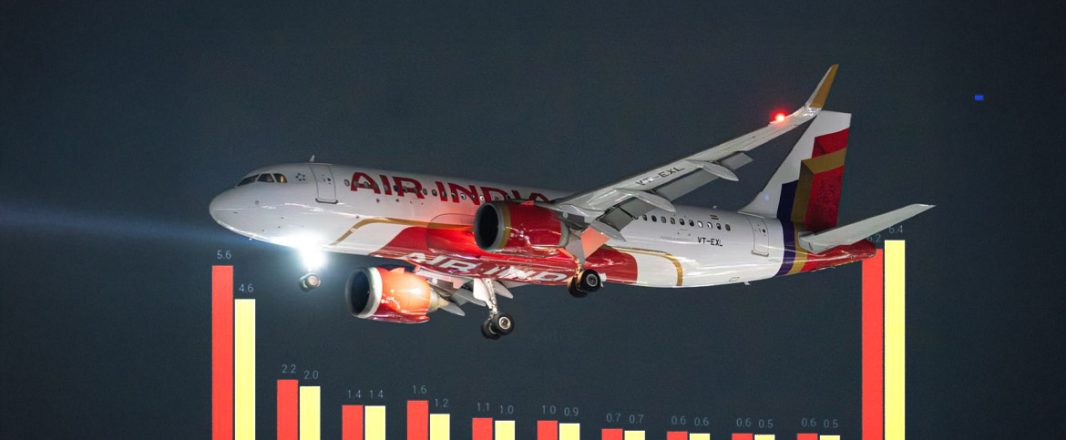
Geopolitical disruptions and rising costs have weighed on India’s outbound travel market in 2026. Between January and August 2026, Indian outbound departures reached 19.8 million, down nearly 8% from 21.5 million during the corresponding period in 2025.
The pace of decline, however, has moderated in recent months. Outbound departures fell by an average of 4.5% year-on-year during June-August, compared with almost 19% during March-May. While the market remains below last year’s levels, the easing points to a gradual stabilization in international travel demand.
The overall contraction masks sharply different outcomes across destinations. The Gulf still commands the largest share of outbound travel, while several Asian markets are growing despite the wider slowdown.
GCC remains India’s largest outbound corridor
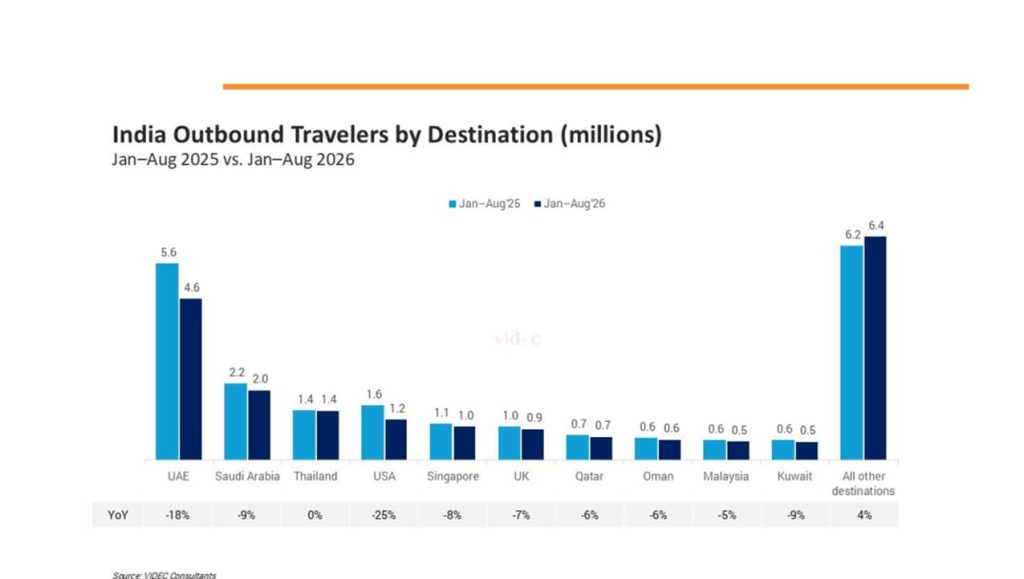
The Gulf remains central to India’s outbound travel story, underpinned by air connectivity, a sizeable Indian diaspora, business and religious travel. The UAE and Saudi Arabia held their positions as India’s two largest outbound destinations, together accounting for 33.5% of departures during January-August 2026, even as their combined share slipped from 36.5% a year earlier.
The UAE led with 4.6 million Indian departures, compared with 5.6 million during the same period in 2025. Despite an almost 18% decline, more than twice the overall market contraction, it still accounted for nearly one-fourth of India’s outbound traffic. Saudi Arabia followed with about 2 million departures, down 9% year-on-year. Its share was broadly stable at 10%, as the overall outbound market contracted.
Qatar, Oman and Kuwait also maintained their positions among India’s top 10 outbound markets. Together, they drew around 9% of departures, which is markedly significant for them considering the significant dent in their inbound visitor traffic due to the ongoing West Asia disruption.
These longstanding links have sustained the Gulf’s lead, even as flight disruptions have depressed departures and Asian destinations have gained ground.
Southeast Asia retains its appeal, emerging destinations gain ground
Southeast Asia benefits from shorter flying times, extensive air connectivity and sustained leisure demand, although individual markets performed differently in 2026.
Established Southeast Asian markets such as Thailand, Singapore and Malaysia either saw their passenger volumes decline or remain flat.
Thailand held its position as India’s third-largest outbound destination, with 1.4 million departures. While volumes were flat, its market share rose from 6.6% to 7.2%. Singapore recorded a 7.6% decline in passenger volumes, but its share held steady at nearly 5%. Malaysia saw a relatively smaller decline of 5.3%, with its market share unchanged at 2.7%.
In contrast, Vietnam and the Philippines were among the region’s fastest-growing destinations, with Indian arrivals increasing 33% and 32%, respectively, during January-August 2026.
Beyond Southeast Asia, East Asian destinations also attracted more Indian travelers. Japan and South Korea each recorded 19% year-on-year growth during January-August 2026, indicating stronger demand for both markets.
These gains stand out against the broader contraction in Indian outbound departures. Beyond the top 10 destinations, departures collectively rose 4.2%, increasing their share of India’s outbound traffic from 28.6% to 32.3%.
Long-haul travel faces mixed demand
Long-haul travel also came under pressure, most notably to the US, India’s fourth-largest outbound destination. Departures fell 26% to 1.2 million during January-August 2026, the steepest decline among the top 10 markets. The US share of outbound departures fell from 7.3% to 5.9%.
The UK recorded a smaller decline of 7.2%, leaving its share unchanged at 4.5%. Traffic to Canada also weakened. The sharper US decline is notable given North America’s importance for visiting friends and relatives, education and business travel.
International aviation faces operating pressures
Disruptions in West Asia and rising operating costs contributed to the pressures facing India’s international aviation market during the first half of 2026. Total international flown passengers, covering both inbound and outbound traffic, declined 5.2% year-on-year to 36.2 million during January-June 2026.
Indian airlines faced higher fuel costs, rupee depreciation and operational challenges associated with the conflict. Pakistan’s continued airspace restrictions have compounded these pressures, forcing Indian carriers to take longer routes to Europe and North America, particularly from Delhi. Air India and IndiGo are now planning to shift selected international services to Navi Mumbai, which offers an operational advantage through its more favourable location for westbound flights and additional airport capacity.
Indian carriers’ combined international passenger traffic fell 18%, while foreign airlines registered almost 6% growth. As a result, Indian carriers’ share of international traffic declined from 46.3% in the first half of 2025 to 40% a year later.
Air India Group recorded a 26.5% decline in international passengers, while IndiGo registered a 9% fall. Foreign carriers saw mixed performance, with Emirates, Etihad Airways, Singapore Airlines and Lufthansa registering growth, while Qatar Airways and Air Arabia recorded declines of 16% and 4%, respectively.
The differences in airline performance, alongside changing destination preferences, underscore the broader challenges facing India’s international travel market.
What’s next?
India’s outbound market is showing signs of stabilization, but recovery is likely to vary by destination. The Gulf remains the largest destination corridor, even after a decline in its share, while Vietnam, Japan and other Asian markets are drawing more Indian travelers.
Recovery will depend on the affordability of fares and reliable air connectivity. Oil prices, currency movements and geopolitical tensions will shape how quickly the market can regain momentum.
About the author: Virendra Jain is the co-founder & CEO at VIDEC Consultants and specialises in commercial due diligence (CDD) and mergers and acquisitions (M&A) in the travel sector.