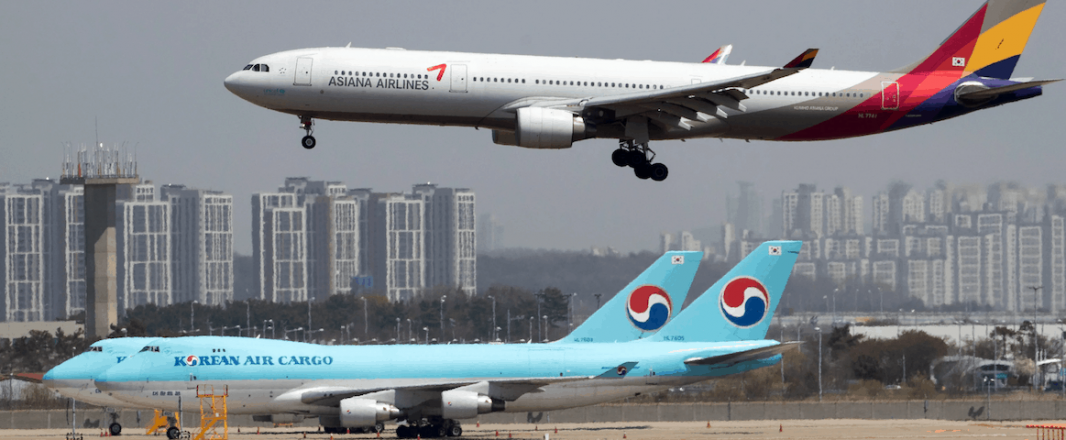
KOREAN Air is forking out 1.8 trillion won (US$1.6 billion) for Asiana and its affiliates Air Seoul and Air Busan, using cash from a 2.5 trillion won rights issue early next year.
Korean Air, currently the world’s 18th largest, will become Asiana’s biggest shareholder with a 63.9 percent stake if the acquisition is completed.
Under the acquisition plan, Korean Air will gradually integrate three low-cost carriers – Korean Air’s Jin Air Co. and Asiana’s Air Busan Co. and Air Seoul Inc. – after completing the acquisition of Asiana, said news reports.
“The company made the decision to help the country’s airline industry continue to grow (amid uncertainties) and minimise the injection of public funds (into Asiana),” Korean Air Chairman Cho Won-tae said in the statement.
“In general, countries with a population less than 100 million have a single full-service carrier,” the airline said in a statement. “However, Korea has two full-service carriers, which gives it a competitive disadvantage compared to countries like Germany, France and Singapore with a single major airline.”
The chairman also said the company will put the job security of current employees at the two airlines before anything else in the acquisition process.
In a recent appearance at WiT Seoul, Korean Air’s president Kee-Hong Woo said his focus has been on two things: the health and safety of its employees and its customers, and the job security of its 20,000 Korean airlines employees.
Although the proposed merger is “sensible” and would “improve the position of the overall South Korean market, it is nonetheless controversial and may not be approved by competition/antitrust authorities”, said independent analyst Brendan Sobie of Sobie Aviation.
“However, I believe sufficient competition would be maintained. There is ample LCC competition on routes within Asia and plenty of foreign airline competition on long haul routes as well as potential new competition from LCC/hybrid long-haul start-up Air Premia,” he added.
Giving an overview of the South Korean aviation scene, Sobie pointed out that South Korea had nine airlines at the beginning of 2020 – two major full service carriers and seven low cost carriers (LCC). Another two LCCs were planning to launch this year and while delayed by COVID-19 are still expected to launch at some point.
In 2019, South Korea had 90 million international passengers, including 60.5 million flown by local airlines, and 33 million domestic passengers. The five airlines under Asiana and Korean carried 22 million domestic passengers (67% market share) and 44 million international passengers (49% market share).
“The independent LCCs, led by Jeju Air, will likely expand given the opportunities in the post-COVID consolidated environment. Hence, sufficient completion should be maintained and the question mark over the future of Asiana, which could collapse without this merger, will be resolved,” he said.
According to a report in The Korea Herald, the state-run Korea
Development Bank (KDB), the main creditor of Asiana Airlines, will inject 800
billion won into Hanjin KAL, Korean Air Lines’ parent firm, through a rights
offering and convertible bonds. Hanjin KAL will then participate in the 2.5
trillion won worth of stock sale by Korean Air.
Asiana has not held a healthy financial position even pre-Covid, prompting
parent company Kumho Industrial to put its 31 per cent stake up for sale last
year. A previous deal for HDC Hyundai Developer to buy Asiana collapsed in September.
Asiana reported operating losses of 268 billion won in the first six months of
this year, with debts amounting to 11.5 trillion won.
Korean Air had reported two profitable quarters and is on track to produce another, buoyed by healthy cargo demand. It posted an operating profit of 148.5 billion won (US$125.2 million) during the second quarter, and 7.6 billion won (US$6.75 million) in operating profit in the third quarter of 2020.
Featured image credit: Getty Images/Nikkei Asia