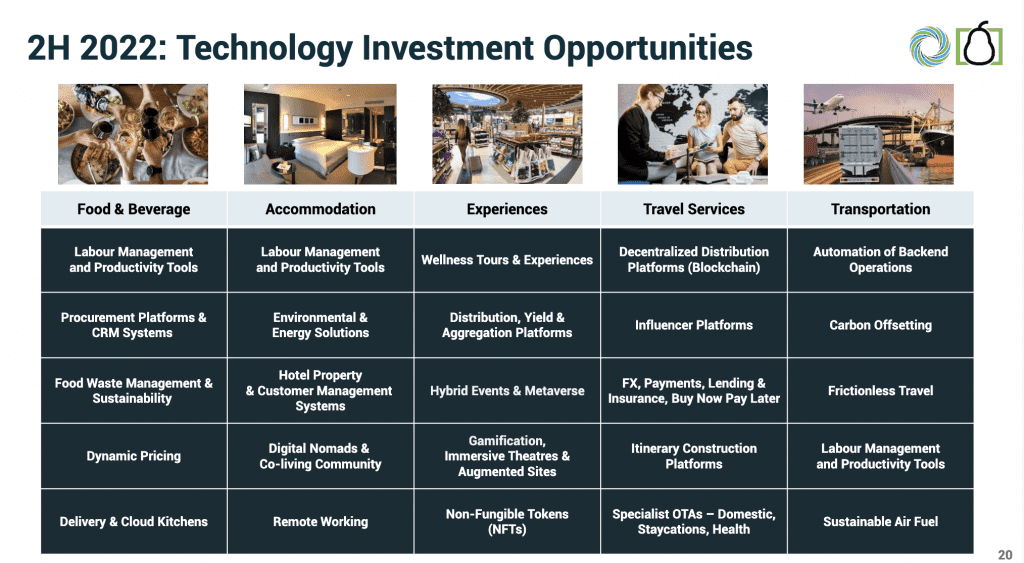
Singapore-based travel and hospitality fund, Velocity Ventures, has picked three investment themes for the second half of 2022 – labour solutions, fintech and block chain solutions and brand growth and customer loyalty.
Supporting its thesis in its 2H 2022 Travel and Hospitality Strategy & Investment Outlook report, it said, “The easing of restrictions post-COVID has resulted in a large rebound in travel. Demand for labour is far outpacing the current supply. Changes in mindsets from workers throughout the pandemic have also made it difficult to recruit. Businesses are looking to improve operational efficiencies, recruitment processes and retention of labour.”
“Developments in Fintech and Blockchain Solutions have enabled business operations to be more secure and efficient, while at the same time providing travellers a seamless and personalized travel experience.
“With the recovery of travel and hospitality post-pandemic, businesses are shifting their focus to growing their brand and ensuring customer loyalty. With hyper connected consumers, businesses are looking to deepen engagement levels through User Generated Contents, Social Media integrations and hyper-personalized travel experiences.”
The report, prepared with Pear Anderson, highlighted a few key trends to watch.
It urged travel players to optimise their performance marketing budgets given that outbound travel searches for both flights and hotels have significantly increased in 1H 2022, after remaining at very suppressed levels for 2021. “Travel players need to ensure that they are visible in these searches, balancing search demand vs actual bookings, ensuring that they are spending strategically.”
It reminded the industry that wholesalers have a valuable role to play. “Siteminder’s top channels for hotel bookings in 2021 report showed that both wholesalers, such as MG Bedbank, and GDSs, took market share. Physical travel agents will rely on wholesalers to be able to compete with consumer-facing OTAs, as price sensitivity becomes important.”
And it pointed out the power of super apps, saying they will harness consumer data points to create more personalised tourism marketing, citing these examples. “AirAsia super app’s tie-up with Google Cloud allows analysis of users’ consumption across all its verticals. These insights produce personalised recommendations. Traveloka has piloted Amazon Personalize technology to scale its AI recommendations and has seen +66% CTR.”
And one of the biggest shifts of the pandemic – the swing towards localized OTAs, especially in Indonesia. “Tiket.com reported an increase of 93% YoY in air ticket sales, and 80% in accommodation bookings in 1Q 2022. Siteminder reported that Traveloka was the top channel for hotel bookings in 2021, up from #2 in 2020.”
While it remained bullish about travel and tourism recovery in the region, it called out key risks – rising and persistent inflation rates increasing business costs and expenses, increasing interest rates dampening consumer sentiment and raising unemployment, heightened geopolitical tensions causing tightening of regional travel restrictions and lowering consumer sentiments, supply chain disruptions leading to higher fuel and F&B costs and new wave of contagious disease triggering another pandemic (eg. new COVID-19 variants, Monkeypox) among them.
In addition, there can be no full recovery in the region without China. China accounted for 28 million (22%) of total international arrivals into Indonesia, Malaysia, the Philippines, Singapore, Thailand and Vietnam in 2019 and “with no timeline for Chinese outbound travellers’ return, many governments are now realistically planning that this could be in 2023 at the earliest.”
It does not believe India will be able to fill the gap in 2022. “Pre-pandemic, India was an up-and-coming market for Southeast Asia, with a growing air connectivity. In 2019, Southeast Asian countries accounted for 21% of all India international capacity. Nurturing a new source market takes time – and initiatives which are being taken in 2022 are unlikely to see a significant pay-off within the year.”
It urged the industry to be China-ready. “When the China outbound market does return, there will be fierce competition – not only within Southeast Asia, but worldwide. Tourism stakeholders need to keep a keen eye on developments of Chinese traveller trends and technology, ensuring that their systems are compatible with the Chinese tech ecosystem, to allow Chinese travellers frictionless booking and visiting experiences.”
Velocity Ventures’ portfolio includes Aigens, Food Market Hub, Tablevibe, TripGuru, Zuzu and Zytlyn, covering f&b, experiences, accommodation, transportation mobility and travel services. Two more are in the pipeline, it said.
Download the full report here.