My first night in Barcelona after having spent a week traipsing around the coast of Costa Brava and rambling through the vineyards and isolated, mountainous villages of Priorat without encountering many tourists, indeed many humans, was a bit of a shock.
Back in this big, busting, beautiful city, cars honking, people everywhere, construction at every corner – this city of Gaudi dreams which I first visited as a youth in the early blush of romance with travel.
My first night back in Barcelona after several years away was a member’s invitation to Soho House, today’s communal answer to the village square and where the cool, trendy and beautiful set of the world gather everywhere they flit around the world. On the rooftop, a DJ spins her music while gorgeous folks sip cocktails against a stunning backdrop of gleaming yachts on blue water at Port Vell Marina.
Feeling as out of place as a snow goose in a desert, I nevertheless soaked in the moment and reflected on how global the world increasingly is – I counted on the website 42 Soho Houses around the world – and how old world and new world are colliding in ways that it’s hard to decipher where the old ends and the new begins.
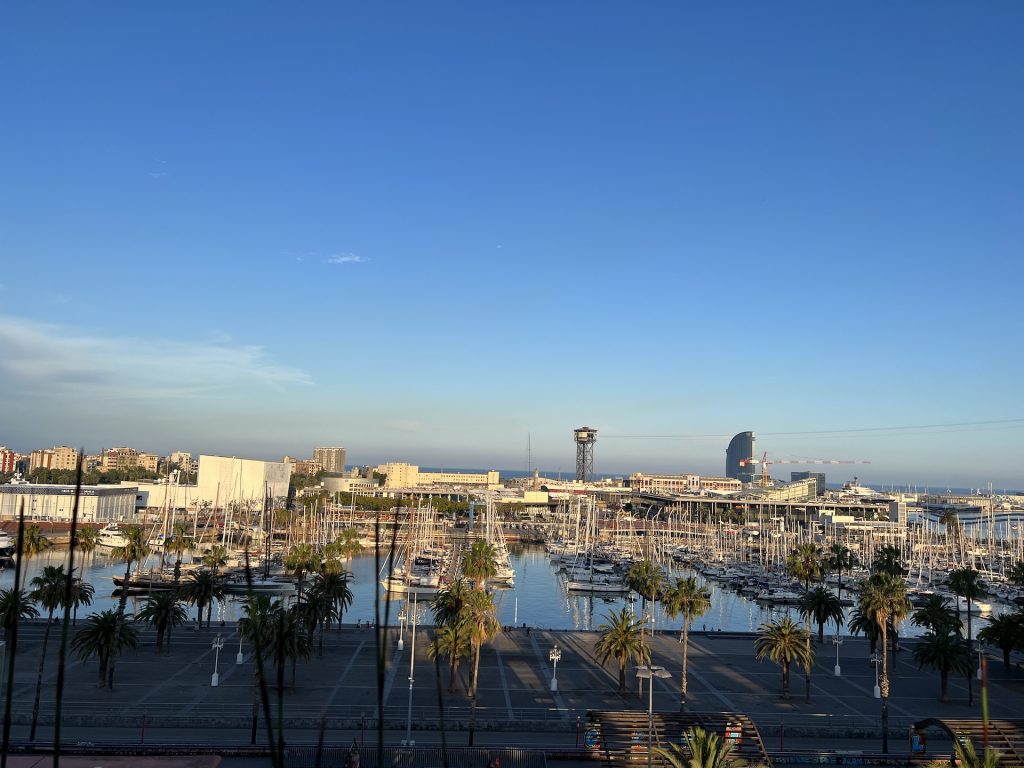
The view of Port Vell Marina from Soho House Barcelona
Soho House Barcelona, for example, is in a 18th century in the Gothic Quarter and has been refitted with Catalan-inspired designs to exude a distinctly modern vibe. The hotel I stayed in, Barcelo Sants, sits on top of Barcelona’s largest train stations, Sants, built in the 70s, and greeting you on arrival is an astronaut.
When I asked the receptionist why there was a spaceman in the lobby, she shrugged and said, “It’s our theme.”
The hotel is designed to look like a space ship – its website tells you it wants guests “to imagine they’re on an inter-galactic trip”. A huge orbital bar dominates the lobby and you constantly see humans gather around the bar, not talking to one another, but heads bent over laptops or mobile screens, each locked in their own virtual space.
In keeping with the spirit of my Dali journey – in Girona, I stayed at a hotel that was mostly about him and in Cadaques, I visited his house/museum – I decided to check out Dali: Cybernetics, also curious to see how different it would be from the Van Gogh immersive experience I had tried in Singapore.
Dali Cybernetics is less extensive but somehow more intense. Perhaps it’s the style of his work but this was a man who was as entranced with nature as he was with science and Artificial Intelligence. Born in 1904 and living up to the 1989, he saw the advent of modern technology, including the atomic age, from which his darkest works were derived, and he was obsessed with science and concepts such as the fluidity of time and space.
There’s a section about Dali’s relationship with Artificial Intelligence where images morph and explode, which is rather disturbing yet somehow thrilling at the same time, exactly how many of us feel about AI at the moment.
I also enjoyed the immersion in the screening zone where Dali art comes to life on giant 360-degree LED walls, and you get transported into the different ages of his work, from his emotional passage to the atomic age, and after.
But the highlight is the Dalinien Metaverse, which definitely felt a lot more enhanced than what I experienced at Van Gogh. You don a pair of goggles, and the person in front of you turns into a numbered, floating cosmonaut head. You follow the head and walk onto what feels like a ship.

Getting ready to enter the Dalinien Metaverse
You go on a sea voyage and you are buffeted by the elements. You get eaten by a giant lobster (or what looked like one), you feel the strong winds as a giant candle flickers and gets blown out and storm clouds gather, and thereafter you enter a world of giant elephants and tigers, as if you’re walking amongst them.
At times, it felt so real I wanted to reach for my phone to take photos and oh yes, at one moment, I felt like swatting the flies (which are all part of the legends of Girona) which swarm over you.
I know there are people who are sceptical about VR and the metaverse but experiencing this enhanced version and timed with the launch of Apple Vision Pro, I can only imagine that this technology is just at the beginning of the beginning and I can imagine its applications in education, medicine, theatre and entertainment and not to mention, travel.
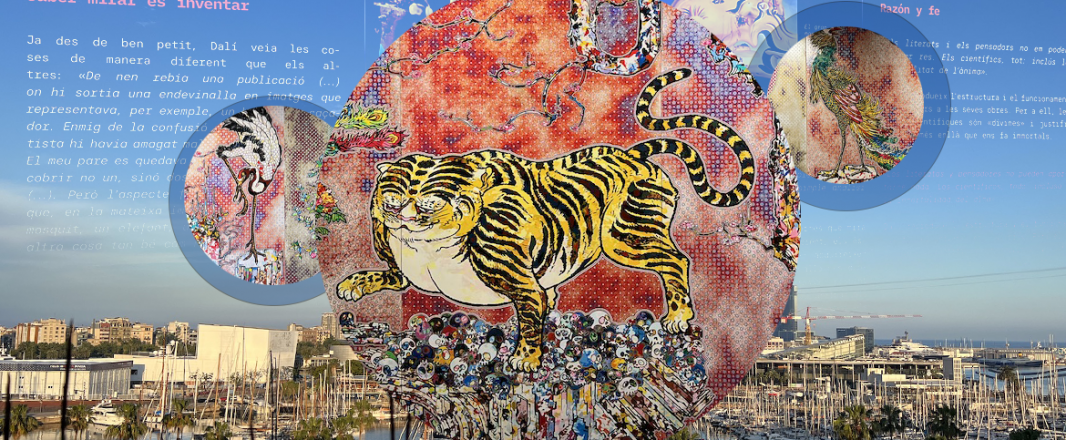
Feeling in the mood for modern art, I visited the Moco Museum. There, the “Sacred Heart” of Damien Hirst throbs as a centrepiece and works by artists such as Andy Warhol, Banksy, Yayoi Kusuma and Takashi Murakami are the highlights.

Takashi Murakami: “When I was making my debut as an artist, I felt that it was very important that I try to combine the background of my own culture, my people and the country into the contemporary art world.”
There’s a digital section that was somewhat ho-hum after the sensurround sensations of the Dalinien Metaverse and it was interesting to see that the NFT section was the least busiest section – once the flavour of the art world, it seems to have been relegated into yet another brief-sensation-whose-time-has-passed for the moment. Without the word “NFT” attached to it, it’s really just like looking at digital art pieces, and it goes to prove that everything new becomes old., and everything old becomes new again.

The archaeological site of El Born’s old market
Which was how I felt when I accidentally stumbled onto the archaeological site of El Born’s old market, while wandering around the charming El Born neighbourhood. The ancient site takes you back to the everyday life of Barcelona at the end of the 17th century and start of the 18th century, and seeing the ruins allows you to imagine the streets of a city that resisted Philip V’s troops up to its capitulation on 11 September 1714.
And that’s the beauty of rambling slowly through Barcelona – one moment, you are sipping cocktails and watching the beautiful sunset in Soho House, the next you’re eating gambas al ajillo and crèma Catalana with the tourists on the beach at La Barceloneta, or dining on the freshest seafood at El Pescadors in a quiet village square in the heart of the city, or being eaten alive by giant lobsters and trampled on by long-legged elephants in a virtual world.
As Dali said, “Beauty should be edible, or not at all.”