Sometime in 2026, if I am still around, I’ll be able to travel from Singapore to Kuala Lumpur by high speed train and I will be able to do it in 90 minutes as opposed to four hours by car.
For now, though, while the ambitious rail link project conceived in 2013 and formally signed last December, is being worked on – and who knows what delays it will run into – the quickest way is still via air.
The AirAsia flight I’m on is full. It’s still Chinese New Year season and I can imagine the ancillary revenues the airline is chalking up in baggage fees during this festive period – there’s now the option online to buy extra baggage – and even on such a short flight, people have pre-booked meals.
I am on my way to visit AirAsia’s new headquarters at Sepang. It’s called RedQ as a result of a naming competition won by Filipina AirAsia X flight attendant January Ann Baysa. About 2,000 AirAsia and AirAsia X employees moved into this new 18,000sqm, RM140m facility, late last year, and it is clear this new RedQ is built with them in mind.

It’s a far cry from the old dark and cramped offices I once visited. This RedQ is spacious, open and cheerful – lots of spaces and rooms for meetings and for hanging out. The central area is like a playground and the day I was there, there was a group of Chinese schoolkids on a student programme to explore Malaysia and a CCTV crew was accompanying the kids.
A huge poster hangs in the middle, in memory of the late Anaz Tajuddin, AirAsia Group COO, who died last month, an event that broke hearts at the airline.

Remembering Anaz Tajuddin
There’s cafes, a salad bar, and Japanese and Korean food on offer, as well as a local buffet. Every staff member gets a RM10 credit daily to cover meals and drinks. On the rooftop there’s space for yoga and Zumba classes, and the gymnasium smells so new I wonder if anyone ever uses it, but I am told they do in the evenings.
RedQ embraces the new workplace mantra which wants everyone to enjoy work so much they never want to leave.

Tony Fernandes’ hat collection
Everything is open plan, even Group CEO Datuk Tony Fernandes doesn’t get a walled office. He does get a bigger open space, he’s got a wall full of his hat collection and I am told when he’s in, music often plays from his corner.
You could say that RedQ is the manifestation of the workplace culture AirAsia has tried to build. It has launched Facebook Workplace to enable its teams to share what they are doing in the field. A new position called Chief Storyteller has been created to ensure stories are shared not only with customers but also with staff.
You can sense the renewed can-do spirit of AirAsia with Fernandes back at the helm. There’s excitement about the recent announcement of AirAsiaX flights to Honolulu, AirAsia’s plans to expand in North Asia and Fernandes’ declaration that 2017 will be the year of digital.
Announcing third quarter results, he said, “2017 promises to be an exciting year as it marks the emergence of AirAsia Group as a digital airline company. We are investing heavily in digitalisation and have been growing our family of digital services; BIG Duty Free, BIG Pay, BIG Loyalty, Touristly, Rokki onboard Wifi and Xcite inflight entertainment to name a few.
“Digitalisation is expected to boost our ancillary income from RM46 currently to our RM60 target.”
I met up with new CIO, Declan Hogan, who’s got a big job on his hands and who’s running the airline’s first travel hackathon for starters. Formerly with Fly Dubai, the Irish-born executive is pumped up about the challenges ahead but remains grounded about what needs to be done, beyond the buzzwords of “digital disruption”.
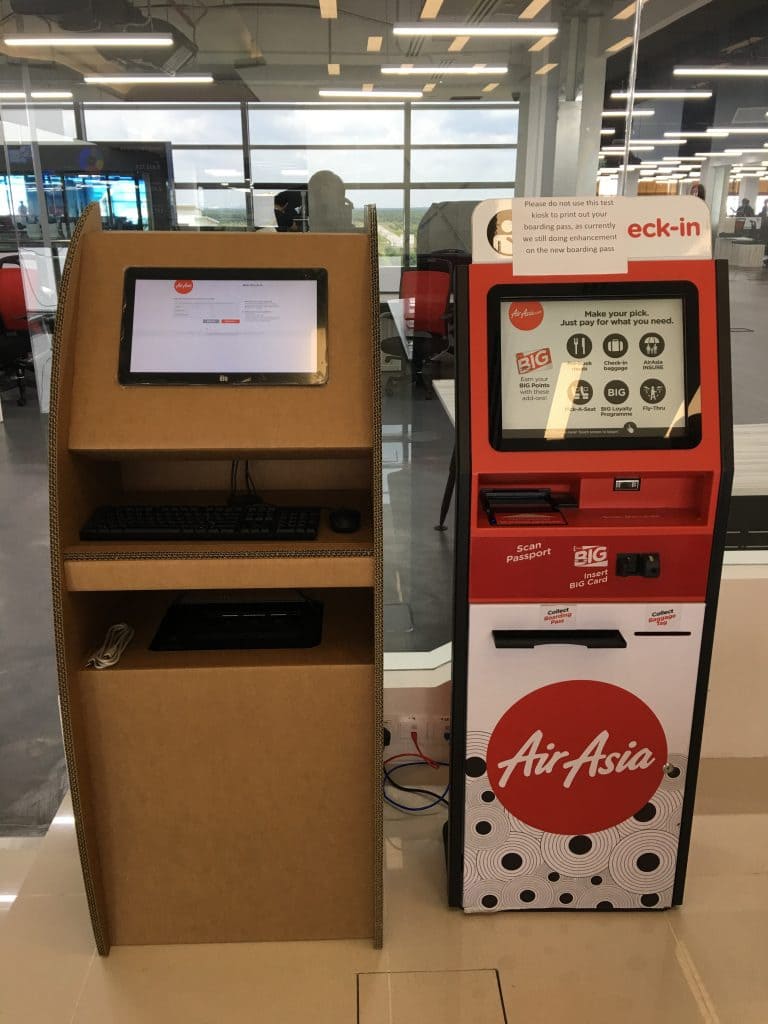
The check-in kiosk made of cardboard
There’s an innovation space where startups can demonstrate their products and services. Hogan shows me a new self-service check-in kiosk that’s made of cardboard and that could eventually replace the current metal kiosks. The Japanese invention will cost under US$3,000 (hardware/software included) as opposed to $10,000 for the current kiosks. Even better, they are foldable, portable and environmentally-friendly.
There’s no doubt the rapid growth of AirAsia over the last 15 years has placed strains on its infrastructure and resources. To date, this airline has flown close to 400 million passengers on its network.
The KLIA2 terminal it operates from is more shopping mall than airport – more space has been given to retail and f&b than to passengers – and so the customer experience is not ideal. You know it’s a major bone of contention between the airline and the airport authority.
The weak Malaysian currency has effectively dampened appetite for outbound travel but domestic travel is strong, and inbound tourism is booming. So all in, good news for its Malaysia operations which grew revenue by 11% and net operating profit by 165% during third quarter 2016.
As I sat outside RedQ waiting for my GrabCar, thinking about how much travel has changed, thanks to airlines like AirAsia, a dog comes up to me and licks my hand.
“He’s ours,” said a AirAsia All-Star sitting next to me. “There are a few dogs in the compound, they even have their own spaces at the back,” she added.
Perhaps for my next visit, there will be a DogQ. I wouldn’t put it past this airline that dares to do things differently.