Mission to expand their cleaning services to short-term rentals in Asia
IT was back in 2013, when the terms “remote worker” or “digital nomads” had not yet been coined, when husband-and-wife team, Nuno Rodrigues and Noelia Novella, did a round-the-world trip, covering 11 cities and spending two weeks in each, with the intent of finding a future place to live.
With two kids in tow, one nine months and the other, two, they had what they said was the best time of their lives, visiting London, New York, Washington, Toronto, Vancouver, Auckland, Sydney, Brisbane, Melbourne, Singapore, Hong Kong and Macau.
“We booked Airbnb everywhere, lived like locals, met a lot of people, got to know each place. We wanted to get under the skin of each place because sometimes they may look perfect in books but in real life, they’re not,” said Spanish-born Noelia.
Fast forward August 2022, and the couple behind Doinn, a startup offering cleaning services for short-term rentals, has moved to Singapore from Madrid, with their two kids and a dog. “It’s taken us nine years but we are finally here,” said Portuguese-born Nuno. “Even the kids wanted to live here, we don’t like European food all that much.”
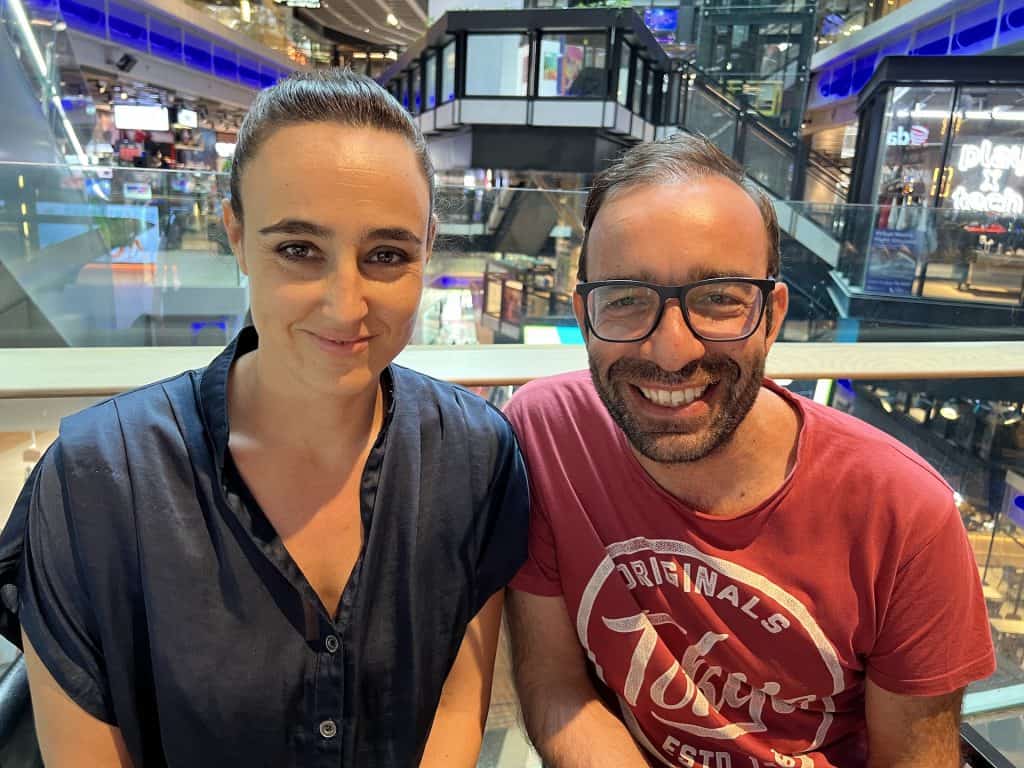
Noelia Novella and Nuno Rodrigues: “He is tech, I do business. We are very different, yet complementary.”
They also see Singapore as the ideal launchpad from which to expand Doinn in Asia Pacific. The idea of Doinn saw the light of day in 2014 when the couple took part in the Lisbon Challenge and they applied with the idea “of making the second level of sharing economy” – how to build services on top of the first level that companies like Airbnb were creating.
“We looked at offering services to hosts and guests – cleaning and laundry for hosts and experiences for guests,” said Noelia. “But it was hard to get people to buy experiences from a brand they did not know so we realised we had to focus on the hosts.”
During their future-home-checking trip, they also realised that cleaning was a real problem to be addressed. “Some of the apartments were so dirty. Our worst experience was in St Kilda, Melbourne, when the place was so filthy we couldn’t have our kids walk on the floor.”
The couple started asking cleaning companies serving the hospitality industry about their pain points that could be addressed with technology. “Sending 20 cleaners to a hotel is easier than sending 20 cleaners to 55 apartments spread over the city,” said Noelia.
“How not to burn the money” is top priority
Doinn started in Lisbon as a B2C business, working directly with individual hosts. Finding this a challenge to scale, it pivoted to B2B, working directly with property management companies. It started with an injection of 300,000 Euros from Portugal Ventures, a Portuguese VC, and later raised a pre-seed round of 1.4m Euros. It is hoping to raise the next round in first quarter 2023.
Its top market is now Spain, followed by France and the UK. “Our model is not difficult to replicate in different markets. We work with a handful of providers we trust – cleaning and laundry – and then we connect them with property management companies in short-term rentals.
“The biggest challenge of building our business is how not to burn the money. We are selling tech but behind the scenes, it’s a very manual business. We have always been conservative with spending and while there was nothing good that came out of the pandemic, what was actually good was it made us even more efficient, pushed us to improve the product and expand to new cities.
“Airbnb used to be our core business but during the pandemic, leisure cities became more popular and we started working with new hosts in leisure destinations,” said Noelia.
This year is turning out to be Doinn’s best year as travel rebounded. “It was tough during the start of the pandemic when business dropped to zero and stayed zero for several months. We had 13 staff but we kept the ship steady and retained the talent. Between March and June this year, we saw record bookings with the shift in travellers to short-term rentals in Europe,” said Nuno.
Lessons learnt from Mexico and Dominican Republic
With 17 staff working remotely, Doinn is now ready to expand to South-east Asia. Given that the rules around short-term rentals are stricter in Singapore, Noelia said they will focus on co-living spaces, of which there has been an explosion, on the back of co-working spaces, with brands such as CasaMia and Lyf, the CapitaLand co-living brand, with its largest property, Lyf Funan, in the heart of the city.
“The growth in co-living spaces in Asia is tremendous, and in Singapore, most of them are running full occupancy. In a normal Airbnb, the average in Spain is seven to eight turnovers in a month. With co-living, the average is four times a month. Our first task is to build supply first and identify cleaning providers,” said Noelia.
It is eyeing Singapore, Australia and Kuala Lumpur as a start. Given the shortage of cleaning staff in key cities across Asia, Doinn would be solving a major pain point – the key challenge is finding enough supply outside the traditional hospitality channel.
Both founders believe Doinn’s ability to solve pain points such as scheduling and optimization of resources is particularly necessary due to the staff shortage. “Cleaning companies are looking for software to solve their problems. We integrate with their systems – we have over 10 integrations – and we automate the work flow. We focus on data, giving clients a visual dashboard – they can tell which ones are the better customers, which ones to say no to.
“With our best providers, we build metrics for them – productivity, logistics. Hospitality is not real estate, it’s hospitality. Labour shortage is a huge problem everywhere, and we don’t have the culture of saying, good job to the cleaners. The key is to convince cleaning companies to use tech, because a lot of them are still using manual processes,” said Noelia.
In expanding in Asia, it is also mindful of the failure it had in Mexico and Dominican Republic. “It didn’t work out because the cleaners are not used to technology. We have an app for the cleaners to use, to bring transparency to their job – if there is water in the wall, they can take a picture and create a maintenance alert.
“We wasted so much time and money in Mexico – we thought we could handle it from where we were in Spain. You need local teams on the ground. The idea that you can grow because you speak the same language is not right,” said Nuno.
Which is why they have relocated to Singapore and oversee the expansion here, while the team continues to look after the European business which is running on its own steam.
This is a couple used to the nomadic life – they’ve lived in Portugal, Belgium and Spain – and working together. “We’ve been together for 22 years,” said Noelia. “He is tech, I do business. We are very different, yet complementary.”