While many companies, whether legacy or startup, have been considering pivoting as a strategy to get through this crisis, Portier Technologies’ co-founder Deniz Tekerek feels differently.
“I have thought a lot about this. If a travel company, because of this crisis, becomes an e-commerce company, for example, that wouldn’t really sit well with me. I feel that would show a lack of commitment. I went into this industry because I wanted to be here and I wanted to commit to it. I wanted to deliver value to this industry. By pivoting away from it, it seems opportunistic. I hope even if I lose something now, I will gain in the future by staying loyal,” said Tekerek.
 “If I pivot away from our core business, it wouldn’t be fair on all the hoteliers that have believed in us and supported us from the beginning,” he added.
Admittedly, Tekerek feels fortunate to have fallen on the “lucky side” – its revenue streams are not related as much to the amount of travel but rather to businesses that pay for a service. “I know there are many others whose incomes depend on the amount of travel that happens and that makes it very difficult now,” he said.
Portier had a stellar year in 2019, growing by a factor of eight in a year, and managing to go live in 11 cities, up from just two or three the year before. It also managed to add a number of large branded chain hotels to its portfolio. The fact that it surpassed targets last year has helped during this time of crisis, and it hasn’t had to “dial down” very much as yet.
In fact, this crisis has actually given Portier an opportunity to take a breather, using this time to refine its product and work out some kinks.
“We launched version two of our platform towards the end of December, and we were having some issues with it because it worked almost like a new product. It is now a lot more machine-learning driven and has a much higher level of personalisation. Also, we had a lot more hotels than we ever had before, meaning more users, and more issues.
“Just then, the crisis hit and travel stopped, which actually then gave us the time to step back and look at those bugs and improve the experience. Now, we feel a lot more comfortable with it as we have spent the last few months refining it. This has been a blessing in disguise for us,” said Tekerek.
No doubt, Portier has had to move its 2020 targets to 2021 as it “doesn’t expect too much activity this year in terms of onboarding new clients”, but otherwise, it will continue to work on building its partnership networks throughout the world.
Its earlier decision to go “asset-light” has paid off hugely, especially at a time like this. Because it gave up quickly on its idea of being involved in the entire process including providing the hardware and logistics of getting phones into hotel rooms, it is now able to grow much quicker and even continue doing so while in a middle of a global shutdown.
“I find it interesting that we have managed to stretch ourselves in so many countries. And we did all that sitting here in Hong Kong. We never had to turn up in places like Amsterdam or Paris, or Southern France and yet we were able to launch hotels there with a physical product. That has been very positive for us,” said Tekerek.
“One of the things we have learnt is to double down on partnerships and relationships and the importance of understanding which areas we are not good at, acknowledging that we are not good at them, and trying not to take ownership of the entire spectrum of the service,” he said.
Once Portier got out of the hardware and logistics space, it immediately turned its focus on building strong partnerships with companies that were experts in those fields. In Europe, it now works with Paris-based Cell Hire which covers 29 European countries for them, providing devices and telco partners to the hotels there.
Even its training for hotel staff is done virtually. “Prior to Zoom becoming a big thing, we were already running our training sessions via video calls. We launched hotels in Amsterdam and Geneva this way. We never turned up in those places,” he said.
On reiterating its mission, Tekerek said Portier remains focused on its in-destination offering. “A lot of startups are focused on what happens before people travel and even after they travel, but we are and were always very keen on being the only thing travellers need when they travel.”
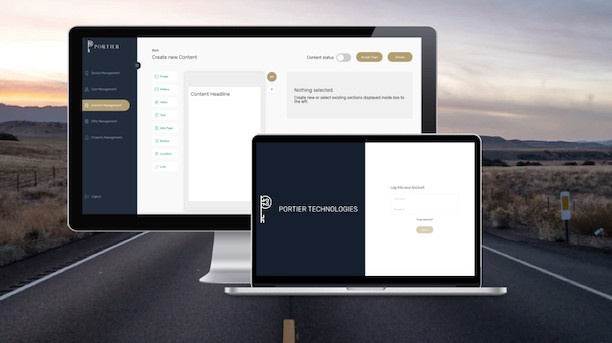
“Our focus for the rest of this year is to help hotels extend their footprint beyond the limitations of the hotel. How we will help hotels, post-Covid, is to help them recover lost revenues. In reality, for the immediate few months and years potentially, there is going to be much fewer travellers arriving at hotels so they are not going to have as many guests to benefit from. The focus for hotels should, therefore, shift away from attracting more people to the hotels to getting more from people who actually do show up. Our platform is very much designed to do exactly that. It’s about making more from less,” he said.
Other areas Tekerek feels Portier can contribute post-Covid is in education and sanitisation.
“Education, post-Covid, is going to be very important. Hotels in Hong Kong are already putting up screens and messages to inform guests of what they should and shouldn’t do when they go out to the city [to avoid contracting the virus]. Because we are a digital platform and have the attention of the guests, hotels can use our platform to post content that helps in education of the guests. They can create messages and chat to the guests when they are out and about in the city and point out how they can stay safe,” said Tekerek.
As to sanitisation, Tekerek said hotel rooms will have to look at keeping things in the hotel to a minimum. The compendium folder in the rooms, for example, is where “a lot of germs could potentially sit”. “It is a very traditional thing, and many hotels still have them, but we are all about digitisation and hotels can easily replace it and make the guest experience completely digital,” suggested Tekerek.
Personalisation and customisation have become favourite corporate buzzwords. Post-Covid, however, will it be more about community and standards?
“It’s a tough one to answer. One thing for sure, as a people, we will find, post-Covid, that we will have a lot more things in common because we have all gone through this experience together. All of a sudden, we may find that we are a lot more similar to one another than we ever acknowledged.
“But this might also create a certain level of fatigue. People might start to crave for individuality again and say ‘I want to be the person that I am again when I travel’. I think in this way, personalisation will become more granular. I will argue that because we had this time of ‘depersonalisation’, personalisation will bounce back with aggression and people will say ‘I really want to be different now’.