
NEW research from the Mastercard Economics Institute reveals that for the first time since the pandemic global leisure and business flight bookings surpassed pre-pandemic levels, while spending on cruise lines, buses and trains saw sharp improvements this year.
The Travel 2022: Trends and Transitions report was carried out across nine markets in Asia Pacific (APAC) and 37 markets globally offers insight into the state of travel in a less restricted, post-vaccine chapter of the Covid-19 pandemic era.
These are the key findings for APAC:
- Reopening of borders puts Asia back on the tourist map: According to the data, if flight booking trends continue at the current pace an estimated 430 million more passengers will fly in APAC compared to last year. The travel outlook for the region is optimistic, even with markets across North Asia and mainland China yet to relax border measures, an event which will likely be felt across the entire region and the world.
- Pent-up demand expected to fuel travel recovery: Following two years of little to no travel for APAC the loosening of travel restrictions and reopening of borders have sparked a surge in demand for both inbound and outbound travel. A trend observed in markets across the region is consumers are spending their excess savings on travel. In 2022 borders opened in Australia, resulting in a sudden ability to travel. Flight bookings from Australia to Indonesia, for example, spiked nearly 200% in 2022, and flights to the U.S. more than doubled.
- Swing towards experiences over things: Globally, international tourists were seen spending more on experiences rather than things when in destination. This trend was also witnessed in Asia where Singapore recorded one of the highest international tourist spending on experiences in destination globally, with 60% increase in spending from pre-pandemic levels through March 2022. Indonesia and South Korea, whose borders opened in April, have seen low levels of inbound tourism. This will be an important trend to watch for the rest of the year as ongoing travel restrictions across the region ease and APAC tourists begin to shop and spend abroad.
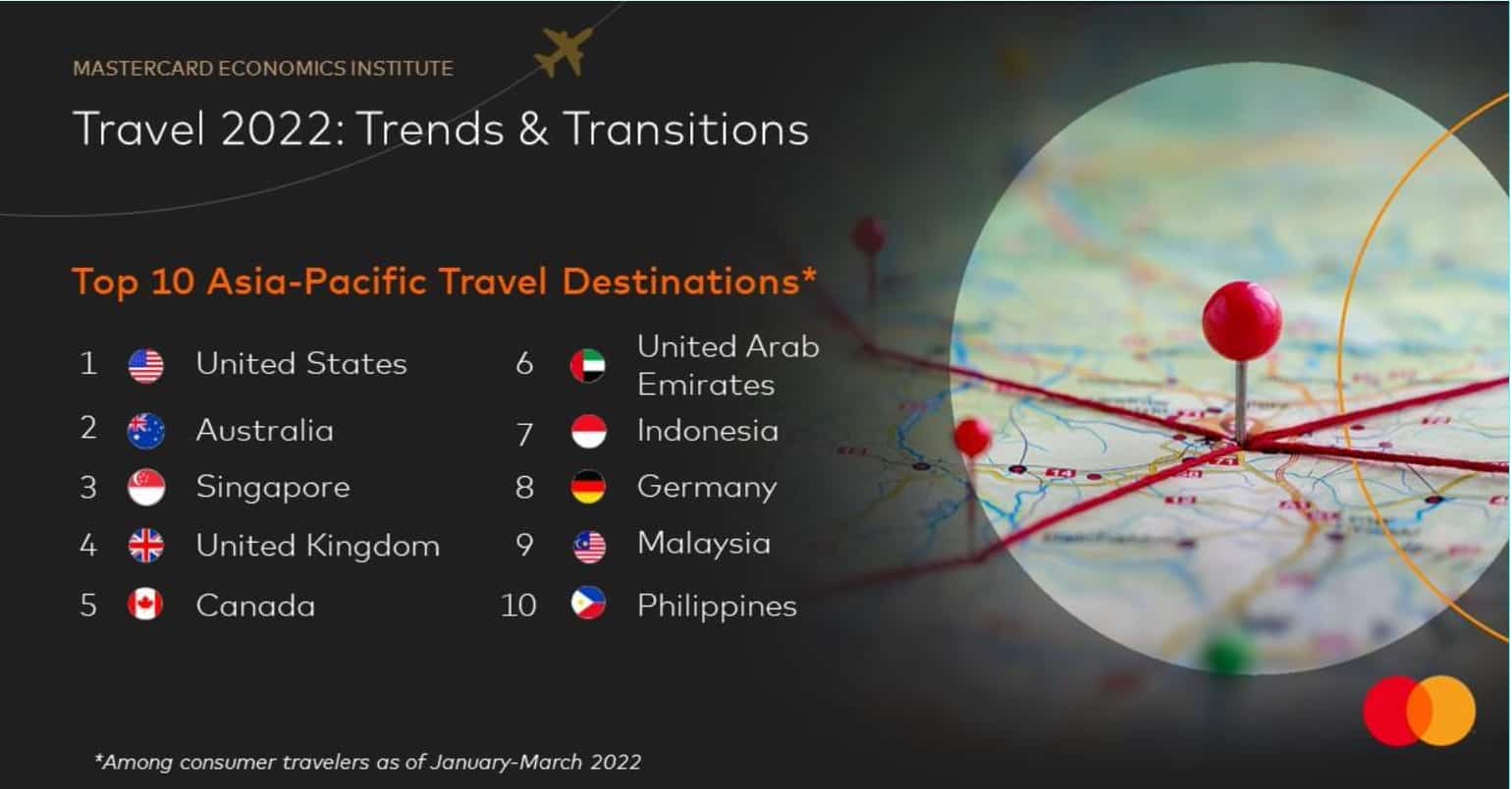
- Choice of travel destinations influenced by mobility restrictions: Since the onset of the pandemic trends reveal that people have been favouring travel destinations that are less complex to navigate amid confusing entry and quarantine requirements, travel restrictions and testing procedures. As such, the US remained the most popular choice for APAC travellers, followed by Australia, Singapore, the UK and Canada. In the months to come, however, this trend is likely to shift in favour of intra-regional travel as restrictions are relaxed and domestic travel picks up once again.
- Cost of travel remains elevated across the region: Travel deficits triggered by the pandemic have expanded the operating expense burden for airlines and the broader transportation industry, resulting in higher fares for APAC travellers.compared to their global counterparts. The average airfares in the region remain high, about 11% and 27% above 2019 levels in Australia and Singapore respectively, due to supply-side constraints such as air transportation employment that continues to remain below pre-pandemic levels across the region.
- Domestic spending picks up momentum across transportation industries: With people increasingly relying on domestic modes of transportation, particularly cars for mobility during the pandemic, the spending on auto rentals and tolls consistently exceeded 2019 levels throughout the past two years. Domestic ground travel has seen a robust demand in many APAC markets where road trips have retained their appeal. Fuel spending has steadily increased in Singapore, Hong Kong, the Philippines and Australia. Public transportation and cruise lines have also stepped back onto the road to recovery after an initial slow start due to restrictions surrounding group travel.
“Despite a delayed recovery, and numerous risks such as inflation impacting discretionary spending travellers in Asia Pacific have demonstrated a strong desire to return to travel,” said David Mann, chief economist, Asia Pacific and Middle East Africa of the Mastercard Economics Institute.
“2022 will prove to be a significant year for the travel industry in Asia Pacific. As border restrictions relax we have witnessed an accelerated return to travel that indicates cause for optimism, with the region poised to swiftly catch up with the rest of the world.”
• Featured image credit: Apiwan Borrikonratchata/Getty Image